
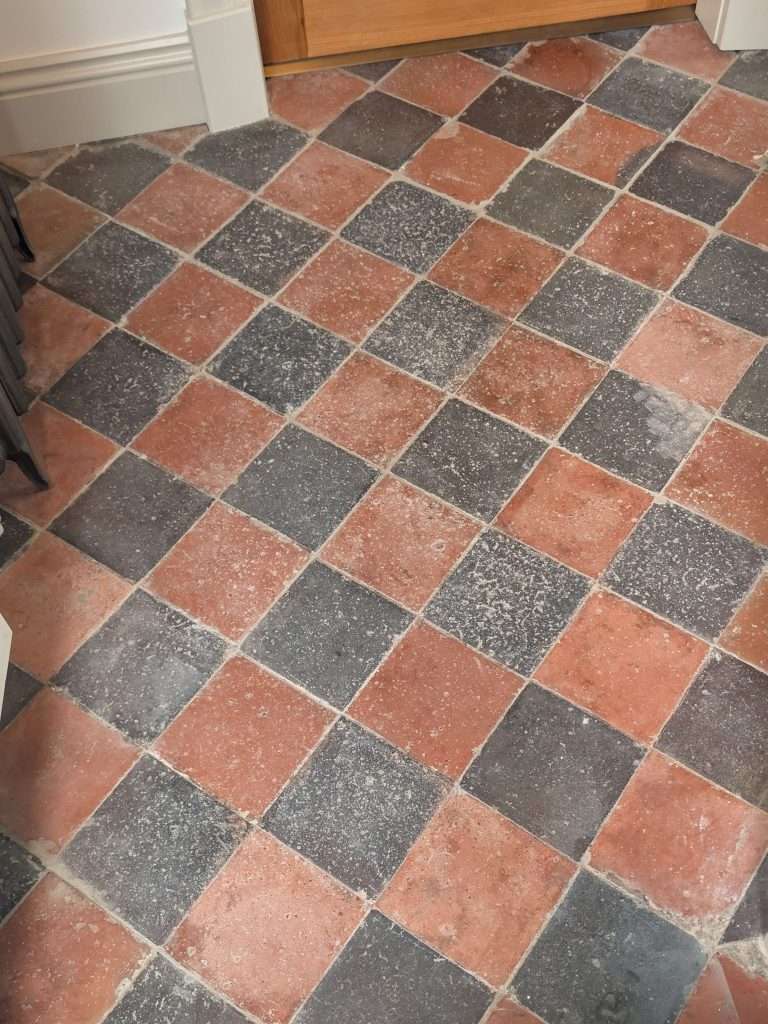
Anyone who has taken on a period property knows the moment. Underneath the carpet, or hidden behind a stud wall that finally comes down, there it is: a black and red quarry tile floor, probably well over a century old, dulled by decades of foot traffic, old wax and general grime, and now carrying a fresh layer of cement splashes and dust from the renovation work going on around it.
It looks tired rather than damaged, and the instinct is usually to reach for whatever is in the van, or even the old brick acid. That is the point where a lot of these floors get permanently scarred rather than restored.
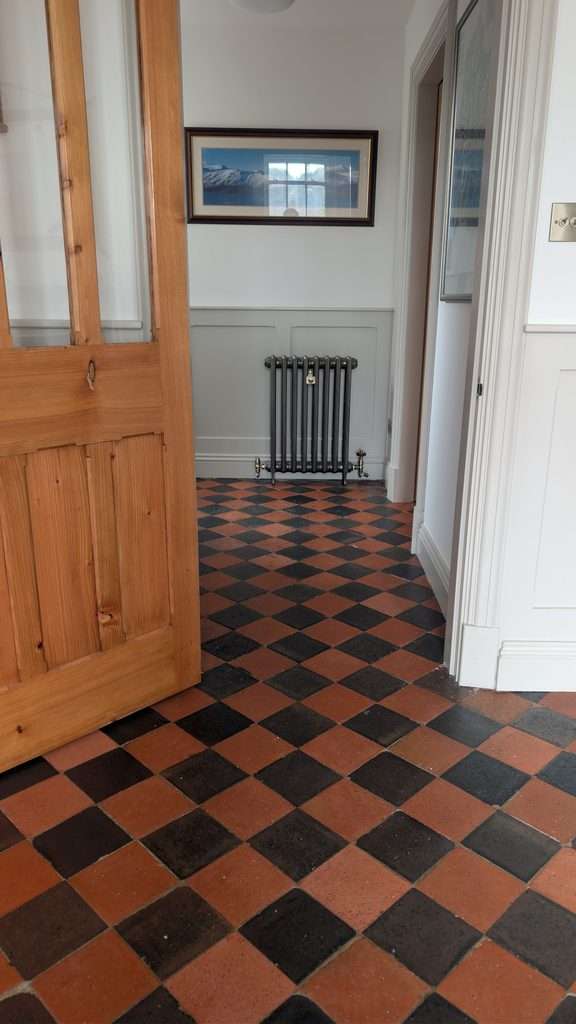
This is one of the most common jobs HF Flooring Supplies customers bring to us, and it is exactly the job shown in the photos on this page: an original Victorian quarry tiled hallway, contaminated with construction residue, cleaned back to bare tile, then sealed with a breathable colour enhancer to bring the black and red tones back to life. This guide walks through the science behind each step and the specific products used, so you can repeat the result on your own floor without guessing.
- FloorVictorian quarry tile
- MethodAcid clean, alkaline clean, then seal
- Also suitsTerracotta and other unpolished absorbent tile and stone
- Time to read11 minutes
The short version
- Cement haze, mortar splashes and efflorescence: dissolve with Faber Disycott, an inhibited acid cleaner.
- Old wax, grease and ingrained grime: lift with Faber 30, a concentrated alkaline deep cleaner.
- Finish: seal with Faber P147 Plus, a breathable treatment that enhances colour without a surface film.
Get the order wrong, or use too hard a brush on the thin black surface of older black tiles, and you risk permanent damage rather than restoration.
The kit used on this floor
Everything below was used on the hallway shown above, in this order.
-
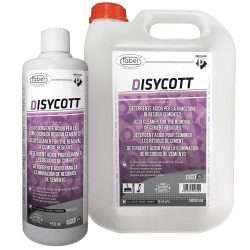
 Step 1Faber DisycottAcid cleaner for cement haze, mortar and efflorescenceFrom £9.91 + VATView product
-
-
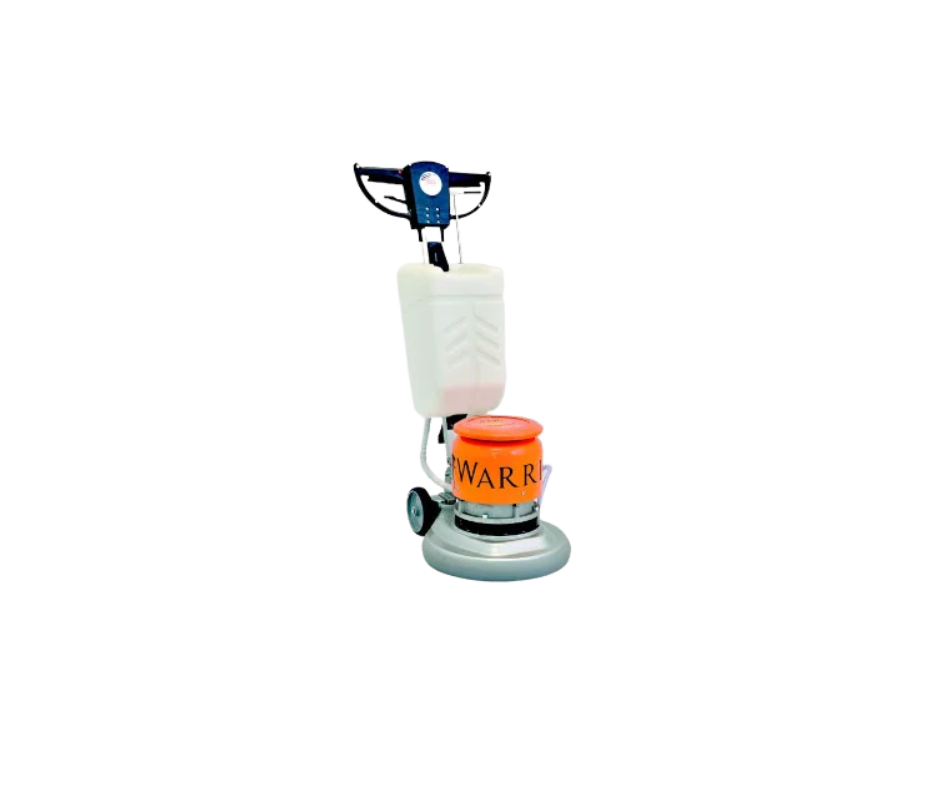
Step 3Faber Warrior single disc machine2.5 HP, 430mm single disc floor machine£1,950.00 + VATView product
-
Step 3Crobber M Medium scrub brushSafe agitation for thin surface fired black tilesFrom £55.56 + VATView product
-



Trade businesses need a trade account to see trade prices. Trade account information
The science of Victorian quarry tiles: why the black tiles need extra care
Before any chemical goes near a period tiled floor, it is worth understanding what you are actually looking at. Victorian quarry tiles are unglazed, fired clay tiles, and in a classic black and red chequerboard hallway the two colours are very often not made the same way.
Red quarry tiles are usually full bodied. The colour runs all the way through the clay, so light surface wear over the decades has very little visual effect.
Black quarry tiles vary more. Many are full bodied too, but older tiles, particularly those made before 1900, can be black only on the top, with a thin black surface fired onto a red body rather than a clay that is black all the way through. That thin black surface is exactly what gives these floors their rich, almost slate like appearance, but it also means the black layer can be worn through by anything too aggressive, revealing the red body underneath.
Full bodied quarry tile
- Colour depth
- Colour runs all the way through the tile. Red tiles, and many black ones.
- Risk from aggressive scrubbing
- LowMinor wear does not change appearance.
Older surface fired black quarry tile
- Colour depth
- Black on the top only, over a red body. Found on older tiles, particularly pre 1900.
- Risk from aggressive scrubbing
- HighAbrasive pads or stiff brushes can wear through the black to the red body underneath.
This is why brush and pad selection matters just as much as the chemicals you choose, which is covered in the machine and brush section below.
Removing construction contamination: cement haze, mortar splashes and efflorescence
Renovation work almost always leaves cementitious residue on an exposed floor, whether that is dried mortar splashes, cement haze, or the white efflorescence that forms as mineral salts migrate to the surface and dry. These deposits are alkaline, and an ordinary detergent, which is often mildly alkaline itself, will not touch them.
The fix is to go the other way on the pH scale. Faber Disycott is an acid based cleaner with an approximate pH of 1.5, formulated with what Faber calls an inhibited acid, meaning the acid is buffered to dissolve cementitious and mineral deposits without behaving like an uncontrolled hardware store acid that can etch or damage the tile surface. In practical terms, the acid reacts with and breaks down the alkaline cement and mineral deposits, lifting them from the tile so they can be rinsed away.
- Approx. pH
- 1.5
- Dilution
- 20 percent for light haze, up to 40 percent for heavier or more porous contamination
- Dwell time
- 10 to 15 minutes with occasional agitation
- Finish
- Rinse thoroughly with clean water
It is worth noting the pleasant, low odour formulation compared with a raw acid, which makes it far more workable indoors on a hallway floor than a traditional brick acid wash would be.
Even an inhibited, buffered acid cleaner should be tested on a small, inconspicuous area first, since tile bodies, grout and glazes vary.
Cutting through decades of grease and grime
Once the mineral contamination is dealt with, the older problem underneath usually remains: years, sometimes a century, of accumulated wax, grease from foot traffic and general ingrained grime sitting in the pores of the tile. This is a different chemical problem to the cement haze, because grease and wax are not mineral deposits, they are organic soiling, and acid does very little to them.
This is where Faber 30 comes in, a concentrated alkaline deep cleaner at around pH 11. Alkaline cleaners work on grease through saponification, the same basic chemical reaction that turns fat into soap: the alkaline solution breaks down the structure of the grease and wax so it becomes soluble and can be lifted from the tile and extracted, rather than just pushed around on the surface.
- Wax stripping
- Undiluted
- Heavy degreasing
- 1 to 2 with water
- Routine deep cleaning
- 1 to 6 with water
Apply and leave to dwell for 10 to 15 minutes with periodic agitation, then extract and rinse. It is formulated to be used on the full range of natural stone and porcelain without etching polished marble or acid sensitive stone, so it is a safe deep clean step across most period floor types, not just quarry tile.
Choosing the right machine and brush for a historic floor
Both of the cleaning stages above work far better with mechanical agitation than with a mop and bucket, but on a floor with a thin, surface fired black layer, the wrong brush can undo all the good the chemistry has done.
The job shown here used a Faber Warrior single disc machine, a 2.5 HP, 430mm single disc floor machine, fitted with a Crobber M Medium scrub brush. The Crobber M sits deliberately between a soft brush and a genuinely aggressive one, giving enough mechanical agitation to work the Disycott and Faber 30 solutions into the tile and lift contamination, without the abrasive bite of a harder brush that could strip through the thin black surface layer described above. For this reason, a medium brush was chosen specifically because of the tile construction, not as a default setting.
If you are working on a floor of full bodied tiles throughout, such as an all red quarry floor, a firmer brush can usually be used without the same risk. On a mixed black and red chequerboard floor like this one, treating the whole floor at the more cautious medium setting protects the black tiles without meaningfully slowing down the clean on the red ones.
Drying before sealing
Once the floor has been cleaned, agitated and rinsed, it needs to be left to dry out fully before any sealer or colour enhancer goes down. This step is easy to rush, but a solvent based impregnating treatment needs a genuinely dry, absorbent surface to penetrate properly. Any residual moisture sitting in the pores of the tile will compete with the treatment for that same space, leading to patchy penetration and an uneven finish.
Sealing and colour enhancement: why breathability matters on a period floor
With the floor clean, contamination free and dry, the final step is sealing. This is where a lot of period floors are damaged years after the original clean, because the wrong type of sealer is used.
Victorian solid floors like this one were laid directly onto a lime mortar bed, with no modern damp proof membrane underneath. That means ground moisture needs a route to migrate upward through the tile and evaporate at the surface. A standard film forming sealer sits on top of the tile like a layer of plastic, sealing that route off. Trapped moisture underneath a film forming coating on an older solid floor is a common cause of efflorescence returning, tiles lifting, or the coating itself failing and turning white or hazy.
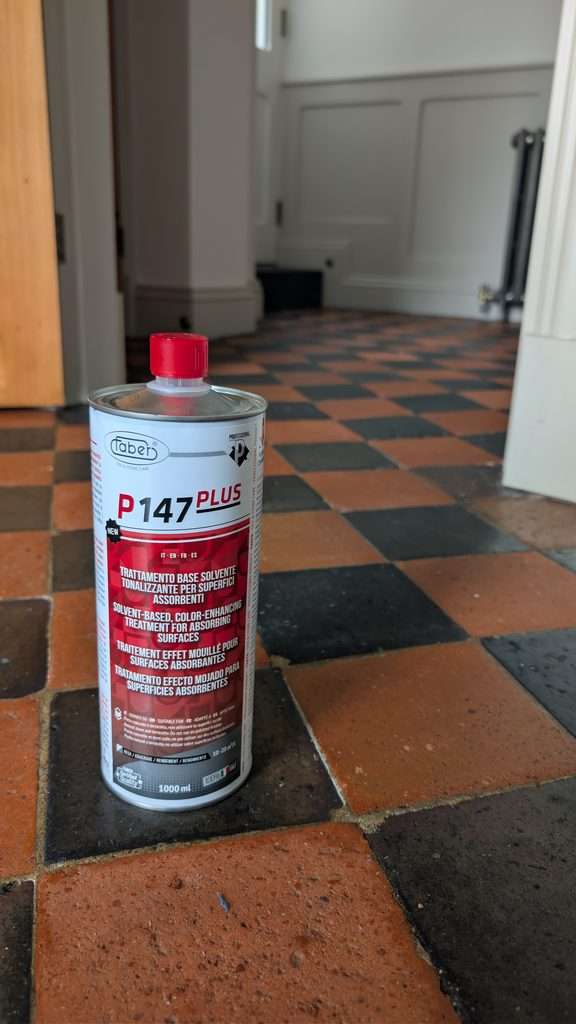
Faber P147 Plus
From £45.17 + VAT
Faber P147 Plus avoids this because it is a solvent based, non film forming treatment. Rather than sitting on the surface, it penetrates into the pore structure of the tile itself, so it does not create a barrier and the floor keeps its natural breathability.
At the same time, because the product is working from within the pores rather than on the surface, it intensifies the natural colour, depth and tonal variation of the tile, producing what is often described as a wet look effect with a matt rather than glossy finish. On this floor it brought the reds and blacks back to a much richer, more saturated tone than the dry, dulled tile that was there before cleaning, without leaving any surface film that could trap moisture underneath.
Shop Faber P147 PlusP147 Plus is suitable for a wide range of absorbent surfaces including quarry tile, terracotta, limestone, sandstone, slate, and other unpolished or medium to highly absorbent stone. It is not suitable for polished surfaces, since the treatment needs an absorbent surface to penetrate into.
How to apply Faber P147 Plus
- Confirm the surface is completely clean and dry, ideally in a working temperature of 5 to 40 degrees Celsius.
- Apply an even coat across the tile using a brush, roller or cloth.
- Redistribute any excess product after 5 to 10 minutes so it does not pool or dry unevenly.
- Remove any remaining surface residue after 20 to 30 minutes using a floor polisher or clean cloth.
- Allow the floor to dry, which typically takes 1 to 2 hours, with the surface fully ready for normal use after 4 to 6 hours.
This is a solvent based product with a flash point below 23 degrees Celsius. Work in a well ventilated space and clean tools with white spirit rather than water.
Conclusion
Restoring an original Victorian quarry tile floor is really three separate problems solved in the right order: removing alkaline construction contamination with an acid based cleaner, removing decades of organic grease and wax with an alkaline deep cleaner, and only then sealing with a treatment that enhances colour without trapping moisture underneath a floor that was never designed to have a damp proof membrane. Get the order wrong, or use the wrong brush on a surface fired black tile, and you risk permanent damage rather than restoration.
For this job, that meant Faber Disycott to strip the cement contamination, Faber 30 for the deep alkaline clean, a Crobber M medium brush on a Faber Warrior single disc machine to protect the surface fired black tiles, and Faber P147 Plus to finish, breathable and colour enhancing in one step.
Bring the original colour back into your period floor
Order Faber P147 Plus from HF Flooring Supplies today. Trade businesses need a trade account to see trade prices.
- Orders placed Mon to Fri before 2PM are dispatched the same day for next working day delivery
- Not sure which product? Contact us
Frequently asked questions
Why do black Victorian quarry tiles wear differently to red ones?
Red quarry tiles are usually full bodied, meaning the colour runs all the way through the clay. Many black tiles are full bodied too, but older ones, particularly those made before 1900, can be black only on the top, with a thin black surface fired onto a red body. Aggressive scrubbing can wear through that thin black layer and expose the red body underneath, so these black tiles generally need a gentler brush than red ones on the same floor.
Can I use a strong acid cleaner like Disycott on a full tiled floor without testing it first?
No. Even an inhibited, buffered acid cleaner like Faber Disycott should be tested on a small, inconspicuous area first, since tile bodies, grout and glazes vary. Disycott is formulated to be gentler than a raw acid, but it is still an acid based product at around pH 1.5 and reacts with mineral deposits.
Do I need both an acid cleaner and an alkaline cleaner, or would one do the job?
Cement haze, mortar splashes and efflorescence are alkaline mineral deposits, which respond to an acid based cleaner such as Faber Disycott. Grease, wax and ingrained grime are organic soiling, which respond to an alkaline cleaner such as Faber 30. A floor with both types of contamination, which is common after building work on an older floor, generally needs both steps to come up properly clean.
Will Faber P147 Plus make my tiles look glossy or plastic looking?
No. P147 Plus is a non film forming treatment that penetrates into the tile rather than coating the surface, so it produces a wet look colour enhancement with a matt finish rather than a glossy, plastic looking coating.
Is it safe to seal a period floor that does not have a damp proof membrane?
A non film forming, breathable treatment like Faber P147 Plus is a suitable choice for this type of floor, because it does not create a surface barrier that would trap ground moisture underneath the tile. A film forming sealer is more likely to cause problems on this type of construction over time.
Can this same process be used on terracotta or other quarry tile floors, not just black and red Victorian tiles?
Yes. Faber Disycott, Faber 30 and Faber P147 Plus are all suitable for terracotta and other unpolished, absorbent tile and stone surfaces, not only Victorian quarry tile. The main thing to adjust for a different floor is brush selection, based on how durable the specific tile surface is.
How long after sealing with P147 Plus can the floor be walked on?
The surface typically dries within 1 to 2 hours, and is ready for normal use after 4 to 6 hours, though this can vary slightly with room temperature and ventilation.
What machine and brush combination was used on this floor, and why?
This floor was restored using a Faber Warrior single disc machine fitted with a Crobber M medium scrub brush. The medium brush was chosen specifically because the black tiles on this floor were surface fired rather than full bodied, so a brush firm enough to lift contamination but gentle enough not to abrade through the thin black surface layer was needed.
