
How to Remove Stains From Stone and Tile — Without Etching the Floor
A professional’s guide to reading the stain, reading the surface, and reaching for the right product the first time.
There’s a myth that stain removal is about effort — that if a mark won’t shift, you haven’t scrubbed hard enough or bought a strong enough chemical. After the better part of a decade on our knees restoring stone and tile floors, we can tell you it’s almost never true. The stubborn stain isn’t a strength problem. It’s a diagnosis problem.
Get the diagnosis right and most stains lift with almost no effort — the correct chemistry does the work while you make a brew. Get it wrong and you’ll either waste an afternoon achieving nothing, or, far worse, cause damage that no amount of cleaning will undo. Reach for the wrong rust remover on a marble hearth and you won’t just fail to remove the rust — you’ll etch the marble permanently.
This guide is the diagnostic framework we use on real jobs. It comes down to two questions, asked in the right order, and a small set of products each matched to a specific problem.
The two questions that decide everything
Before you open a single tin, answer these:
- What is the surface? Specifically: is it acid-sensitive or acid-resistant? This decides which products are even allowed near it.
- What is the stain? Colour, grease, rust, damp, or installation residue — each is a different chemistry problem with a different answer.
Most people jump straight to question two, grab whatever “stain remover” is nearest, and hope. The professionals ask question one first, every single time. So will you, by the end of this.
Question one: is your surface acid-sensitive or acid-resistant?
This is the single most important thing on the page, so it’s worth understanding why it matters rather than just memorising a list.
Natural stone splits broadly into two families based on what holds it together. Calcareous stones — marble, limestone, travertine, onyx, and some slates — are bound by calcium carbonate. Siliceous stones — granite, quartzite, most sandstone, slate — are bound by silica. That difference is the whole game.
Calcium carbonate reacts with acid. Put an acidic product on marble or limestone and the acid dissolves a microscopic layer of the surface, leaving a dull, rough patch we call an etch. On a polished floor it shows up instantly as a matte mark where the shine used to be — and it’s physical damage, not a stain, so you can’t clean it off. It has to be re-polished or honed out. Silica doesn’t react this way, which is why acidic products are fine on granite, porcelain and quartz.
So the surfaces divide like this:
- Acid-sensitive (calcareous): marble, limestone, travertine, onyx, polished/honed calcareous stone.
- Acid-resistant (siliceous / man-made): granite, quartzite, porcelain stoneware, quartz agglomerate, glazed ceramic, most slate and sandstone.
Not sure which you’ve got? Two safe habits. First assume it’s acid-sensitive until proven otherwise — that covers most marble and limestone and you don’t want to etch those. Second, always patch-test any remover on a hidden area (under a unit, in a cupboard, on an offcut) before committing. Trade professionals sometimes confirm a calcareous stone with a spot test — a drop of a dilute acid on an inconspicuous corner fizzes on carbonate stone — but if you’re at all unsure, skip the test and just treat it as acid-sensitive. It costs you nothing and it can’t backfire.
With the surface understood, you can safely move to the stain.
Question two: what kind of stain is it?
Here are the six stain families you’ll actually meet on floors and surfaces, what causes each, and the product matched to it.
1. Colour and organic stains — wine, coffee, ink, algae, mould
These are the everyday marks: red wine rings, coffee and tea, fruit and food, permanent marker and coloured ink, plus biological growth like algae and mould on outdoor stone. They’re absorbed colour — the pigment has soaked into the pores of the material.
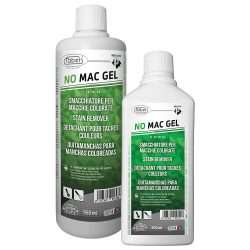
The answer is a colour-extraction gel like Faber No Mac Gel. It’s neutral and water-based, which is what makes it safe right across the board — including polished marble — and its gel body holds it in contact with the stain long enough to draw the colour back out. Apply it thick and undiluted, let it dwell from fifteen minutes up to a couple of hours depending on how old the stain is, then lift the residue and wipe down. Old, set-in stains often need a second pass; that’s normal, and repeating is always better than reaching for something harsher.
2. Grease and oil — cooking oil, motor oil, fat, wax
Oil stains behave differently from colour stains. Oil is drawn deep into porous stone and sits inside the material, often spreading into a dark halo. Water-based cleaners can’t touch it because oil and water don’t mix — you need a solvent that can dissolve the oil and a mechanism to pull it back out.
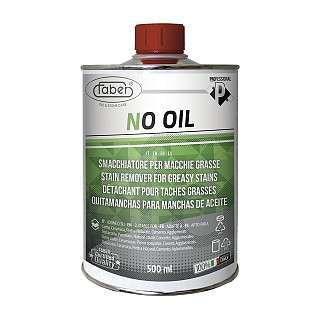
Faber No Oil is a solvent-based extractor that does exactly that, and cleverly, it’s still safe on acid-sensitive stone. Here’s the satisfying part: you apply it as a thick paste, and as it dries it turns to a white powder — and that powder is the oil, drawn up out of the stone and trapped in the drying medium. Once it’s fully dry (usually one to two hours), you simply brush the powder away. It’s the closest thing to watching a stain physically leave the floor. Deep or old oil stains may need repeating, and again, that’s expected.
3. Rust on hard (acid-resistant) stone — granite, porcelain, quartz
Rust comes from iron — a dropped tin, a metal planter, rebar bleeding through, or iron minerals in the stone itself oxidising. On acid-resistant surfaces like granite, porcelain, quartz and slate, you can use a proper acidic rust remover, which is the most direct chemistry for the job.
Faber No Rug is built for this. It penetrates deep to lift rust, oxidation and salt efflorescence, and because the surface is acid-tolerant there’s no etching risk. Dwell times run from thirty minutes on surface rust up to many hours — even overnight — on deep, old staining. This is the product you must never put on marble, limestone or travertine. Which is exactly why the next one exists.

4. Rust on soft (acid-sensitive) stone — marble, limestone, travertine
This is where most rust jobs go wrong. The instinct is to grab a rust remover, but a standard one is acidic, and on marble that means an etched floor. You need rust chemistry that works without acid.
Faber Mar Gel Plus is an acid-free rust remover developed specifically for calcareous stone. It lifts iron staining from marble, limestone and travertine with no etching risk — and it gives you a genuinely useful visual cue: it turns purple as it reacts with the rust, so you can see it working and judge when it’s done. Once you’ve removed the gel, finish the area with Faber Oxidant to clear any residual purple tint and complete the job. Dwell ranges from a few minutes on light marks to several hours on deep ones.
The pairing of No Rug and Mar Gel Plus is the whole reason a proper stain kit carries two rust removers. It’s not redundancy — it’s the difference between a clean floor and a ruined one.

5. Damp, dark marks and yellowing
Some of the most frustrating marks aren’t spills at all. Rising damp leaves dark patches and a tide line. Old stone yellows. Tannins from timber or leaves bleed in. Organic matter breaks down and darkens the stone from within. These are the deep, diffuse stains that colour-removers won’t shift because they’re not simple surface pigment — they need an oxidising extractor.
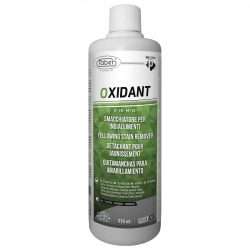
Faber Oxidant is the heavyweight here. It’s water-based and safe on acid-sensitive stone, and it reaches into porous material to neutralise and lift damp marks, yellowing, tannin and general oxidation from within. These are stubborn stains, so dwell times are long — anywhere from an hour up to a full twenty-four on the worst cases, often helped by holding the product in place with a poultice so it doesn’t dry out too soon. Oxidant is also the finishing partner for Mar Gel Plus, clearing the purple reaction residue after a rust treatment.
6. Grout haze and epoxy film — the installer’s stain
Not every mark is a spill on an old floor. On a fresh installation you get grout haze, sealant film, adhesive residue and epoxy patina — the cloudy, filmy leftovers that make a brand-new floor look dirty. On acid-sensitive stone this is a trap, because the traditional cementitious-haze remover is acidic and will etch the very marble you’ve just laid.
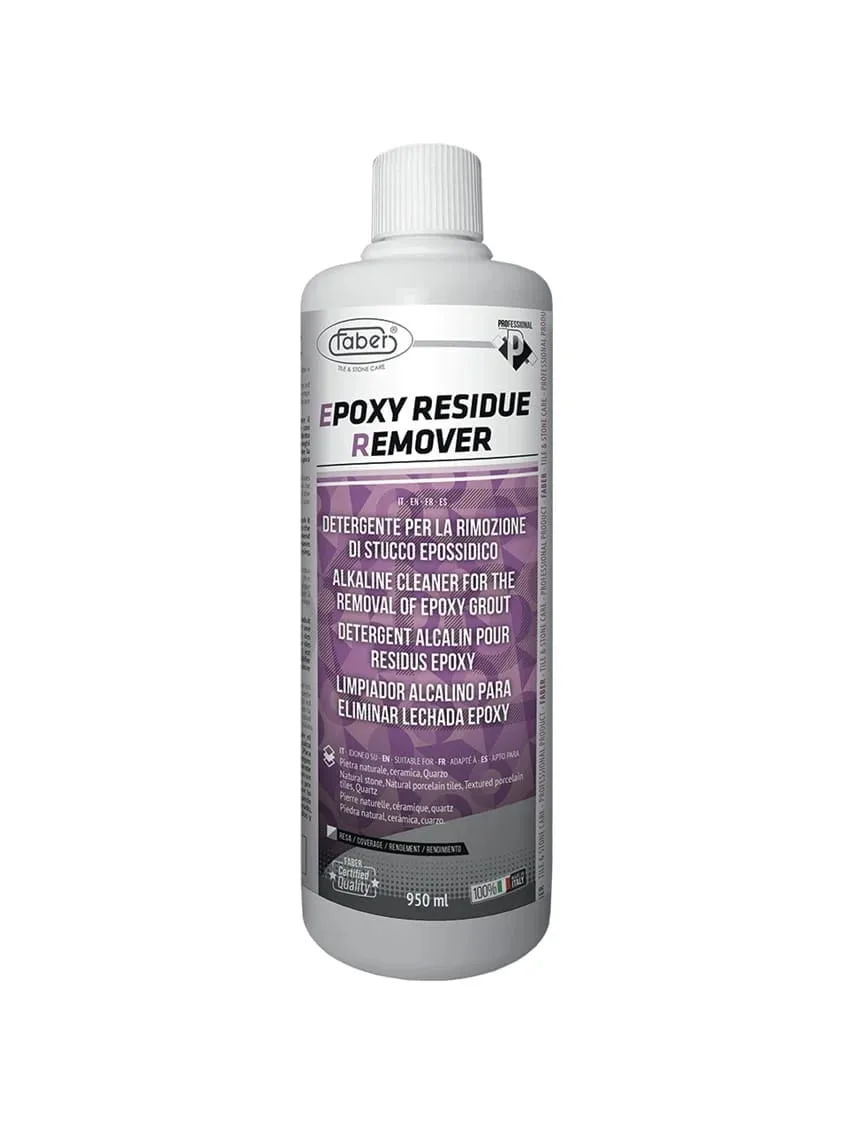
Faber Epoxy Residue Remover sidesteps that. It’s an alkaline cleaner — acid-free — so it dissolves grout haze, epoxy and sealant film and adhesive residue while staying safe on marble and limestone, and it handles the awkward textures (structured, matte and micro-finished porcelain) that trap residue. Short dwell, ten to thirty minutes, agitate, rinse thoroughly. It’s the product every tiler needs on the van and most don’t carry until the first haze disaster teaches them to.
The golden rule, one more time
If you take nothing else from this guide, take this: acidic rust removers etch marble. Marble, limestone and travertine are always acid-sensitive. On those stones use Mar Gel Plus, never No Rug. When you don’t know what the stone is, treat any pale, polished surface as acid-sensitive and patch-test a hidden area first. That one decision, made correctly, is the line between a floor you’ve rescued and a floor you’ve damaged.
Technique that applies to every stain
Whatever the stain, the workflow is the same, and getting the process right matters as much as picking the product:
- Clean and dry first. Remove surface dirt so the product contacts the stain, not the grime on top of it.
- Patch-test. Always, on unknown or polished stone.
- Apply generously and undiluted. These are gels and pastes designed to be laid on thick — a thin layer dries out and stops working.
- Give it time, not force. If a stain resists, extend the dwell or repeat the treatment. Do not jump to a harsher chemical — that’s how surfaces get damaged. On stubborn or vertical stains, a poultice holds the product in place and stops it drying before it’s finished.
- Rinse and inspect. Remove residue, rinse with clean water, let it dry fully, and only then judge the result — stone often looks darker when wet and clears as it dries.
- Re-seal afterwards. This is the step everyone skips. Once you’ve stripped a stain out of porous stone, that stone is wide open to the next spill. A quality impregnating sealer closes the door so you’re not back doing the same job in six months.
An honest word: not every stain comes out
Part of being straight with people is admitting the limits. Some stains aren’t stains in the normal sense — they’re compounds that have migrated deep into the body of the material and chemically bonded there. The classic example is the dark rubber-backing marks left on Victorian tile by decades of old carpet underlay: the antioxidant compounds in the rubber have soaked in and oxidised inside the clay, and no surface treatment fully reaches them. For cases like that, the honest professional answer is a test panel, realistic expectations, and sometimes a colour-enhancing sealer to reduce the contrast rather than a promise to remove the mark entirely. If a supplier tells you every stain always lifts, they haven’t done enough floors.
That caveat aside, the six families above cover the overwhelming majority of what you’ll meet — and matched correctly, they lift cleanly.
One kit, every stain family
We built the Faber Complete Stain Removal Kit around exactly this framework: one product for each of the six stain families, spanning every chemistry class — neutral, acidic, alkaline, solvent and acid-free — with two dedicated rust removers so whatever the stone, you always have the safe option to hand. It’s the kit we’d want in our own van: no guessing, and nothing in it that can etch a floor you’ve been trusted with.
If you’re a trade business, open a trade account for your best pricing across the full Faber range.
Quick FAQ
Can I use one all-purpose stain remover for everything? Not well. “Colour,” “grease,” “rust” and “damp” are genuinely different chemistry problems — a colour-extraction gel won’t touch oil, and an oil solvent won’t lift rust. Matching the product to the stain family is what makes removal quick and reliable.
How do I know if my stone is acid-sensitive? If it’s marble, limestone or travertine, it is. If you’re unsure, assume any pale, polished natural stone is acid-sensitive and patch-test before using anything acidic.
Why does my rust remover keep failing on marble? Most likely it’s acidic and etching the marble rather than removing the rust — the dull mark you’re seeing may be etch damage, not the original stain. Switch to an acid-free rust remover made for calcareous stone.
Do I really need to reseal after removing a stain? Yes, on porous stone. Stripping the stain also strips protection, leaving the stone more absorbent than before. A fresh impregnating sealer stops the next spill becoming the next stain.
Should I go stronger if a stain won’t shift? No — go longer, or repeat. Extend the dwell time or do a second application. Escalating to harsher chemistry is the most common way people damage a surface they were trying to save.
Written by the team at HF Flooring Supplies — an official Faber Surface Care partner, drawing on years of hands-on stone and tile restoration. We work with these products on real floors, and we’re happy to help you match a product to your problem.
