Posted on — Leave a comment

Deep Cleaning & Sealing Slate Floors: The Professional Guide

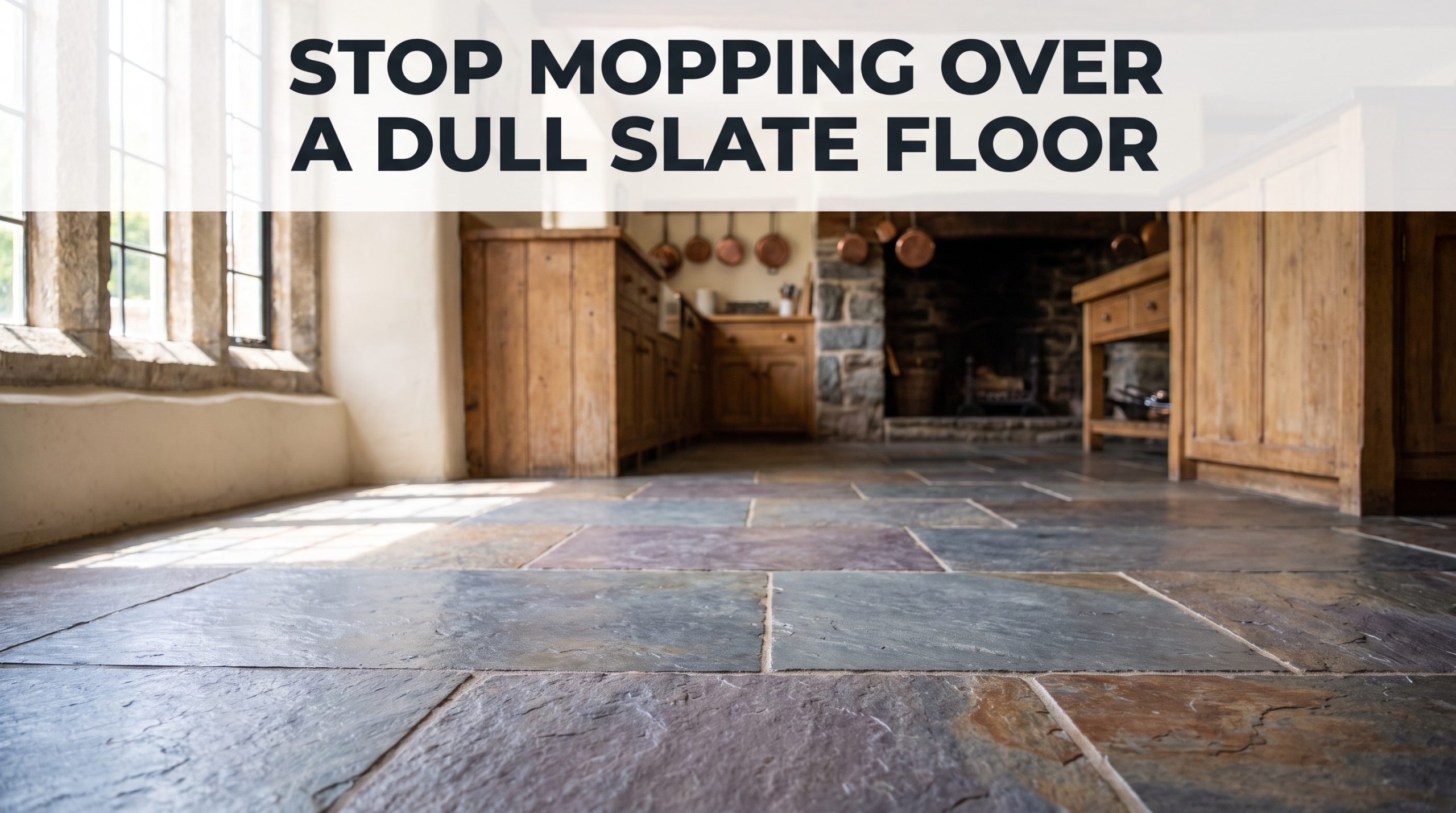
A customer comes in with a familiar story. Their slate hallway or kitchen floor has been down for ten, fifteen, twenty years. It used to have real depth to it. The blues and greys had character, the surface looked almost wet. Now it just looks tired.

They have mopped it with washing up liquid for years, maybe hit it with vinegar a few times when it looked especially grim, and the floor has responded by getting duller, not cleaner.

This is one of the most common problems we hear about at HF Flooring Supplies, and it is almost never actually a wear problem. It is a chemistry problem. Slate that looks flat and lifeless usually has two things going on at once: years of ingrained grime sitting in the stone's natural texture, and a sealer that either was never applied correctly or has worn out and stopped protecting the surface. Cleaning over the top of that with the wrong products just adds another layer to the problem.

The short version

  1. Deep clean first: strip the floor back to bare, uncontaminated stone with Faber 30, a concentrated alkaline deep cleaner.
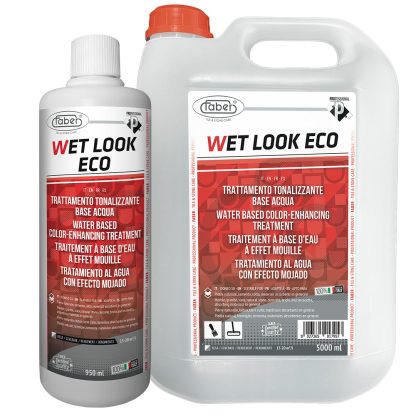
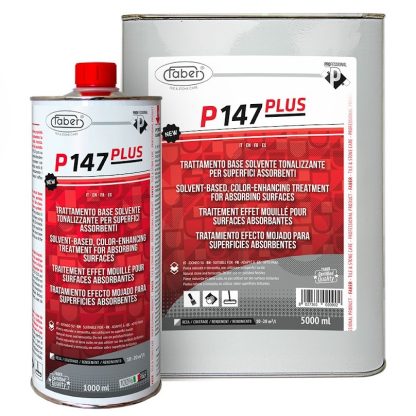
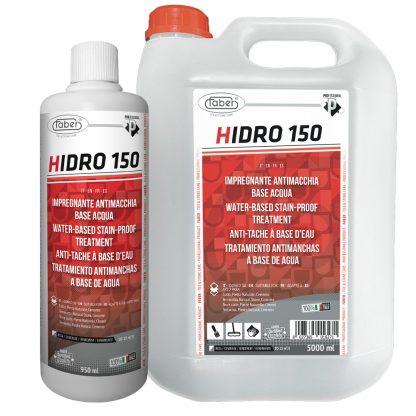
  2. Match the sealer to your slate: Deep Enhancer for dense slate, Wet Look Eco or P147 Plus for standard or more porous slate, Hidro 150 for no colour change at all.
  3. Not sure which? A simple water test on clean, dry stone tells you whether your slate is dense or porous.

Sealing over contaminated stone locks the problem in, so never skip the deep clean.

  • FloorSlate, cleft surface
  • MethodDeep clean, rinse, dry, then seal
  • CleanerFaber 30, alkaline at around pH 11
  • Cleaner dwell time10 to 15 minutes

The products in this guide

A deep clean followed by one of four sealers, chosen by how dense your slate is.

  • Faber 30 concentrated alkaline deep cleaner
    Deep cleanFaber 30Alkaline deep cleaner for ingrained grease and old residueFrom £11.36 + VATView product
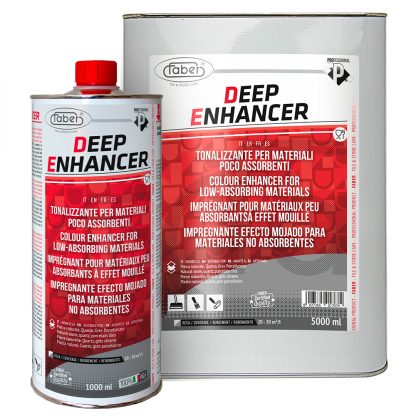
  • Faber Deep Enhancer colour enhancing impregnator
    Dense slateFaber Deep EnhancerSolvent based colour enhancer for low porosity slateFrom £46.59 + VATView product
  • Faber Wet Look Eco water based colour enhancing sealant
    Porous slateFaber Wet Look EcoWater based, subtle natural colour deepeningFrom £54.91 + VATView product
  • Faber P147 Plus colour enhancing sealer
    Porous slateFaber P147 PlusSolvent based, stronger colour enhancementFrom £45.17 + VATView product
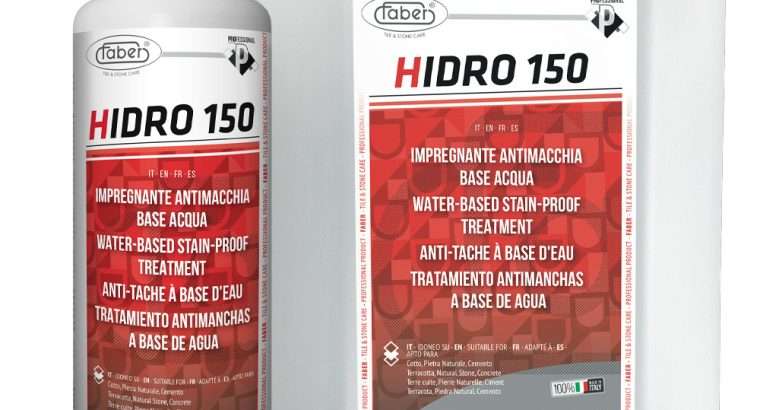
  • Faber Hidro 150 water based impregnator for natural stone
    No colour changeFaber Hidro 150Water based, breathable stain proof impregnatorFrom £30.14 + VATView product
01
The science

Why slate behaves differently to other stone

Slate is a metamorphic rock. Clay minerals and volcanic ash are compressed under heat and pressure until they form the dense, layered structure that gives slate its characteristic cleft surface. That splitting along planes structure is what makes slate slate, and it is also exactly why it needs different treatment to something like granite or marble.

The cleft surface is not flat. It has natural micro fissures and texture variation across every tile, and those fissures do two things: they absorb liquid more readily than the stone's overall density would suggest, and they trap residue from anything you clean it with that does not rinse away completely. A neutral looking cleaning product that would be fine on smooth porcelain can build up in slate's texture over years and leave the floor looking permanently dull, no matter how often it is mopped.

Slate also is not chemically uniform. Most commercial slate is predominantly quartz and mica, both broadly acid resistant, but almost all of it contains at least some calcite or dolomite. Acidic cleaners, vinegar being the classic offender, react with those minerals slowly and invisibly. You will not see damage after one clean. You will see it after two years of regular vinegar cleaning, by which point the surface texture and colour have both changed permanently.

Density and porosity also vary significantly by where the slate came from.

Slate typeTypical densityPorosityColour character
Welsh slateVery denseLowDark blue grey, subtle
Brazilian slateVery denseLowDark, fine grained
Spanish slateDenseLow to mediumConsistent dark grey
Westmorland greenMediumMediumGrey green, strong cleft
Indian black slateVariableMedium to high, origin dependentFine texture, can look flat unsealed

This variation matters for cleaning and it matters even more for sealing, because the sealer that suits a dense Welsh slate is not necessarily the one that suits a more porous Indian black slate. More on that in section 04.

02
The mistake

Why cleaning over the problem never works

Every ineffective slate cleaning routine follows the same pattern, and it is worth being specific about why it fails.

  • Household cleaners redistribute soilWashing up liquid cuts light surface grease well enough on a smooth worktop, but on slate's textured surface it leaves a surfactant film in the fissures rather than lifting soil out of them. The floor looks temporarily cleaner and then dulls again within days.
  • Sealing over contamination locks it inIf you apply any impregnating sealer, even the correct one, over a surface that still has grease, old wax residue, or years of surfactant build up in its texture, the sealer cannot penetrate properly. You end up sealing in the contamination rather than protecting clean stone.
  • Acidic and abrasive products compound damageVinegar etches calcite bearing minerals. Baking soda is mildly abrasive. Neither causes obvious damage on day one, which is exactly why people keep using them. The damage is cumulative and only becomes visible once it is already significant.

The only way to actually fix a dull, ingrained slate floor is to strip it back to bare, chemically clean stone first, and that is a job for a proper alkaline deep cleaner, not a mop and washing up liquid.

03
Stage one

Deep cleaning with Faber 30

Faber 30 2.0 is Faber Chimica's concentrated alkaline deep cleaner, and it is the correct product for exactly this problem: ingrained grease, foot traffic soiling, and old residue that routine cleaning cannot touch. It is rated safe for slate among the other natural stones on its approved surface list.
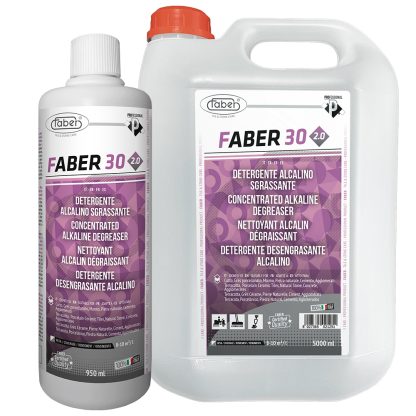
Faber 30 concentrated alkaline deep cleaner

Faber 30 2.0

From £11.36 + VAT

Concentrated alkaline deep cleaner, available in 1 litre and 5 litre bottles.

Shop Faber 30

How it works

  • High alkalinity, around pH 11It breaks down organic soiling through saponification, the same chemical process that turns fat into soap. Grease and oily grime that are otherwise insoluble in water become water soluble and lift away in the rinse, rather than just being smeared around.
  • Dwell time does the real workFaber 30 needs 10 to 15 minutes of contact time to fully penetrate the micro fissures in slate's cleft surface and act on soiling sitting below the visible surface, not just on top of it.
  • Three dilution strengthsMatch the chemistry to the job. Used undiluted it will strip old wax or polymer coatings. At 1 to 2 it handles heavy ingrained grease. At 1 to 6 it is calibrated for periodic deep cleaning rather than a full strip.
  • Safe on acid sensitive stoneThe alkalinity that dissolves grease does not etch calcite the way an acidic cleaner would, which matters given how much UK slate contains at least some calcite.
Full strip of wax or polymer
Undiluted
Heavy ingrained grease
1 to 2 with water
Periodic deep clean
1 to 6 with water

How to use it on slate

  1. Prepare the floor by sweeping or vacuuming loose debris, and treat manageable sections rather than the whole floor at once.
  2. Dilute to the strength that matches the job: 1 to 2 for a genuinely neglected floor with heavy ingrained soiling, 1 to 6 for a periodic deep clean on a floor in reasonable condition.
  3. Apply the solution evenly across the section with a single disc machine or stiff brush, working it into the cleft texture.
  4. Wait 10 to 15 minutes, agitating periodically to help the solution penetrate the fissures fully.
  5. Extract with a wet vacuum, then rinse thoroughly with clean water.
  6. Let the floor dry completely before moving on to sealing.
Do not skip the rinse or the drying time

Any alkaline residue left on the surface can interfere with how a sealer cures afterwards, and sealing a damp floor traps moisture beneath the sealer and compromises the result.

04
Stage two

Sealing slate: matching the product to your stone

This is the step most DIY slate restorations get wrong. Not because sealing is complicated, but because there is not a single best slate sealer. The right choice depends on your slate's density and porosity, and on whether you want the floor to look natural or to have its colour deepened.

Step 4.1Test first: is your slate dense or porous?

Before choosing a sealer, do a simple water test on clean, dry stone. Drop a small amount of water onto the surface and watch what it does.

Water beads and sits on top

What it means
Denser, lower porosity slate. The water sits for a while before slowly darkening the stone. Typically Welsh, Brazilian, or good quality Spanish slate.
Best suited to
Faber Deep Enhancer

Water absorbs and darkens quickly

What it means
More porous slate. This is common with Indian black slate and some Westmorland green.
Best suited to
Faber Wet Look Eco or P147 Plus

Step 4.2Dense, low porosity slate: Faber Deep Enhancer

Faber Deep Enhancer is a solvent based colour enhancing impregnator built specifically for low absorption, compact surfaces where water based products struggle to penetrate efficiently. Its hydrocarbon carrier gets into dense material structure that water based enhancers cannot reach effectively. On genuinely dense slate, this is exactly the profile that suits it: it deepens the natural tone, delivers strong stain and water repellency, and leaves a matt finish with no added gloss or surface film.

Deep Enhancer offers a dwell time choice that is worth understanding.

20 to 30 minutes
Good, easily managed colour enhancement
45 to 60 minutes
Noticeably deeper colour and stronger protection, with residue slightly harder to remove

On a dense slate where penetration is naturally slower, the extended dwell time is usually worth the extra care at the removal stage.

How to use it

  1. Apply an even coat with a brush, roller, or lambswool applicator, covering the section fully.
  2. Redistribute any excess across the surface after 5 to 10 minutes so nothing pools.
  3. Wait 20 to 30 minutes for standard enhancement, or 45 to 60 minutes for maximum colour depth on very dense stone.
  4. Remove all residue thoroughly with a floor polisher and a white or lambswool pad. This step is critical.
  5. Clean equipment immediately with white spirit, not water. This is a solvent based product and water will not shift it from brushes or applicators.
  6. The surface is dry within 1 to 2 hours. Return the floor to normal use after 4 to 6 hours.
Remove every trace of residue

Anything left on the surface dries into a greasy patina that is genuinely difficult to remove later.

Step 4.3Standard or more porous slate: Wet Look Eco or P147 Plus

If your slate is more porous, with Indian black slate the most common example along with some Westmorland green, a compact surface product like Deep Enhancer is not the right fit. HF's own experience with slate restoration points to two better options instead.

Faber Wet Look Eco

Type
Water based colour enhancing impregnator
Look
Subtle, natural colour deepening that replicates freshly wetted slate, with a slight sheen and no surface film
Best for
Most residential slate floors, including Indian black and Westmorland green. Lower VOC and easier to apply in an occupied property.

Faber P147 Plus

Type
Solvent based colour enhancer
Look
Noticeably stronger, more dramatic colour enhancement. Matt rather than glossy, so the enhancement is about colour depth, not shine.
Best for
Restoration jobs where slate has faded significantly and the client wants the floor returned to how it looked when first laid

Both are applied in broadly the same way as Deep Enhancer: even coat, dwell time, then residue removal. Always check the specific technical data sheet for exact timings before starting, since dwell times differ between the two products.

Step 4.4No colour change at all: Faber Hidro 150

If the floor's natural colour is exactly what the customer wants preserved, which is common on conservation properties or where a very light slate would look wrong artificially darkened, Faber Hidro 150 is the right product regardless of density or porosity. It is a water based, breathable impregnator that penetrates the stone and protects against oil and water based staining without changing the colour, texture, or sheen of the surface at all.

Type
Water based, breathable
Drying
Fast drying
Certified
Food contact certified
Suitable for
Indoor and outdoor slate

How to use it

  1. Apply a thin, even coat with a brush, lambswool applicator, roller, or cloth.
  2. Wipe off any residue immediately with a clean dry cloth. Hidro 150 is fast drying and generally leaves nothing behind, but on more compact areas a slight residue can appear.
  3. Apply a second coat on highly absorbent slate, waiting at least 45 minutes after the first.
  4. The surface is dry within about an hour. Normal use can resume after 2 to 3 hours.
05
Conclusion

Clean first, then seal to match

Restoring a dull, tired slate floor comes down to getting two things right in order: strip out the years of ingrained grime and residue with a proper alkaline deep clean, then seal with the product that actually matches your slate's density and the finish you want, rather than whatever sealer happens to be to hand.

The key takeaways

  • Slate's cleft, textured surface traps residue from household cleaners in a way smoother stone does not, which is why it dulls even when it is being cleaned regularly.
  • Sealing over contaminated stone locks the problem in. Deep clean first, always.
  • Faber 30 handles the deep clean, using alkaline saponification and proper dwell time to break down grease and grime that mopping cannot touch.
  • Sealer choice depends on density: Deep Enhancer for dense, low porosity slate wanting colour enhancement, P147 Plus or Wet Look Eco for standard or more porous slate, and Hidro 150 wherever the natural colour needs to stay exactly as it is.

If your slate floor has lost its depth and character and mopping is not bringing it back, the fix starts with proper deep cleaning chemistry, not a stronger scrub.

Ready to bring your slate floor back?

Start with the deep clean. Order Faber 30 from HF Flooring Supplies and restore your slate floor properly today.

  • Orders placed Mon to Fri before 2PM are dispatched the same day for next working day delivery
  • Not sure which sealer? Contact us
Questions

Frequently asked questions

Can I seal my slate floor without deep cleaning it first?

No. Sealing over grease, old wax, or years of cleaning product residue traps the contamination beneath the sealer and prevents proper penetration. The result looks patchy and never achieves the finish the sealer is capable of. Always deep clean with Faber 30 and rinse thoroughly before applying any sealer.

How do I know if my slate is dense or porous?

Do a water test on clean, dry stone. Drop a small amount of water on the surface. If it beads and sits for a while before slowly darkening the stone, it is dense, low porosity slate suited to Deep Enhancer. If it absorbs and darkens quickly, it is more porous and better suited to P147 Plus or Wet Look Eco.

Is Faber 30 safe to use on all types of slate, including Welsh slate?

Yes. Faber 30 is formulated to be safe on acid sensitive stone, including slate containing calcite or dolomite, when used at the correct dilution and rinsed thoroughly afterwards. Welsh slate, Spanish slate, Brazilian slate, and Indian black slate can all be deep cleaned with Faber 30.

What is the difference between Deep Enhancer and P147 Plus for colour enhancement?

Deep Enhancer is formulated specifically for dense, low absorption compact surfaces and penetrates that type of structure efficiently. P147 Plus is a more general purpose solvent based colour enhancer suited to standard or more porous slate. Both give a matt, colour deepened finish rather than gloss, but choosing the one that matches your slate's porosity gives a better, more even result.

Can I use a water based sealer if I want strong colour enhancement?

Wet Look Eco is water based and gives a genuine but subtler colour deepening than the solvent based options. If maximum colour depth is the priority, for example on a faded floor being restored to its original appearance, P147 Plus (or Deep Enhancer, on dense slate) will give a more pronounced result than a water based product can.

How often does a sealed slate floor need re sealing?

Do a water bead test periodically. If water still beads on the surface, the sealer is active. Once water starts absorbing and darkening the stone, the sealer has depleted. In a typical residential setting this is roughly every three to five years, though heavy foot traffic will shorten that.

Are Deep Enhancer and P147 Plus safe to use indoors?

Both are solvent based with a flash point below 21°C, so they require good ventilation during application, no naked flames or ignition sources nearby, and appropriate PPE. They are safe for indoor use when applied correctly under these conditions. Faber 30 and Hidro 150, by contrast, are water based and do not carry the same flammability precautions.

All Faber products mentioned in this guide are available from HF Flooring Supplies. HF Flooring Supplies is a selected UK partner for Faber Chimica.

Posted on — Leave a comment

Nano Protection in Stone, Tile & Wood Care Products — Marketing Word or Real Science?

Walk into any stone care supplier, browse any trade website, or pick up almost any sealer in the surface care market and you’ll see it. Nano protection. Nano technology. Nano seal. Nano guard.

It’s everywhere. And nobody — not the suppliers selling it, not the contractors buying it, not the end users paying for it — is asking the obvious question.

Where’s the nano?

We read the SDS sheets so you don’t have to. Here’s what we found.


What Nanotechnology Actually Means

Nanotechnology is the manipulation and engineering of matter at a scale of 1 to 100 nanometres. To put that in context, a human hair is approximately 80,000 to 100,000 nanometres wide. A single red blood cell is around 7,000 nanometres. We’re talking about engineering at a scale that is genuinely extraordinary — and genuinely expensive.

At the nanoscale, materials behave differently to their bulk equivalents. Nano-engineered silica particles, for example, can penetrate stone pore structures at a molecular level and bond within them in ways that conventional particle-size chemistry cannot replicate. Nano-fluoropolymer particles can deliver water and oil repellency at concentrations that would be ineffective at larger particle sizes.

This is real science. It exists. It works. And it costs serious money to produce, stabilise, and deliver in a commercial product.

A genuinely nano-engineered surface care product reflects that cost. When you see nano claims at mainstream price points — and particularly when you see them on products that haven’t disclosed any nano-specific chemistry — it’s worth asking what you’re actually paying for.


The SDS Sheet — Your Most Important Tool

Every professional cleaning and sealing product sold in the UK and EU is legally required to have a Safety Data Sheet — an SDS — produced to a standardised 16-section format under REACH Regulation 1907/2006.

Section 3 of every SDS must disclose the composition of the product — every significant ingredient above regulatory disclosure thresholds, with its CAS number, concentration range, and hazard classification. This is a legal requirement. Manufacturers cannot omit significant ingredients. They cannot hide an active component that is present at a meaningful concentration.

The SDS is the most honest document a manufacturer produces about their product. It’s written for regulators and safety professionals, not for marketing purposes. And it tells you, with legal precision, what is actually in the bottle.

If a product genuinely contained engineered nanoparticles at a concentration sufficient to deliver the protection being claimed on the label, those nanoparticles would appear in Section 3 of the SDS with a CAS number.

This is where the nano story in stone and wood care gets very interesting indeed.


What You Actually Find in “Nano” Cleaners

Look at the SDS of products marketed as nano cleaners in the stone, tile, and wood care sector and the picture is consistent. You’ll find some variation of the following: water as the primary carrier, a surfactant system — ethoxylated alcohols, alkyl polyglucosides, or similar chemistry — sometimes a glycol ether co-solvent to assist penetration, sometimes a fragrance, sometimes a preservative or biocide.

These are conventional cleaning formulations. Good ones, often — surfactant chemistry is well understood and genuinely effective at lifting soiling from hard surfaces. But they are not nanotechnology. The nano claim adds nothing to the formulation, nothing to the cleaning performance, and nothing to the value of the product. It adds to the price.

Some nano-labelled cleaners in our sector also contain methanol — present as an impurity from cheap industrial ethanol used in the formulation. Methanol is genuinely toxic. It absorbs through the skin, metabolises to formaldehyde and formic acid in the body, and presents a real concern for professional cleaners using products repeatedly in enclosed spaces. A product with methanol in the SDS and nano on the label should prompt some serious questions about where the manufacturer’s priorities lie.

The cleaner you want for daily stone and tile maintenance is pH neutral, low residue, and honestly formulated. Faber AlgaFloor — pH 6.5, no rinse required, fully disclosed ingredients — costs less than 3p per litre of working solution at the recommended daily dilution. No nano required.


What You Actually Find in “Nano” Sealers

Sealer SDS sheets tell an equally consistent story.

The majority of solvent-based sealers marketed with nano claims contain a hydrocarbon solvent system — typically C9-C13 isoalkane fractions, white spirit derivatives, or turpentine substitutes — making up anywhere from 45% to 85% of the product by weight. A co-solvent such as butyl acetate or a glycol ether. And an active sealing ingredient — typically a fluoropolymer, silane, or siloxane — present at relatively low concentration and often described only generically in the SDS.

The hydrocarbon carrier is doing the delivery work. It carries the active ingredient into the stone pore structure and then evaporates, leaving the active chemistry behind. This is proven, well-established sealer technology. It works. It has worked for decades. But it is not nanotechnology.

The VOC content is the tell. Products with 80%+ VOC content by weight — classified as flammable liquids under UN1993 for transport — are overwhelmingly solvent carrier systems. Genuine nano-particle chemistry in surface care tends toward water-based or low-VOC systems, because nanoparticles can be stably dispersed in water without aggressive hydrocarbon carriers.

A product sitting at over £100 per litre, carrying a prominent nano claim, with VOC content above 80% and an ingredient list dominated by C9-C13 hydrocarbons and butyl acetate, is a solvent-based impregnator. Potentially an excellent one — the active chemistry it carries may perform very well. But the nano on the label is a marketing decision. It is not a chemistry decision.


What Honest Formulation Disclosure Actually Looks Like

To understand why the nano habit matters, it helps to look at what fully transparent chemistry disclosure looks like in practice. We stock Faber Chimica’s professional range, and their SDS sheets across the sealer product line are instructive — not because their products are perfect, but because every ingredient is named, every concentration is declared, and nothing hides behind a marketing word.

Take Faber Protex, a fast-drying solvent-based stain protection treatment for marble, granite, and natural stone. The SDS is completely direct. The primary ingredient is n-butyl acetate at 94–98% — the solvent carrier. Supporting it is a small fraction of C11-14 hydrocarbon isoalkanes and dipropylene glycol monomethyl ether. It ships as UN1123, Butyl Acetates Solution, a Class 3 flammable liquid. Protex doesn’t call itself nano. It doesn’t need to. It’s a fast-drying solvent impregnator, and the SDS tells you exactly that.

Now look at Faber P147 Plus, a solvent-based tonalising treatment for absorbent surfaces. The formulation is more complex: propylene glycol methyl ether acetate as the primary carrier at 30–35%, C9-C11 hydrocarbon isoalkanes at 21–25%, methyl acetate at 2.5–3%. Then, disclosed individually with CAS numbers, come the more interesting components: decamethylcyclopentasiloxane (D5) at 1–1.5% — flagged as a PBT substance — methanol at 0.5–0.6% with full toxicological data, and two cyclosiloxane components at trace concentrations, disclosed as PBT, vPvB, and endocrine disrupting. The SDS states this directly in Section 2.3. Faber doesn’t hide the regulatory complexity of these ingredients behind a nano label. They disclose it and let the professional decide.

Faber Wet Look Eco moves to water-based chemistry entirely. The primary active is poly amino functional siloxane, hydroxy-terminated — a silicone polymer — at 13.5–15%, with triethoxyoctylsilane as the penetrating silane component at 4–4.5%. The functional ingredients are named precisely. Not flammable, no UN number, no hydrocarbon carrier. It doesn’t claim nano. It tells you it contains triethoxyoctylsilane, and triethoxyoctylsilane is what does the work.

Faber Hidro 150, a water-based stain-proof impregnator, takes the disclosure further still. The active chemistry is tripotassium propylsilanetriolate — an alkali metal silanetriolate — at 1–1.5%. This is the molecule that bonds within the stone pore structure and creates the hydrophobic barrier after application. It’s present alongside propan-2-ol at 1–1.5% as a co-solvent, 1-methoxy-2-propanol at a trace fraction, and IPBC — a biocide — at below 0.05%. The full hazard profile of that biocide, including its aquatic toxicity and sensitisation classifications, is disclosed. Incombustible. pH 11 at 5% concentration. No nano claim. Just chemistry, named.

And Faber Hidro Protector MM, their eco-friendly water-based impregnator, goes further in a different direction entirely: sodium silicate at 21–22.5%, in a water carrier, with no organic solvents whatsoever. Inorganic mineral chemistry. pH 10–11. The ingredient is sodium silicate and the SDS says so.

This is what the range looks like when a manufacturer tells you what is in the bottle. Solvent-based systems are named as solvent-based. Water-based silane chemistry is identified by the specific silane molecule. Inorganic chemistry is disclosed as inorganic. PBT substances are flagged. Biocides are declared. Nothing is summarised as nano.


The Comparison That Matters

Now hold that picture — five products, five fully disclosed formulations, five entirely different chemistry approaches for five different applications — and go back to the Lithofin NanoTOP SDS we looked at previously.

NanoTOP is a product literally named for its nano claim. The SDS shows hydrocarbons C9-C10 isoalkanes at 45–50%, n-butyl acetate at 15–20%, further C11-C13 isoalkane fractions at up to 20%, and a glycol ether carrier. VOC content: 80.5% by weight. Transport classification: UN1993, flammable liquid. Flash point: flammable. The word nano appears nowhere in Section 3. No nanoparticle CAS number. No engineered nano-silica. No nano-fluoropolymer. The active sealing ingredient — whatever is carrying the actual sealing function — is present in undisclosed form within a predominantly hydrocarbon solvent system.

It retails at over £100 per litre.

Compare that to Faber’s range. Hidro 150 names its active ingredient — tripotassium propylsilanetriolate — tells you its concentration, its pH, its hazard profile, and its transport classification. Wet Look Eco names triethoxyoctylsilane and poly amino functional siloxane and tells you the same. Hidro Protector MM tells you it’s sodium silicate and nothing else of significance.

None of these products claims nano. All of them tell you what the chemistry is.

This is not an argument that Lithofin make a bad product. NanoTOP may perform excellently as a solvent-based impregnator. The point is simpler than that: the word nano on the label and nothing in the SDS to support it is a gap between marketing and chemistry that every professional using these products deserves to understand.


Why the Cyclosiloxane Disclosure Matters Particularly

One detail from the P147 Plus SDS is worth pausing on, because it illuminates something important about what transparent disclosure looks like even when the news is complicated.

P147 Plus contains decamethylcyclopentasiloxane (D5) and two related cyclosiloxane components — OttmethylCiclotetrasilossano and Dodeca Metil Cicexasilossano — in trace concentrations. All three are on the REACH Candidate List. D5 is classified as a PBT substance. The cyclotetasiloxane is flagged as a PBT, vPvB, and endocrine disrupting substance. Faber discloses all of this in Section 2.3 and Section 3 without ambiguity.

Now consider: siloxane chemistry is frequently present in premium “nano” sealers — it’s one of the chemistries that nano marketing often gestures toward, implicitly or explicitly. If those sealers contain D5 or related cyclosiloxanes without disclosing them, that’s not just a marketing problem. It’s a regulatory compliance problem. And the contractor applying the product — often in enclosed commercial kitchen stone areas, hotel lobbies, or bathroom installations — has no way to make an informed assessment of occupational exposure if the ingredients aren’t declared.

Honest SDS disclosure protects the professional using the product. The nano label does not.


What Good Sealer Chemistry Actually Looks Like

Professional stone sealers work through a small number of proven mechanisms. None of them require a nano claim to justify their performance. The Faber range makes this concrete.

Silane and siloxane impregnation is the workhorse of professional stone protection. The mechanism — silane molecules penetrate the pore structure, react with the mineral substrate, and form a hydrophobic barrier below the surface — is fully understood, extensively researched, and completely effective. Faber Hidro 150 delivers this through tripotassium propylsilanetriolate. Faber Wet Look Eco delivers it through triethoxyoctylsilane. Both SDS sheets name the chemistry. Neither calls it nano.

Inorganic mineral consolidation through sodium silicate — as in Hidro Protector MM — is a different mechanism entirely. The silicate penetrates and reacts with the substrate itself, binding fine particles and consolidating the pore structure. It’s particularly effective against rising damp in dense natural stone. No organic solvents, no VOCs, genuinely eco. Still not nano.

Solvent-carried impregnation — as in Protex and P147 Plus — uses a hydrocarbon or ester carrier to deliver the active chemistry more aggressively into denser stone pore structures. The solvent evaporates; the active remains. Proven, fast, effective for difficult substrates. Honestly described in the SDS.

When you know what the active chemistry is — because the SDS tells you — you can choose the right product for the surface, the application, and the occupational environment. A solvent-based impregnator is not the right choice in a poorly ventilated space with prolonged application time. A water-based silane system is not the right choice on a very dense, low-porosity stone where solvent carry is needed to achieve penetration. These are professional judgements. They require professional information. The word nano gives you none of it.


Why Nobody in the Industry Talks About This

The surface care sector has quietly adopted nano as a premium signifier in the same way the food industry adopted artisan or the cosmetics industry adopted clinical. It implies advanced technology, superior performance, professional-grade results. It justifies a higher price point. And nobody upstream has an incentive to question it.

Distributors don’t ask because the margin is good. Retailers don’t ask because the word sells. Contractors don’t ask because they trust the brand. End users don’t ask because they assume someone upstream has done the due diligence.

Nobody reads the SDS.

This isn’t unique to any one brand or any one product. It is an industry-wide habit. Some of the most respected names in stone and wood care use the word nano on products whose SDS sheets contain no nano-specific chemistry whatsoever. They do so because it works as a marketing tool, because there is no regulatory definition of nano in the surface care sector that would prevent them, and because nobody is asking the question.

We’re asking the question.


How to Evaluate Any Stone or Wood Care Product

Before purchasing any cleaner or sealer — nano claim or otherwise — apply this process.

Request the SDS. Every supplier is legally obliged to provide it. If they won’t, that tells you something.

Look at Section 3. What is the carrier system — water or solvent? What are the active ingredients? Are they specifically named with CAS numbers? Is anything that would justify a nano claim — engineered nanoparticles, reactive nano-silica, nano-fluoropolymer — actually disclosed? Or is Section 3 a list of hydrocarbon solvents and generic carriers?

Look at Section 9. What is the flash point? What are the VOCs? A flash point in the low twenties and a flammable liquid classification confirms a hydrocarbon carrier. A product that is incombustible with no flash point is water-based. These are not minor details — they affect storage, handling, and application safety.

Look at Section 2.3. Are there PBT substances? Endocrine disrupting components? Candidate List substances? A manufacturer who discloses these honestly is giving you information you need. A manufacturer who doesn’t disclose them may have more to hide than a nano claim.

Look at the price relative to the disclosed chemistry. Does what’s in the bottle justify what’s on the label?

A cleaner built on citric acid, surfactant, and a grease-cutting agent is a cleaner. A sealer built on hydrocarbon solvents carrying a silane or fluoropolymer active is a penetrating impregnator. Both can be excellent products for the right application. Neither is nanotechnology — and neither needs to be to do its job well.


What We Stock and Why

At HF Flooring Supplies we stock Faber Chimica’s professional cleaning and surface care range alongside Arboritec wood floor treatments because these brands don’t rely on marketing language to justify their products. Their SDS sheets are complete. Their TDS sheets give real dilution ratios, real coverage figures, and real application guidance. Their chemistry is engineered for specific surface types and specific problems — and the SDS tells you exactly what that chemistry is, including where it’s complicated.

Full SDS and TDS documentation is available for every product we sell. For trade pricing and accounts visit hfflooringsupplies.co.uk or contact us directly.

Read the SDS. Know what you’re buying. Your surfaces — and your margins — will thank you.


Frequently Asked Questions

What does nano mean in stone sealers?
Nanotechnology refers to particles engineered at 1–100 nanometre scale. In genuine nano sealers these particles would penetrate stone at a molecular level and bond within the pore structure — and would be disclosed in Section 3 of the SDS with a CAS number. Most products using the word nano in stone care are conventional silane, siloxane, or fluoropolymer sealers in a hydrocarbon or water carrier. The word nano has no regulatory definition in the surface care sector and is widely used as a marketing term without supporting chemistry.

How can I tell if a stone sealer actually contains nano chemistry?
Request the Safety Data Sheet and look at Section 3. Genuine nano-engineered particles would be disclosed with a CAS number. If Section 3 lists only hydrocarbon solvents and generic carrier chemistry with no specifically named active sealing ingredient, the nano claim has no chemical basis. For comparison: Faber Hidro 150 names its active ingredient as tripotassium propylsilanetriolate with CAS number 93857-00-2. That’s what transparent disclosure looks like.

What is an SDS sheet and why does it matter?
A Safety Data Sheet is a legal document required under REACH Regulation 1907/2006 for all professional cleaning and sealing products. Section 3 must disclose all significant ingredients above regulatory thresholds with CAS numbers and concentrations. It tells you exactly what is in a product regardless of what the marketing material claims. Section 2.3 discloses PBT substances, vPvB substances, and endocrine disruptors. Section 9 gives you physical properties including VOC content and flash point. The SDS is the most honest document a manufacturer produces about their product.

Are nano stone sealers worth the money?
That depends entirely on whether the product genuinely contains nano-engineered chemistry — which you can only establish by reading Section 3 of the SDS. Most products marketed as nano sealers are conventional solvent-based impregnators. They can be excellent products. But a well-formulated silane or siloxane impregnator with transparent, fully disclosed ingredients at a fair price will outperform an overpriced product with a nano label and no supporting chemistry in the SDS. Read the SDS first. Always.

What is the best stone sealer for natural stone in the UK?
It depends on stone type, finish, porosity, and application environment. Faber Chimica’s professional sealer range spans water-based silane chemistry, inorganic mineral impregnation, and solvent-based penetrating treatments — all with fully disclosed chemistry and complete SDS documentation. Contact HF Flooring Supplies for advice on the right product for your specific surface.

What is silane siloxane sealer and how does it work?
Silane and siloxane sealers are penetrating impregnators that enter the pore structure of stone and react with the mineral substrate to form a water and oil repellent barrier below the surface. Silanes are smaller molecules that penetrate more deeply into dense stone; siloxanes work effectively closer to the surface on more porous substrates. Both are proven, well-understood sealing technologies that do not rely on nano claims to justify their performance. Faber Hidro 150 uses tripotassium propylsilanetriolate; Faber Wet Look Eco uses triethoxyoctylsilane. The SDS names both.

Can I use a daily floor cleaner on natural stone?
Yes, but it must be pH neutral. Acidic cleaners etch polished marble, limestone, and travertine. Alkaline cleaners used repeatedly can strip impregnating sealers over time. A genuinely pH neutral cleaner such as Faber AlgaFloor at pH 6.5 is safe for daily use on all sealed natural stone, polished porcelain, and glazed ceramics. At the recommended dilution AlgaFloor costs less than 3p per litre of working solution.

Why does mould keep coming back in tile grout?
Bleach-based mould removers decolourise mould at the surface but do not penetrate deeply enough to kill the full colony within porous grout. The dead organic matter then feeds the deeper mould growth, which re-establishes often faster than before. The correct approach is alkaline deep cleaning to physically lift the mould from the grout body, followed by an impregnating sealer to close the pores and prevent re-establishment.

What is the difference between a cleaner and a sealer for stone floors?
A cleaner removes soiling from the surface or pore structure of stone. A penetrating impregnator enters the pore structure and creates a water and oil repellent barrier that makes the stone easier to clean and more resistant to staining. The stone should be thoroughly cleaned before sealing and a suitable maintenance cleaner used regularly after sealing to preserve the treatment.

Posted on — Leave a comment

Is The Pink Stuff Safe on Marble & Natural Stone?

If you’ve searched this question, you’ve probably already found the problem: the internet can’t agree on the answer. One cleaning blog says The Pink Stuff will scratch your marble. Another quotes the brand saying it’s fine with a soft sponge. A TikTok shows someone “rescuing” a stained worktop with it — right next to a comment warning it ruined theirs.

So here’s a straight answer from a UK stone and tile supplier, based on the chemistry and on what the manufacturer itself actually recommends.

The short answer

The Pink Stuff’s own manufacturer advises against using its Multi-Purpose Cleaning Paste on marble and granite, and recommends using a cleaner made specifically for those surfaces. That’s not our opinion — it’s stated on their own FAQ page.

The reason is simple. It’s an abrasive alkaline paste. On robust, sealed, everyday surfaces that’s exactly what makes it effective. But marble, limestone and travertine are soft, acid- and alkali-sensitive stones, and abrasion plus alkalinity is the combination most likely to dull polish, etch the surface and leave permanent marks over repeated use.

If you want the cleaning power of a paste without the risk, the answer is a near-neutral, non-abrasive paste — the kind formulated for sensitive stone in the first place, such as Faber Magic 123 at pH 6.5.

Why marble and natural stone are different

Marble, limestone and travertine are all calcium carbonate stones. That single fact explains almost every cleaning rule you’ll ever read about them.

Calcium carbonate reacts with acids — which is why lemon juice, vinegar and many descalers leave dull “etch marks” on marble. Over time it’s also vulnerable to strongly alkaline products, and because polished marble is relatively soft, it scratches far more easily than the granite or porcelain most people assume behaves the same way.

Two things damage this kind of stone during cleaning:

  • The wrong pH — strongly acidic or strongly alkaline products attack the surface chemically, etching and dulling the polish.
  • Abrasive particles — mineral grit in a paste physically scratches the finish. On a polished surface, those micro-scratches read as a permanent loss of shine.

An abrasive alkaline paste hits both risks at once. That’s why a product that’s brilliant on an oven door or a stainless sink is the wrong tool for a marble worktop.

What The Pink Stuff actually is

The Pink Stuff Cleaning Paste works through a combination of mild abrasion and an alkaline cleaning action. That’s a genuinely effective formula on the surfaces it’s designed for — enamel, stainless steel, glazed ceramics, uPVC, pans and outdoor items.

The manufacturer doesn’t classify it as hazardous, and for everyday cleaning it’s a good general-purpose product. The issue isn’t safety to you — it’s suitability for the surface. Abrasive particles and an alkaline pH are precisely the two things a soft, polished, acid-sensitive stone can’t tolerate long-term, which is why the manufacturer’s own guidance steers people away from marble and granite and towards a stone-specific cleaner.

Surface by surface: where an abrasive alkaline paste is risky

Surface

Risk from an abrasive alkaline paste

Marble, limestone, travertine

High — etching and dulling from alkalinity, scratching from abrasion. Avoid.

Polished granite & quartz

Moderate — abrasive particles can micro-scratch a polished finish over repeated use.

Brass, copper, polished metals

Moderate — alkalinity and abrasion strip patina and dull polished finishes.

Glazed ceramic & porcelain

Low–moderate — repeated abrasive cleaning can degrade the glaze over time.

Glass

Low — but alkaline residue can smear and, long-term, bloom.

Enamel, stainless steel, uPVC, pans

Low — these are the surfaces it’s genuinely made for.

The pattern is clear: the more polished, soft or sensitive the finish, the less an abrasive alkaline paste belongs on it.

“But I’ve already used it on my marble — is it ruined?”

Not necessarily. A single careful use with a soft sponge is very different from months of scrubbing. If you notice dull patches or a loss of shine where you’ve been cleaning, that’s etching or fine scratching, and light cases can often be re-polished by a stone restoration professional.

The more useful takeaway is to switch your regular cleaning routine to something safe before the damage accumulates — because etching is gradual, and by the time it’s obvious it usually needs professional attention.

The safe alternative: a near-neutral paste built for stone

The reason people reach for a paste in the first place is sound. On rough, textured or structured surfaces — grout lines, craquelé glazes, riven slate, structured porcelain — liquid cleaners run straight off before they can dwell and work. A paste stays in contact with the full surface profile and lifts ingrained soiling a spray simply can’t.

The fix isn’t to give up the paste format. It’s to use a paste that keeps that dwell-and-lift advantage without the abrasive, alkaline chemistry.

Faber Magic 123 is a heavy-duty multi-surface cleaning paste made by Faber Chimica in Italy, formulated at a near-neutral pH of 6.5. It cleans through surfactant action in a paste carrier rather than through aggressive abrasion, which is what makes it safe on the surfaces an abrasive alkaline paste puts at risk:

  • Marble, limestone and travertine — near-neutral pH sits outside the etching risk zone for acid-sensitive stone.
  • Polished granite, quartz and glazed finishes — cleans without abrasive scratching.
  • Brass, copper and decorative metals — lifts light oxidation without stripping polished finishes.
  • Glass, rubber, PVC and more — one paste across mixed materials, indoors or out.

It handles the same stubborn, ingrained jobs people buy an abrasive paste for — stone worktops, textured tile, grout lines, taps and fixtures, even car rims and garden furniture — on surfaces where you can’t afford to gamble with the finish.

For routine daily cleaning of stone rather than heavy spot jobs, pair it with a pH-neutral maintenance cleaner such as Faber Neugel. For large-area heavy alkaline cleaning on robust floors where etching isn’t a concern, Faber 30 is the workhorse. Magic 123 is the targeted, surface-safe paste that sits between them.

Faber Magic 123 500g multi-surface cleaning paste — near-neutral pH 6.5 professional cleaner for stone tile marble metal and glass
Faber Magic 123 — heavy-duty cleaning paste, pH 6.5, 500g jar. Safe on marble, stone, porcelain, metals and glass. Made in Italy by Faber Chimica.

How to clean stubborn marks off marble safely

  1. Test first on an inconspicuous area, especially on polished or delicate finishes.
  2. Take a small amount of a near-neutral paste on a damp white pad, microfibre cloth or sponge.
  3. Work it in gentle circular motions until it foams — let the chemistry do the work, not pressure.
  4. Rinse thoroughly with clean water until no residue remains.
  5. Repeat on heavy soiling rather than scrubbing harder in one pass.

A little goes a long way, and gentle-but-repeated always beats aggressive-but-once on soft stone.

Frequently asked questions

Is The Pink Stuff safe on marble? The manufacturer advises against using its Multi-Purpose Cleaning Paste on marble and recommends a cleaner made specifically for the surface. Marble is a soft, acid- and abrasion-sensitive stone, and an abrasive alkaline paste can dull and etch it over repeated use. A near-neutral, non-abrasive paste such as Faber Magic 123 (pH 6.5) is the safer choice.

Is The Pink Stuff safe on granite? The manufacturer also advises against granite. Sealed granite is more robust than marble, but abrasive particles can micro-scratch a polished finish over time. For regular use, a stone-safe cleaner is the better long-term option.

Can you use The Pink Stuff on quartz worktops? Abrasive pastes aren’t ideal on quartz — repeated abrasion can dull the polished surface, and many quartz manufacturers advise against abrasive cleaners. A near-neutral paste cleans stubborn marks without that risk.

What can I use instead of The Pink Stuff on marble? A near-neutral, non-abrasive cleaning paste formulated for stone. Faber Magic 123 (pH 6.5) delivers the same paste-format cleaning power on marble, granite, polished metal and glazed surfaces without the etching or scratching risk.

Why use a paste instead of a spray on stone? On textured and structured surfaces — grout lines, riven stone, craquelé glazes, structured porcelain — liquid cleaners run off before they can work. A paste stays in contact with the full surface profile and lifts ingrained soiling a spray can’t reach.

HF Flooring Supplies is a UK trade supplier of Faber Chimica professional stone, tile and surface care products. Trade accounts available — get in touch.

Posted on — Leave a comment

How to Remove Stains From Stone and Tile — Without Etching the Floor

How to Remove Stains From Stone and Tile — Without Etching the Floor

A professional’s guide to reading the stain, reading the surface, and reaching for the right product the first time.

There’s a myth that stain removal is about effort — that if a mark won’t shift, you haven’t scrubbed hard enough or bought a strong enough chemical. After the better part of a decade on our knees restoring stone and tile floors, we can tell you it’s almost never true. The stubborn stain isn’t a strength problem. It’s a diagnosis problem.

Get the diagnosis right and most stains lift with almost no effort — the correct chemistry does the work while you make a brew. Get it wrong and you’ll either waste an afternoon achieving nothing, or, far worse, cause damage that no amount of cleaning will undo. Reach for the wrong rust remover on a marble hearth and you won’t just fail to remove the rust — you’ll etch the marble permanently.

This guide is the diagnostic framework we use on real jobs. It comes down to two questions, asked in the right order, and a small set of products each matched to a specific problem.

The two questions that decide everything

Before you open a single tin, answer these:

  1. What is the surface? Specifically: is it acid-sensitive or acid-resistant? This decides which products are even allowed near it.
  2. What is the stain? Colour, grease, rust, damp, or installation residue — each is a different chemistry problem with a different answer.

Most people jump straight to question two, grab whatever “stain remover” is nearest, and hope. The professionals ask question one first, every single time. So will you, by the end of this.

Question one: is your surface acid-sensitive or acid-resistant?

This is the single most important thing on the page, so it’s worth understanding why it matters rather than just memorising a list.

Natural stone splits broadly into two families based on what holds it together. Calcareous stones — marble, limestone, travertine, onyx, and some slates — are bound by calcium carbonate. Siliceous stones — granite, quartzite, most sandstone, slate — are bound by silica. That difference is the whole game.

Calcium carbonate reacts with acid. Put an acidic product on marble or limestone and the acid dissolves a microscopic layer of the surface, leaving a dull, rough patch we call an etch. On a polished floor it shows up instantly as a matte mark where the shine used to be — and it’s physical damage, not a stain, so you can’t clean it off. It has to be re-polished or honed out. Silica doesn’t react this way, which is why acidic products are fine on granite, porcelain and quartz.

So the surfaces divide like this:

  • Acid-sensitive (calcareous): marble, limestone, travertine, onyx, polished/honed calcareous stone.
  • Acid-resistant (siliceous / man-made): granite, quartzite, porcelain stoneware, quartz agglomerate, glazed ceramic, most slate and sandstone.

Not sure which you’ve got? Two safe habits. First assume it’s acid-sensitive until proven otherwise — that covers most marble and limestone and you don’t want to etch those. Second, always patch-test any remover on a hidden area (under a unit, in a cupboard, on an offcut) before committing. Trade professionals sometimes confirm a calcareous stone with a spot test — a drop of a dilute acid on an inconspicuous corner fizzes on carbonate stone — but if you’re at all unsure, skip the test and just treat it as acid-sensitive. It costs you nothing and it can’t backfire.

With the surface understood, you can safely move to the stain.

Question two: what kind of stain is it?

Here are the six stain families you’ll actually meet on floors and surfaces, what causes each, and the product matched to it.

1. Colour and organic stains — wine, coffee, ink, algae, mould

These are the everyday marks: red wine rings, coffee and tea, fruit and food, permanent marker and coloured ink, plus biological growth like algae and mould on outdoor stone. They’re absorbed colour — the pigment has soaked into the pores of the material.

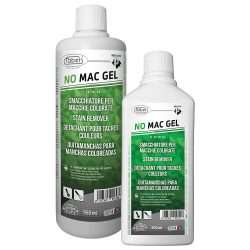
The answer is a colour-extraction gel like Faber No Mac Gel. It’s neutral and water-based, which is what makes it safe right across the board — including polished marble — and its gel body holds it in contact with the stain long enough to draw the colour back out. Apply it thick and undiluted, let it dwell from fifteen minutes up to a couple of hours depending on how old the stain is, then lift the residue and wipe down. Old, set-in stains often need a second pass; that’s normal, and repeating is always better than reaching for something harsher.

Faber No Mac Gel bottle – water-based gel that removes colored stains like coffee, wine, ink, algae and mould from stone, ceramic, and tile.
Faber No Mac Gel powerfully extracts stains like wine, ink, and algae from stone and ceramics—while preserving surface sheen

2. Grease and oil — cooking oil, motor oil, fat, wax

Oil stains behave differently from colour stains. Oil is drawn deep into porous stone and sits inside the material, often spreading into a dark halo. Water-based cleaners can’t touch it because oil and water don’t mix — you need a solvent that can dissolve the oil and a mechanism to pull it back out.

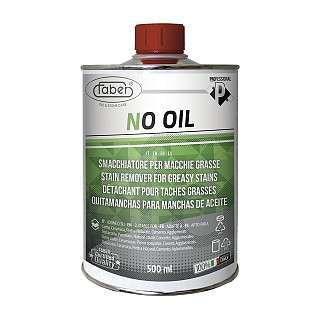
Faber No Oil is a solvent-based extractor that does exactly that, and cleverly, it’s still safe on acid-sensitive stone. Here’s the satisfying part: you apply it as a thick paste, and as it dries it turns to a white powder — and that powder is the oil, drawn up out of the stone and trapped in the drying medium. Once it’s fully dry (usually one to two hours), you simply brush the powder away. It’s the closest thing to watching a stain physically leave the floor. Deep or old oil stains may need repeating, and again, that’s expected.

Faber NO OIL grease stain remover – solvent-based gel for extracting deep oil and grease stains from stone, porcelain, wood, and concrete.
Faber NO OIL’s solvent-rich gel penetrates and lifts deep oil, grease, and bitumen stains—protecting delicate stone finishes without altering appearance.

3. Rust on hard (acid-resistant) stone — granite, porcelain, quartz

Rust comes from iron — a dropped tin, a metal planter, rebar bleeding through, or iron minerals in the stone itself oxidising. On acid-resistant surfaces like granite, porcelain, quartz and slate, you can use a proper acidic rust remover, which is the most direct chemistry for the job.

Faber No Rug is built for this. It penetrates deep to lift rust, oxidation and salt efflorescence, and because the surface is acid-tolerant there’s no etching risk. Dwell times run from thirty minutes on surface rust up to many hours — even overnight — on deep, old staining. This is the product you must never put on marble, limestone or travertine. Which is exactly why the next one exists.

Faber NO RUG – Rust & Oxidation Stain Remover for Acid-Resistant Stone
Remove rust, salt stains, and oxidation from granite, porcelain, quartz and ceramic surfaces with Faber NO RUG. Deep-penetrating and water-based.

4. Rust on soft (acid-sensitive) stone — marble, limestone, travertine

This is where most rust jobs go wrong. The instinct is to grab a rust remover, but a standard one is acidic, and on marble that means an etched floor. You need rust chemistry that works without acid.

Faber Mar Gel Plus is an acid-free rust remover developed specifically for calcareous stone. It lifts iron staining from marble, limestone and travertine with no etching risk — and it gives you a genuinely useful visual cue: it turns purple as it reacts with the rust, so you can see it working and judge when it’s done. Once you’ve removed the gel, finish the area with Faber Oxidant to clear any residual purple tint and complete the job. Dwell ranges from a few minutes on light marks to several hours on deep ones.

The pairing of No Rug and Mar Gel Plus is the whole reason a proper stain kit carries two rust removers. It’s not redundancy — it’s the difference between a clean floor and a ruined one.

Faber MAR GEL PLUS bottle – water-based gel that deeply extracts rust stains from marble, limestone and travertine finishes.
Faber MAR GEL PLUS penetrates and dissolves rust from marble, limestone, and travertine—safe for polished and compact finishes


5. Damp, dark marks and yellowing

Some of the most frustrating marks aren’t spills at all. Rising damp leaves dark patches and a tide line. Old stone yellows. Tannins from timber or leaves bleed in. Organic matter breaks down and darkens the stone from within. These are the deep, diffuse stains that colour-removers won’t shift because they’re not simple surface pigment — they need an oxidising extractor.

Faber Oxidant is the heavyweight here. It’s water-based and safe on acid-sensitive stone, and it reaches into porous material to neutralise and lift damp marks, yellowing, tannin and general oxidation from within. These are stubborn stains, so dwell times are long — anywhere from an hour up to a full twenty-four on the worst cases, often helped by holding the product in place with a poultice so it doesn’t dry out too soon. Oxidant is also the finishing partner for Mar Gel Plus, clearing the purple reaction residue after a rust treatment.

Faber Oxidant – ultimate water-based extractor for stubborn stains caused by rising damp, nicotine, tannin, and rust residue on porous surface
Faber Oxidant eliminates yellowing, damp marks, nicotine, and rust residue—restoring surfaces with gentle, water-based power


6. Grout haze and epoxy film — the installer’s stain

Not every mark is a spill on an old floor. On a fresh installation you get grout haze, sealant film, adhesive residue and epoxy patina — the cloudy, filmy leftovers that make a brand-new floor look dirty. On acid-sensitive stone this is a trap, because the traditional cementitious-haze remover is acidic and will etch the very marble you’ve just laid.

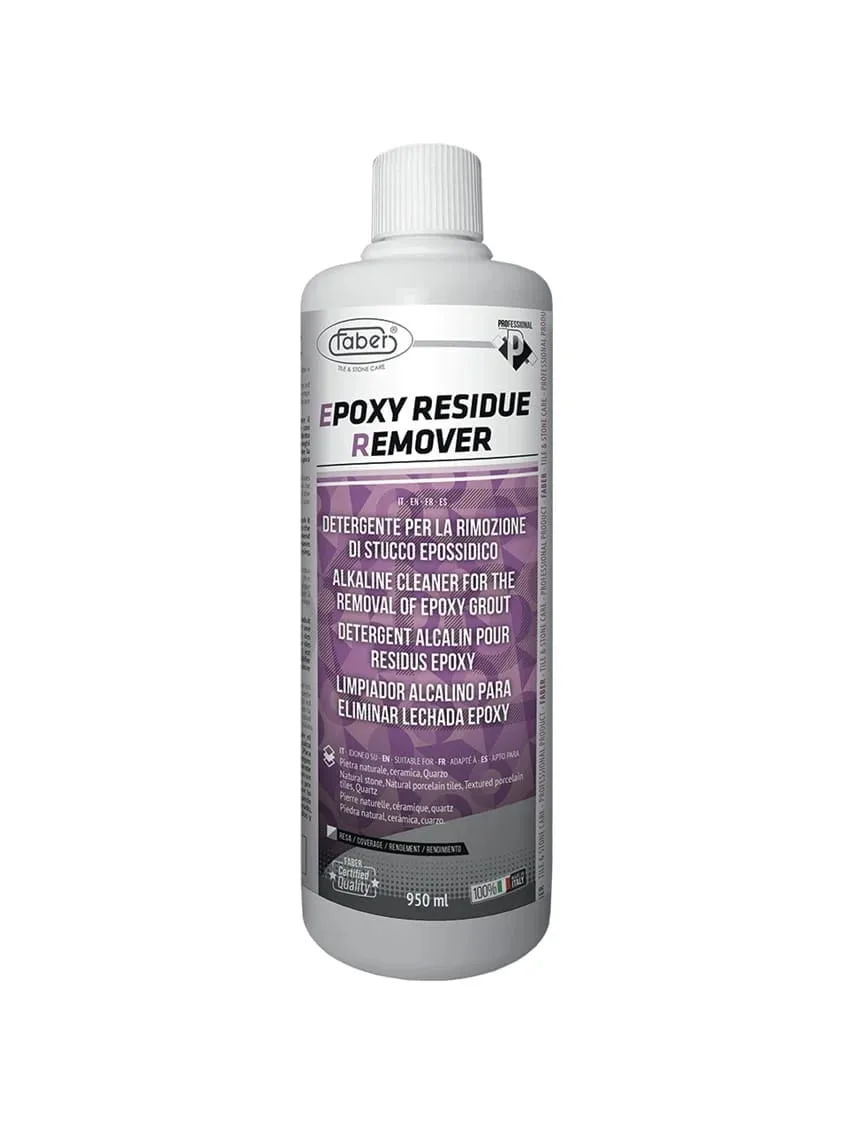
Faber Epoxy Residue Remover sidesteps that. It’s an alkaline cleaner — acid-free — so it dissolves grout haze, epoxy and sealant film and adhesive residue while staying safe on marble and limestone, and it handles the awkward textures (structured, matte and micro-finished porcelain) that trap residue. Short dwell, ten to thirty minutes, agitate, rinse thoroughly. It’s the product every tiler needs on the van and most don’t carry until the first haze disaster teaches them to.

Epoxy Residue Remover bottle – alkaline cleaner that dissolves grout and epoxy films on stone, porcelain, terracotta, and ceramic surfaces.
Use Epoxy Residue Remover to tackle grout haze and stubborn epoxy residues—ideal for freshly installed stone and tile.


The golden rule, one more time

If you take nothing else from this guide, take this: acidic rust removers etch marble. Marble, limestone and travertine are always acid-sensitive. On those stones use Mar Gel Plus, never No Rug. When you don’t know what the stone is, treat any pale, polished surface as acid-sensitive and patch-test a hidden area first. That one decision, made correctly, is the line between a floor you’ve rescued and a floor you’ve damaged.

Technique that applies to every stain

Whatever the stain, the workflow is the same, and getting the process right matters as much as picking the product:

  • Clean and dry first. Remove surface dirt so the product contacts the stain, not the grime on top of it.
  • Patch-test. Always, on unknown or polished stone.
  • Apply generously and undiluted. These are gels and pastes designed to be laid on thick — a thin layer dries out and stops working.
  • Give it time, not force. If a stain resists, extend the dwell or repeat the treatment. Do not jump to a harsher chemical — that’s how surfaces get damaged. On stubborn or vertical stains, a poultice holds the product in place and stops it drying before it’s finished.
  • Rinse and inspect. Remove residue, rinse with clean water, let it dry fully, and only then judge the result — stone often looks darker when wet and clears as it dries.
  • Re-seal afterwards. This is the step everyone skips. Once you’ve stripped a stain out of porous stone, that stone is wide open to the next spill. A quality impregnating sealer closes the door so you’re not back doing the same job in six months.

An honest word: not every stain comes out

Part of being straight with people is admitting the limits. Some stains aren’t stains in the normal sense — they’re compounds that have migrated deep into the body of the material and chemically bonded there. The classic example is the dark rubber-backing marks left on Victorian tile by decades of old carpet underlay: the antioxidant compounds in the rubber have soaked in and oxidised inside the clay, and no surface treatment fully reaches them. For cases like that, the honest professional answer is a test panel, realistic expectations, and sometimes a colour-enhancing sealer to reduce the contrast rather than a promise to remove the mark entirely. If a supplier tells you every stain always lifts, they haven’t done enough floors.

That caveat aside, the six families above cover the overwhelming majority of what you’ll meet — and matched correctly, they lift cleanly.

One kit, every stain family

We built the Faber Complete Stain Removal Kit around exactly this framework: one product for each of the six stain families, spanning every chemistry class — neutral, acidic, alkaline, solvent and acid-free — with two dedicated rust removers so whatever the stone, you always have the safe option to hand. It’s the kit we’d want in our own van: no guessing, and nothing in it that can etch a floor you’ve been trusted with.

If you’re a trade business, open a trade account for your best pricing across the full Faber range.

Quick FAQ

Can I use one all-purpose stain remover for everything? Not well. “Colour,” “grease,” “rust” and “damp” are genuinely different chemistry problems — a colour-extraction gel won’t touch oil, and an oil solvent won’t lift rust. Matching the product to the stain family is what makes removal quick and reliable.

How do I know if my stone is acid-sensitive? If it’s marble, limestone or travertine, it is. If you’re unsure, assume any pale, polished natural stone is acid-sensitive and patch-test before using anything acidic.

Why does my rust remover keep failing on marble? Most likely it’s acidic and etching the marble rather than removing the rust — the dull mark you’re seeing may be etch damage, not the original stain. Switch to an acid-free rust remover made for calcareous stone.

Do I really need to reseal after removing a stain? Yes, on porous stone. Stripping the stain also strips protection, leaving the stone more absorbent than before. A fresh impregnating sealer stops the next spill becoming the next stain.

Should I go stronger if a stain won’t shift? No — go longer, or repeat. Extend the dwell time or do a second application. Escalating to harsher chemistry is the most common way people damage a surface they were trying to save.

Written by the team at HF Flooring Supplies — an official Faber Surface Care partner, drawing on years of hands-on stone and tile restoration. We work with these products on real floors, and we’re happy to help you match a product to your problem.

Posted on — Leave a comment

How to Clean Slate Floors: The Professional Guide to Cleaning, Restoring and Sealing Slate

Slate floor cleaned and sealed with Faber Neugel and Hidro 150 natural look impregnator

Slate is one of the most durable natural stones you can put on a floor. Laid correctly and maintained properly, a slate floor will outlast the building it sits in. But maintaining it properly is the key phrase. Most of the advice circulating online about cleaning slate floors is wrong in ways that cause slow, invisible damage — and by the time the floor looks noticeably worse, years of unnecessary wear have already been done.

This guide explains how professionals clean, restore and protect slate floors. It covers the products that actually work, the household products that cause long-term damage, and how to choose the right sealer finish for your slate.


Why Most Slate Cleaning Advice Gets It Wrong

Search “how to clean slate floor” and you will find dozens of guides recommending vinegar, washing up liquid, baking soda, or hydrogen peroxide. These are household products, and they are the wrong tools for slate.

Vinegar is acidic. Slate is predominantly composed of quartz and mica — minerals that are broadly acid-resistant — but almost all commercially available slate contains some calcite or dolomite. When these minerals contact acid, the reaction is microscopic but cumulative. Over months and years of vinegar cleaning, you get etching, loss of surface texture, and dulling that cannot be reversed without mechanical restoration. Welsh slate is among the most acid-resistant available, but even Welsh slate should not be cleaned with vinegar repeatedly.

Washing up liquid leaves a surfactant film on the floor. On a smooth surface this dries clear and looks clean. On slate, which has a textured cleft surface, the residue builds up in the natural fissures and low points of the stone. Over time it becomes a dirt trap. The floor starts looking dull and difficult to clean, even after washing — because the residue itself is attracting grime.

Baking soda is mildly alkaline and abrasive. The abrasive action is too light to cause visible scratching but is not appropriate for regular use on a natural stone surface that has been sealed.

The professional approach uses purpose-formulated stone cleaning chemistry. pH-neutral or mild-alkaline cleaners that are specifically designed not to leave residue, not to attack stone minerals, and not to strip sealers prematurely.


Understanding Slate Before You Clean It

Slate is a metamorphic rock formed under high pressure from clay minerals and volcanic ash. Its characteristic structure — the natural cleft surface, the layered appearance, the variation in tone — comes from the way it splits along planes of weakness during quarrying and cutting.

This structure means slate is more porous than it looks. The cleft surface has natural micro-channels and fissures that absorb liquids. An unsealed slate floor will stain easily. A poorly sealed floor will allow cleaning products to penetrate and leave residue. A correctly sealed floor is protected at depth, which means cleaning is easier and results last longer.

UK slate commonly used for flooring includes:

Welsh slate — quarried in North Wales, particularly around Penrhyn and Dinorwig. Dark blue-grey, very dense, among the finest natural slates available anywhere. Low porosity, high acid resistance.

Westmorland green slate — from Cumbria. A distinctive grey-green colour with strong cleft character. Slightly more porous than Welsh slate but still excellent for interiors.

Spanish slate — widely used, darker grey tones, generally consistent and well-suited to residential floors.

Indian black slate — popular for contemporary kitchens and bathrooms. Finer texture than traditional UK slates. Can have higher porosity depending on origin. Needs careful sealing.

Brazilian slate — dense, dark, fine-grained. Good acid resistance. Used extensively in commercial applications.

Knowing your slate type matters because porosity determines how much sealer you need and how frequently the floor should be maintained.


Routine Cleaning: The Right Product for Everyday Maintenance

For regular maintenance cleaning of a sealed slate floor, the correct product is a pH-neutral or mild-alkaline stone-specific detergent. It needs to clean effectively without stripping the sealer, without leaving residue, and without affecting the stone chemistry.

Faber Neugel is a professional daily cleaning detergent formulated specifically for natural stone. It is pH-neutral, rinses clean without residue, and is safe for use on sealed and unsealed stone surfaces including slate. It will not attack sealers, will not etch calcite-containing minerals, and will not leave the surfactant film that washing up liquid deposits in the texture of cleft slate.

For daily or weekly maintenance use, dilute Faber Neugel at the recommended rate, apply with a well-wrung mop, and rinse with clean water. For slate with a strong cleft surface, a soft brush used on the floor before mopping helps dislodge debris from the deeper fissures before the wet clean.

This is the routine that keeps a maintained slate floor looking consistent. Simple, repeatable, and chemically correct.


Deep Cleaning: Removing Built-Up Grime from Slate

Slate floors that have not been professionally cleaned for several years typically have a combination of problems: ingrained organic soil in the stone’s texture, residue from years of inappropriate cleaning products, and in some cases old wax or topical coating build-up that has trapped dirt beneath it.

A single mop with a neutral cleaner will not resolve these problems. A proper deep clean uses a stronger alkaline chemistry to break down organic soiling and lift it from the stone.

Faber 30 is a concentrated alkaline deep cleaner designed for heavy-duty cleaning of stone and tile floors. Applied diluted with a dwell time of 10 to 15 minutes before scrubbing and rinsing, it breaks down ingrained grease, organic grime, and soiling that has built up over years of normal use. It is safe for slate and does not damage stone surfaces or active sealers when used at the correct dilution.

For floors with a single disc machine or rotary scrubber, Faber 30 used with a medium scrub pad delivers a thorough clean in a single pass that would take multiple manual cleaning sessions to achieve.

For floors with wax or topical sealer build-up that has become discoloured and trapped dirt, Faber Dec 21 is the appropriate stripping product. It is a solvent-based wax and treatment remover that breaks down old wax polish, synthetic sealer coatings, and other topical treatments. Used before Faber 30, the combination strips the floor back to bare stone and prepares it for re-sealing.

After a deep clean with Faber 30, always rinse thoroughly with clean water. Residual alkaline chemistry left on the floor can affect how subsequent sealers cure.


Removing Cement Haze and Grout Residue

Newly installed slate floors often have cement haze or grout residue across the surface. This is common after installation and can give the floor a dull, milky, or uneven appearance.

Faber Disycott is a concentrated acid-based post-installation cleaner formulated to remove cement film, grout residues, and inorganic deposits. Unlike household acidic cleaners, Disycott is formulated to react with mineral deposits rather than with the stone itself, and is safe for use on slate when applied correctly. Always test on an inconspicuous area first, particularly if you are unsure about the calcite content of your specific slate.

Apply Disycott diluted at the recommended rate, allow to dwell for 5 to 10 minutes watching carefully for any reaction with the stone surface, then scrub and rinse thoroughly with clean water. Neutralise with a clean water rinse before applying any sealer.


Sealing Slate: Choosing the Right Finish

Once the floor is clean — whether from routine maintenance or a full deep clean and strip — it needs to be sealed correctly. The right sealer depends on the finish you want and the environment the floor is in.

There are three distinct approaches, and they produce noticeably different results.

Natural Look: Hidro 150

Faber Hidro 150 is a water-based impregnating sealer that penetrates the slate and provides stain protection without altering the appearance of the stone. The floor looks exactly as it did when dry — the same colour, the same texture, the same natural character — but is protected against water and oil-based staining from within.

This is the right choice if you want the slate to look as natural as possible. Hidro 150 is breathable, which matters for floors installed over older substrates where moisture movement needs to be accommodated. It is also colourless and does not add any sheen or wet-look effect.

Application is straightforward: apply to a clean, dry surface using a microfibre pad or brush, allow to penetrate, remove any excess before it dries on the surface, and allow to cure fully before use.

Colour-Enhanced Look: Faber Wet Look Eco

Faber Wet Look Eco is a water-based colour-enhancing impregnating sealant. It deepens and enriches the natural colours of the slate — the dark blues, the greens, the greys — giving the floor the appearance it has immediately after wetting. It produces a subtle sheen without leaving a surface film.

This is the popular choice for slate floors where the owner wants the colours to look their best. Indian black slate particularly benefits from a colour-enhancing sealer — the stone looks striking when enhanced but flat when sealed with a natural-look product. Welsh slate and Westmorland green also respond well to Wet Look Eco, bringing out the depth of colour that makes these stones so distinctive.

Wet Look Eco is water-based, which means lower VOC than solvent alternatives and easier application in occupied properties.

Maximum Colour Enhancement: Faber P147 Plus

Faber P147 Plus is a solvent-based colour-enhancing impregnating sealer providing the most pronounced colour deepening of the three options. Where Wet Look Eco gives a subtle enrichment, P147 Plus gives a bold, vibrant enhancement — the slate looks as though it has just been thoroughly wetted. The finish is matt rather than glossy, so there is no surface sheen, but the colour depth is significantly greater.

P147 Plus is the professional contractor’s choice for restoration projects where the slate has faded over years of use and the client wants the floor returned to how it looked when originally installed. It provides excellent water and oil repellency and penetrates deeply into the stone rather than sitting on the surface.

Being solvent-based, P147 Plus requires good ventilation during application and appropriate drying time before the floor is brought back into use.

Which Sealer to Choose

Finish Product Best For
Natural, no colour change Faber Hidro 150 Light slates, conservation properties, where original look must be preserved
Subtle colour enhancement, water-based Faber Wet Look Eco Most residential slate floors, Indian black, Westmorland green
Strong colour enhancement, solvent-based Faber P147 Plus Restoration projects, faded floors, Welsh slate, where maximum colour depth is needed

How Often Should You Seal Slate Floors?

The honest answer is that it depends on the sealer used, the porosity of the slate, and the amount of foot traffic the floor receives.

A simple water test will tell you when re-sealing is needed. Drop a small amount of water onto the floor surface. If it beads immediately and stays on the surface, the sealer is active. If it slowly absorbs into the stone and darkens it, the sealer has been depleted in that area and the floor needs re-sealing.

In a residential hallway with normal foot traffic, a quality impregnating sealer applied correctly will typically last three to five years before the water bead test shows depletion. In commercial environments or areas of very heavy use, annual re-sealing may be appropriate.


Slate Floor Maintenance Summary

Daily: Dust mop or sweep to remove grit and debris before it can be ground into the stone.

Weekly: Damp mop with Faber Neugel at maintenance dilution. Wring the mop thoroughly — excessive moisture left standing on slate is unnecessary and counterproductive.

Annually or as needed: Deep clean with Faber 30 at higher concentration to remove built-up soiling. Follow the water bead test to determine whether re-sealing is required.

After installation or full restoration: Strip any existing treatments with Faber Dec 21 if needed. Remove cement haze with Faber Disycott. Deep clean with Faber 30. Seal with the appropriate Faber sealer for your chosen finish.

Frequently Asked Questions

Can you use vinegar to clean slate floors? No. Vinegar is acidic and will react with calcite or dolomite minerals present in most commercial slate. Repeated use causes etching, surface dulling, and colour change that cannot be corrected without mechanical restoration. Always use a pH-neutral or mild-alkaline stone-specific cleaner such as Faber Neugel.

What is the best cleaner for slate floors? For routine maintenance on a sealed slate floor, Faber Neugel is the professional standard — pH-neutral, no residue, safe for stone and sealers. For deep cleaning or removal of built-up grime, Faber 30 concentrated alkaline cleaner is the appropriate product.

Why does my slate floor look dull after cleaning? Dullness after cleaning typically indicates one of three things: surfactant residue from inappropriate cleaning products building up in the stone’s texture; sealer depletion meaning the floor needs re-sealing; or etching damage from acidic cleaners used over time. A professional deep clean with Faber 30 followed by re-sealing with the appropriate Faber impregnator will restore the appearance in most cases.

How often should you seal slate floors? Perform the water bead test regularly. If water absorbs into the stone rather than beading on the surface, the sealer has depleted and re-sealing is needed. In most residential settings this is every three to five years depending on foot traffic and the sealer used.

What is the difference between Wet Look Eco and P147 Plus for slate? Both are colour-enhancing impregnating sealers. Wet Look Eco is water-based and gives a subtle colour deepening. P147 Plus is solvent-based and gives a stronger, more pronounced colour enhancement. For most residential slate floors Wet Look Eco is appropriate. For restoration projects where the slate has faded significantly, P147 Plus gives the more dramatic result.

Is bleach safe to use on slate floors? No. Bleach (sodium hypochlorite) is highly alkaline and will damage slate sealers, cause colour changes, and attack the organic matter in the stone’s natural variation. Never use bleach on natural stone of any type.

Can you use a steam cleaner on slate floors? Steam cleaning is not recommended for sealed slate floors. The high heat and moisture penetrate the stone and can cause delamination of the sealer, force moisture into the substrate, and damage the adhesive bond on some installations. On unsealed slate in the right circumstances professional steam cleaning can be effective, but it should be followed immediately by re-sealing.


All Faber products mentioned in this guide are available from HF Flooring Supplies with free UK delivery on orders over the threshold. HF Flooring Supplies is a selected UK partner for Faber Chimica.
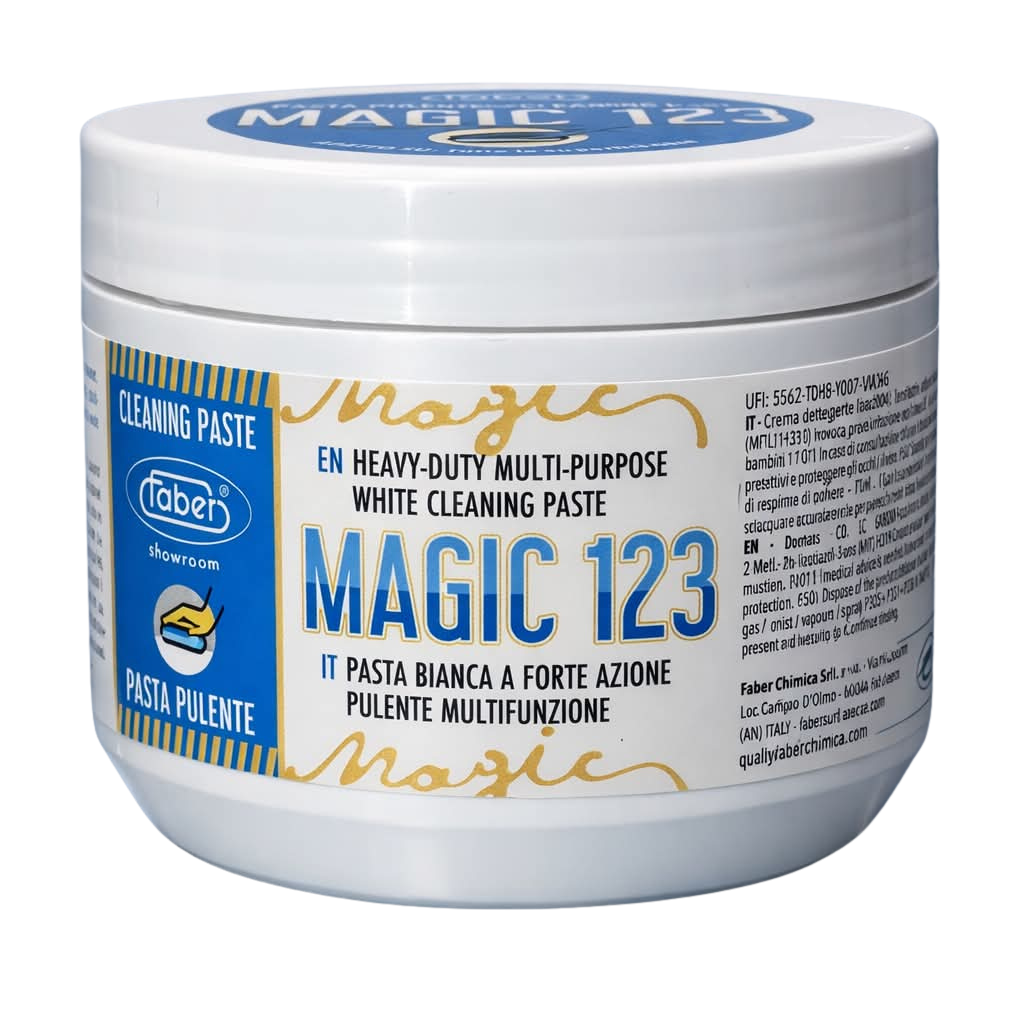
Posted on — Leave a comment

Is Porcelain Really “Bombproof”? The Truth About Acids and Etching

orcelain floor tile with an acid etch mark, illustrating that porcelain is not bombproof against all acids

Porcelain has a reputation. Ask around a showroom or a building site and you’ll hear the same word again and again: bombproof. Hard-wearing, stain-proof, acid-proof, basically indestructible. And to be fair, porcelain is one of the toughest surfaces you can put down. But “tough” and “invincible” are not the same thing — and the gap between them is where a lot of avoidable damage happens.

The truth is that some acids can and do etch porcelain. Knowing which ones, why it happens, and where the real risk lies is the difference between a floor that lasts decades and one that’s permanently dulled by a single bad cleaning decision.

Why porcelain earned its reputation

Porcelain’s strength comes from how it’s made. The clay body is fired at very high temperatures until the particles fuse — a process called vitrification — producing an extremely dense, low-porosity material. That density is the whole point: very little water gets in, very few stains can take hold, and most everyday chemicals simply sit on the surface and wipe away.

This is genuinely why porcelain shrugs off the things that would wreck natural stone. Spill lemon juice or vinegar on polished marble and you’ll get a dull etch mark within minutes, because the acid reacts with the calcium carbonate in the stone. Porcelain has no calcium carbonate to attack, so those same kitchen acids usually do nothing at all. That real-world resilience is where the “bombproof” myth comes from — it’s an exaggeration built on a genuine strength.

So where does the myth break down?

In two places: the type of porcelain, and the type of acid.

Not all porcelain surfaces are equal

The first thing to understand is that “porcelain” is not one single surface. The body of the tile and the finish on top of it behave very differently.

Glazed porcelain has a thin, glass-like layer fused to the surface. That glaze is essentially a coating, and it carries most of the look — the colour, the pattern, the sheen. It’s also the part most vulnerable to chemical attack. Corrosive cleaners used regularly can dull, cloud, or roughen a glaze long before they’d ever touch the dense body underneath. Crucially, once a glaze is etched, you can’t repolish it the way you can grind and restore natural stone — the damage is permanent, and the only fix is replacing the tile.

Unglazed and full-bodied porcelain has no separate glass layer; the colour runs through the whole tile. These are more chemically robust on the surface, but because the exposed body can be slightly more porous than a glaze, aggressive acids have a different route to cause trouble over time.

The practical takeaway: the more decorative and high-gloss the surface, the more you should respect what you’re putting on it.

Not all acids behave the same

Here’s the part that surprises people. The everyday household acids — citric (lemon, vinegar), acetic, and even hydrochloric to a large degree — are well tolerated by quality porcelain. The tile body stays structurally intact under normal exposure. This is exactly why porcelain feels bombproof in a domestic kitchen.

But one acid is in a completely different league: hydrofluoric acid (HF). And it’s the exception that destroys the whole “acid-proof” claim.

How hydrofluoric acid actually etches porcelain

To understand why HF is special, you have to look at what porcelain is made of chemically. The hardness and density of porcelain come largely from silica — silicon dioxide — locked into a glassy, vitrified structure. Almost every common acid leaves that silica network alone. That’s the source of porcelain’s chemical stability.

Hydrofluoric acid is the one acid that attacks silica directly. The fluoride reacts with the silicon-oxygen structure and breaks it down, converting the solid silica into soluble compounds that wash away. In plain terms: HF doesn’t just sit on the surface — it dissolves it.

The result is microscopic. The acid eats into the surface and leaves behind tiny pits, valleys, and ridges where solid, smooth material used to be. On a glazed tile it can etch straight through the glaze and expose the more porous body beneath. This isn’t a stain or a film you can scrub off — it’s a permanent change to the structure of the surface itself.

This effect is so reliable that it’s used deliberately. Anti-slip treatments for tiled floors are frequently HF-based: the acid roughens the surface on purpose to increase grip. Porcelain refinishers use it to “key” a surface so a new coating will stick. The same chemistry that makes HF a useful industrial tool is exactly what makes it catastrophic when it shows up uninvited in a cleaning product.

Why this matters in the real world

You’re not likely to splash hydrofluoric acid around by accident at home. But HF and related fluoride compounds (such as ammonium bifluoride) turn up in places people don’t expect — most notably in some heavy-duty rust removers, certain aluminium and alloy wheel cleaners, some “tough” industrial descalers, and a number of aggressive multi-surface cleaners marketed on the strength of how powerful they are.

The danger is precisely that porcelain’s “bombproof” reputation makes people careless. Someone reaches for the strongest cleaner on the shelf to shift a stubborn mark, assumes porcelain can take anything, and unknowingly applies a fluoride-based product. The etch that follows is permanent, and no amount of polishing brings it back.

A few principles protect you:

  • Read the active ingredients. Be cautious with anything listing hydrofluoric acid, ammonium bifluoride, or fluoride compounds. These are the genuine threat to porcelain — far more than the citric or acetic acids people usually worry about.
  • “Stronger” is not “safer for the job.” The most aggressive product on the shelf is often the wrong choice. Matching the cleaner to the surface beats reaching for maximum strength every time.
  • Respect the glaze. High-gloss and decorative glazed surfaces are the most vulnerable. Treat them with more care than a full-bodied technical tile.
  • Spot-test in a hidden area. If you’re ever unsure about a cleaner, test it somewhere out of sight first. A small test patch is cheaper than a replaced floor.
  • Routine cleaning should be gentle. Day to day, porcelain needs far less than people assume. A suitable pH-balanced or correctly specified cleaner handles the vast majority of jobs without any risk.

The kinds of products to watch for

You won’t find hydrofluoric acid sitting on a supermarket shelf labelled as such, and most general-purpose cleaners are perfectly safe. The risk lives in a handful of specialist, heavy-duty product categories where fluoride compounds are used precisely because they’re aggressive:

  • Alloy and aluminium wheel cleaners. Some of the stronger “acid” wheel cleaners use fluoride compounds to cut through brake dust and oxidation. These are a common source of accidental HF exposure in domestic and trade settings alike.
  • Heavy-duty rust and scale removers. Certain industrial-grade rust removers and metal restorers rely on fluoride chemistry to break down stubborn deposits.
  • Aggressive masonry, brick and stone cleaners. A number of “professional strength” or “builder’s” acid cleaners used to remove cement haze, efflorescence, or mortar residue contain hydrofluoric acid or bifluorides — and these get used near or on tiled surfaces.
  • Some industrial descalers and glass-etching products. Anything specifically designed to etch glass is, by definition, attacking silica — exactly the same mechanism that damages porcelain.

The unifying theme is that these are all specialist products sold on the strength of how powerful they are. The marketing that makes them appealing (“dissolves anything,” “professional strength”) is the same marketing that should make you check the label before it goes anywhere near porcelain.

Names to look for on the label

Product names and formulations change, so the only reliable check is the ingredients list or safety data sheet (SDS). Treat a product with real caution if you see any of these:

  • Hydrofluoric acid
  • Ammonium bifluoride (also written as ammonium hydrogen fluoride)
  • Ammonium fluoride
  • Sodium bifluoride

If any of those appear, assume the product can permanently etch porcelain and keep it well away from your floors — regardless of what the front of the bottle promises. Reading the label this way protects you against any product, including ones not yet on the market.

The honest verdict

Porcelain is exceptional — dense, durable, and far more chemically resistant than almost anything else you’ll put on a floor. It genuinely does resist the acids most people encounter day to day. That part of its reputation is earned.

But “bombproof” is marketing, not chemistry. The silica that gives porcelain its strength has one clear weakness, and hydrofluoric acid exploits it completely. Understanding that single exception is what separates people who maintain porcelain confidently from those who damage it by trusting a myth.

Tough as it is, porcelain still rewards knowing what you’re cleaning it with. Choose the right product, respect the surface, and it really will last a lifetime.

Posted on — Leave a comment

Faber Hidro 150 — The Complete Guide to Professional Stone Sealing, the Science Behind It, and Why Not All Sealers Are Equal

The stone sealer guide

When a beautiful natural stone surface gets laid or installed — marble in a hallway, travertine in a kitchen, limestone flags in a period farmhouse, a granite worktop in a newly fitted kitchen — the question of how to protect it properly is one of the most important decisions the homeowner or contractor will make. Get it right and that surface will look exceptional and be easy to maintain for years. Get it wrong and the stone will stain, absorb oils and moisture, and deteriorate in a way that is expensive and sometimes impossible to reverse.

The market for stone sealers is not short of options. But understanding what separates a genuinely professional sealer from a basic one requires looking beyond the label and understanding a little of the chemistry involved. This guide explains exactly what Faber Hidro 150 is, how it works at a scientific level, why that matters in practice, and what to look for — and look out for — when choosing a stone sealer in the UK.

What is Faber Hidro 150?

Faber Hidro 150 is a professional grade water based impregnating stone sealer made by Faber Chimica, an Italian surface care manufacturer with decades of formulation expertise behind their professional product range. Its intended use, as stated on its safety data sheet, is as a water based stain-proof impregnator for natural stone and tile surfaces.

It is one of the few professional grade stone impregnators that carries independent food contact certification — making it suitable not just for floors but for kitchen worktops, dining tables and food preparation surfaces where other sealers are entirely unsuitable.

Faber Hidro 150 is available in the UK from HF Flooring Supplies in 1 litre and 5 litre sizes with next working day delivery on orders placed before 2pm Monday to Friday.

What Does Impregnating Actually Mean?

The term impregnating sealer is used widely in the stone care industry but it is worth understanding precisely what it means — and more importantly what it does not mean.

An impregnating sealer penetrates below the surface of the stone and provides protection from within the pore structure rather than forming a film or coating on top of the stone surface. This is fundamentally different from a surface sealer or topcoat, which sits on the stone and can peel, scratch, dull and require stripping and reapplication over time.

A good impregnating sealer leaves the stone looking natural — no surface sheen, no plastic appearance, no change to the texture underfoot. The stone looks and feels like stone. It just repels water and oil rather than absorbing them.

However — and this is critical — not all impregnating sealers are equal. The term describes the delivery method, not the quality of the chemistry doing the protecting. What matters enormously is what active ingredient is being delivered into those pores and what it does once it gets there. And equally important — whether the carrier vehicle actually gives the active ingredient enough time to get there at all.

The Chemistry That Makes Hidro 150 Different

The active sealing ingredient in Faber Hidro 150 is tripotassium propylsilanetriolate — a professional grade organosilane compound. This is transparently disclosed on the product safety data sheet at a concentration of 1-1.5%. Understanding what this does, and why it matters, requires a brief explanation of how stone sealing works at a molecular level.

The pore structure of natural stone

Natural stone — marble, limestone, travertine, granite, sandstone, slate — is a porous material. Even stone that appears smooth and dense to the naked eye contains a network of microscopic pores and capillaries running through its structure. These pores are what make unsealed stone vulnerable to staining — liquids, oils and contaminants are drawn into them by capillary action and become trapped within the stone.

The walls of these pores are covered in hydroxyl groups — chemical attachment points on the stone surface at a molecular level. These hydroxyl groups are reactive, and this reactivity is exactly what professional organosilane chemistry exploits.

What happens when Hidro 150 penetrates the stone

When Hidro 150 is applied to the stone surface, its water based carrier allows the active ingredient to penetrate into the pore structure. Once inside the pores, the curing process begins.

The tripotassium propylsilanetriolate undergoes hydrolysis — reacting with moisture present in the stone and in the atmosphere — to generate reactive silanol groups. These silanol groups then react with the hydroxyl groups on the pore walls, forming strong covalent Si-O-Si bonds. These are siloxane bonds — the same type of chemical bond that gives quartz and silica their structural integrity.

The result is that the active ingredient becomes chemically bonded to the walls of the pores themselves — not deposited in the middle of the pore, not sitting as a film, but covalently grafted to the actual surface of the pore walls throughout the depth of penetration.

Simultaneously, the silanol groups on adjacent active ingredient molecules react with each other — crosslinking to form a continuous polymer network that lines the pore walls from the inside. This crosslinked network is the hydrophobic and oleophobic barrier that repels water and oil.

Why this matters in plain terms

Think of the pores in your stone as a network of tiny tunnels running through the material. Hidro 150 does not block those tunnels — it lines the walls of every tunnel with a permanent water and oil repellent coating that is chemically welded in place at a molecular level.

Because the protection is on the pore walls rather than blocking the pore itself, the stone remains breathable. Air and water vapour can still move freely through the pore structure — important for moisture management in natural stone, particularly in older properties, ground floor installations and surfaces over underfloor heating systems. But liquid water and oil encounter the hydrophobic lining and bead up rather than being absorbed.

This is fundamentally different from a sealer that simply deposits a physical barrier of dried material in the pores. A deposited barrier can be worn away, dissolved or displaced over time. A chemically crosslinked organosilane network that is covalently bonded to the stone substrate is part of the stone’s pore structure — and it is significantly more durable and longer lasting as a result.

The paint on a wall versus the dye in fabric

A useful way to think about the difference between a basic deposited sealer and professional organosilane chemistry:

You could paint a piece of fabric red. The paint sits on the surface, looks right initially, but cracks, peels and wears away over time. The fabric underneath was never changed.

Or you could dye it red. The dye penetrates the fibres and chemically bonds with them. The colour becomes part of the fabric itself. It does not peel, it does not sit on top — it is in there.

That is the difference between a basic deposited sealer and what tripotassium propylsilanetriolate does inside the pores of your stone. One coats. The other bonds.

Why the Carrier Matters as Much as the Active Ingredient

There is an aspect of stone sealer performance that almost nobody in the consumer market discusses but that makes a significant practical difference to how well a sealer actually works — the evaporation rate of the carrier solvent.

For an impregnating sealer to do its job properly, the carrier — the liquid vehicle that transports the active ingredient into the stone — needs to remain in liquid form long enough to carry that active ingredient down into the pore structure to a meaningful depth. The active ingredient is then deposited and bonded within the pore network as the carrier evaporates off.

If the carrier evaporates too quickly, the active ingredient never makes it deep into the stone. It gets deposited at or near the surface as the carrier flashes off, rather than being distributed throughout the pore structure where it can provide genuine long term protection. The result looks like impregnation but functionally behaves more like a superficial surface deposit.

The fast evaporating solvent problem

Isopropyl alcohol — a solvent used as the primary ingredient in some stone sealers at concentrations as high as 92% — has a flashpoint of just 12°C. At a normal UK room temperature of around 20°C you are already 8 degrees above that flashpoint. Isopropyl alcohol is a fast evaporating solvent under any conditions, and at typical UK indoor temperatures it volatilises rapidly from the moment it contacts the stone surface.

This creates a fundamental problem for penetration. The carrier is flashing off quickly — potentially before the active ingredient has had the opportunity to be carried to any meaningful depth within the pore structure. What you are left with is likely a predominantly surface level deposit of whatever active ingredient is present, rather than the deep impregnation the product claims to deliver.

The situation is compounded in warmer conditions — a sun warmed stone patio on a summer day, underfloor heating running beneath a kitchen floor, a warm room in a well heated British home. The higher the surface temperature above the flashpoint, the faster the alcohol evaporates and the shorter the penetration window becomes.

Why water based chemistry has a fundamental advantage here

Water has a boiling point of 100°C and a significantly lower evaporation rate than isopropyl alcohol at normal room temperatures. A water based sealer carrier remains in liquid form at the stone surface for considerably longer than a fast evaporating alcohol solvent — giving the active ingredient the dwell time it needs to penetrate properly into the pore structure before the carrier evaporates.

This is one of the genuinely underappreciated practical advantages of water based professional sealers. The slower evaporation rate of water as a carrier is not a limitation — it is a feature. It is what allows the active ingredient to be delivered where it actually needs to be.

Faber Hidro 150’s water based carrier stays liquid at the stone surface long enough for the tripotassium propylsilanetriolate active to penetrate into the pore structure, react with the pore walls, and begin the crosslinking and bonding process that delivers genuine long lasting protection throughout the depth of the stone.

In plain terms

If your carrier evaporates faster than your active ingredient can sink into the stone, you are not impregnating the stone — you are coating the surface of it. And a surface deposit, however it got there, will never perform as well or last as long as chemistry that has genuinely penetrated and bonded within the stone’s pore structure.

The carrier is not just packaging. It is a fundamental part of how well the sealer actually works.

What the Safety Data Sheet Tells You

For anyone who wants to verify the quality of a stone sealer before buying it, the safety data sheet is the most reliable source of information available. SDS sheets are legal documents and must accurately reflect a product’s composition.

The Faber Hidro 150 SDS is transparent about its formulation. The active sealing ingredient — tripotassium propylsilanetriolate — is listed at 1-1.5% concentration. The carrier is predominantly water, with isopropanol present at only 1-1.5% and methoxypropanol at less than 0.1%. The product is explicitly classified as incombustible, carries no transport hazard classification, and requires no UN number for shipping — entirely consistent with a water based formulation presenting minimal physical hazard.

The hazard classification is modest — signal word Warning, not Danger — covering eye and skin irritation only, consistent with the slightly alkaline pH of the product.

This transparency is worth noting. Professional manufacturers with genuine active chemistry are not shy about disclosing it — the active ingredient is their competitive advantage and the SDS reflects it clearly.

What to look for in any stone sealer SDS:

  • Is the active sealing ingredient named and identified?
  • What is it and what concentration is it present at?
  • What is the carrier — water based or predominantly solvent?
  • What is the flammability classification?
  • What transport hazard classification does it carry?
  • What signal word does it carry — Warning or Danger?

A sealer that is predominantly solvent carrier with an undisclosed or absent active ingredient in the SDS raises questions that are worth asking before application to an expensive natural stone surface. High solvent content with no identifiable professional active chemistry suggests either a very low active concentration, a basic commodity active, or both. And as discussed, a fast evaporating solvent carrier raises serious questions about whether meaningful penetration is actually being achieved regardless of what the active ingredient is.

If there was genuinely impressive sealing technology in a product, you would expect to see it on the SDS. Professional manufacturers like Faber are proud of their active chemistry — they do not hide it.

The Safety Advantage of Water Based Chemistry

Stone sealers are most commonly applied in kitchens and bathrooms — enclosed domestic spaces that frequently contain potential ignition sources. Gas hob ignition systems, extractor fan motors, underfloor heating controls — all common in the UK homes and kitchens where stone sealers get applied.

A sealer with a flashpoint of 12°C — classified as a highly flammable liquid — presents a genuine fire risk in these environments. The vapours from a highly flammable solvent based product are heavier than air, travel at ground level and can ignite at a considerable distance from the point of application.

Faber Hidro 150 is explicitly classified as incombustible on its SDS. It carries no flammability classification, no flame pictogram and no highly flammable hazard statement. It can be applied safely in occupied domestic spaces without the fire risk associated with high solvent content products, and without the need for respiratory protection beyond sensible basic precautions.

For professional contractors working in occupied homes this also has very practical implications — managing ignition sources when applying a highly flammable product in a client’s kitchen is simply not a concern with a water based formulation.

Food Safe Certified — Why This Matters

Faber Hidro 150 is independently certified safe for food contact. This certification covers kitchen worktops, dining tables and food preparation surfaces — the exact environments where natural stone is increasingly installed in UK homes.

This is not a minor detail. Consider what it means in practice:

The worktop you seal with a stone impregnator is the same surface you prepare food on. Chopping vegetables, rolling pastry, placing freshly washed fruit — all happening on a surface that has been treated with a stone sealer. The question of whether that sealer is certified safe for food contact is not an abstract one.

A sealer that is predominantly isopropyl alcohol with an undisclosed active ingredient is almost certainly not food safe certified. Isopropyl alcohol is not a food safe substance and a product carrying a Danger signal word with a highly flammable classification and undisclosed active chemistry is not one that any reputable certification body would certify for food contact surfaces.

Hidro 150’s food contact certification is independently verified and covers the surfaces where it matters most. For kitchen worktop applications specifically — marble, granite, limestone, quartz agglomerate — this certification should be a baseline requirement, not a premium feature.

Which Surfaces Does Hidro 150 Protect?

Faber Hidro 150 is suitable for use on a wide range of natural stone and tile surfaces commonly found in UK homes and commercial properties:

  • Marble
  • Limestone — including traditional British limestone flags and Cotswold stone
  • Travertine
  • Granite
  • Sandstone — including Yorkshire sandstone and buff sandstone
  • Slate — including Welsh slate and reclaimed slate flooring
  • Basaltina and porphyry
  • Quartzite
  • Agglomerate stone — marble-concrete, marble-resin and quartz-resin agglomerates
  • Terracotta
  • Natural stone worktops — kitchen and bathroom
  • Stone hearths and fireplace surrounds
  • External stone paving, paths and steps

Always test on a small inconspicuous area first, particularly on highly polished or sensitive surfaces.

sandy limestone sealed with Faber Hidro 150

Natural Tone or Colour Enhancement — Hidro 150 vs P147 Plus

Faber Hidro 150 preserves the natural dry appearance of the stone — once cured and dry the stone looks exactly as it did before sealing, with no darkening, no sheen and no change to the surface appearance. This is the preferred finish for most natural stone applications and the appropriate choice where the natural character and colour of the stone is the point.

For applications where a richer, deeper appearance is desired — bringing out the natural colour tones and warmth of the stone — Faber P147 Plus is the alternative. P147 Plus uses a similar professional impregnating approach but delivers a colour enhancing effect that enriches the stone’s natural tones without producing a surface gloss. It is particularly popular on sandstone, travertine and limestone where the warm earthy colour tones of the stone are a key part of the appeal.

Both products provide professional impregnating protection. The choice between them is purely a matter of the desired finish.

How to Apply Faber Hidro 150

Surface preparation The stone surface must be thoroughly clean and completely dry before application. Any existing soiling, grease, mineral deposits, grout haze or old sealer residues must be removed first. Faber 30 is the recommended deep cleaning product for pre-seal preparation — applying Hidro 150 over a contaminated surface will lock contamination in and compromise both penetration and performance.

Surface temperature must be between +5°C and +40°C. Do not apply in direct sunlight, on surfaces hot to the touch, or when there is any risk of rain, frost, mist or high humidity — particularly important for outdoor applications.

Application Apply Hidro 150 generously and evenly to the dry surface using a brush, lambswool applicator, roller or cloth. Ensure complete and even coverage across the whole surface.

The product is fast drying and normally leaves no residues. On low absorbency surfaces, slight residues may appear — simply wipe off with a clean dry cloth before they dry.

For highly absorbent surfaces, apply a second coat no less than 45 minutes after the first.

Coverage and drying Coverage is 15-20 m² per litre — efficient for a professional grade product. The surface dries within one hour of application and is ready for use after 2-3 hours.

Important Always ensure the surface is fully dry and the product fully cured before applying any maintenance cleaner or subsequent treatment. If applying over a penetrating water repellent primer as a first stage, wait for the primer to dry completely before applying Hidro 150.

Faber Hidro 150 in the Stone Care Programme

Hidro 150 sits in the middle of a complete professional stone care programme:

Before sealing — deep clean with Faber 30 Remove all ingrained soiling, grease and mineral deposits to ensure the sealer penetrates clean open stone and performs as designed. This step is not optional — a sealer applied over a contaminated surface will underperform and the contamination will be locked into the stone permanently.

Sealing — Faber Hidro 150 or P147 Plus Apply the appropriate sealer for the desired finish. Allow to cure fully before returning to use.

Ongoing maintenance — Faber Neugel or Faber Algafloor Maintain the sealed surface with a pH neutral cleaner that cleans effectively without attacking or degrading the sealer. Using an inappropriate cleaner — particularly high concentration alkaline cleaners or acidic cleaners — will shorten the life of the sealer significantly.

Periodic resealing Even the best impregnating sealer will require reapplication over time as the protection gradually diminishes with use and cleaning. The frequency depends on traffic levels, the type of stone and the cleaning products used in maintenance. A properly applied Hidro 150 treatment on a well maintained domestic surface should provide several years of protection before resealing is required.

Where to Buy Faber Hidro 150 in the UK

Faber Hidro 150 is available from HF Flooring Supplies in 1 litre and 5 litre sizes with next working day delivery across mainland UK on orders placed before 2pm Monday to Friday.

As a selected UK Faber partner, HF Flooring Supplies stocks the full Faber professional range including cleaners, sealers, polishing products, stain removers and specialist surface treatments for every stone and tile care application. Trade accounts are available for flooring professionals, stone restoration specialists and cleaning contractors across the UK.

Frequently Asked Questions About Faber Hidro 150

What is Faber Hidro 150? Faber Hidro 150 is a professional grade water based impregnating stone sealer. Its active ingredient is tripotassium propylsilanetriolate, a professional organosilane compound that chemically bonds with the stone substrate during curing to provide long lasting water and stain resistance. It is independently certified safe for food contact.

How does Hidro 150 work? Hidro 150 penetrates into the pore structure of the stone. The organosilane active ingredient hydrolyses in the presence of moisture and forms covalent chemical bonds with the hydroxyl groups on the pore walls, while simultaneously crosslinking with adjacent molecules to form a continuous hydrophobic network. The result is protection that is chemically bonded to the stone rather than simply deposited in it.

Is Hidro 150 food safe? Yes — Faber Hidro 150 is independently certified safe for food contact. It is suitable for use on kitchen worktops, dining tables and food preparation surfaces. This certification makes it one of the few professional grade stone impregnators appropriate for kitchen worktop applications where food contact is a genuine consideration.

Will Hidro 150 change the appearance of my stone? No — Hidro 150 preserves the natural dry appearance of the stone. Once cured there is no visible change to the surface, no darkening and no surface sheen. It will not yellow over time. If you want a colour enhancing effect that deepens the natural tones of the stone, Faber P147 Plus is the alternative.

Is Hidro 150 safe to use indoors? Yes — Hidro 150 is water based and explicitly classified as incombustible on its safety data sheet. It carries no flammability classification and can be applied safely in enclosed domestic spaces including kitchens and bathrooms without the fire risks associated with high solvent content sealers.

How long does Hidro 150 take to dry? The surface dries within one hour of application and is ready to return to use after 2-3 hours.

What coverage does Hidro 150 give? Coverage is 15-20 m² per litre depending on the absorbency of the surface. On highly absorbent surfaces a second coat may be required after 45 minutes.

Does Hidro 150 need to be applied before or after grouting? Hidro 150 should be applied after grouting and after the grout has fully cured. Ensure the surface is thoroughly cleaned with Faber 30 or an appropriate grout residue cleaner before sealing to remove any grout haze or residue.

How long does Hidro 150 last? The longevity of any impregnating sealer depends on traffic levels, the type of stone and the cleaning products used in maintenance. Using a pH neutral maintenance cleaner such as Faber Neugel or Algafloor will significantly extend the life of the sealer. On a well maintained domestic surface, a properly applied Hidro 150 treatment should provide several years of protection before resealing is required.

Can Hidro 150 be used on kitchen worktops? Yes — and its food contact certification makes it specifically appropriate for this application. It provides stain resistance against the oils, acids and liquids that kitchen worktops are regularly exposed to, and its invisible finish preserves the natural appearance of the stone.

What is the difference between Hidro 150 and P147 Plus? Both are professional impregnating sealers. The difference is purely aesthetic — Hidro 150 preserves the natural dry appearance of the stone while P147 Plus enhances and deepens the natural colour tones. The choice between them depends entirely on the finish you want.

Can Hidro 150 be used on external stone in the UK? Yes — Hidro 150 is suitable for both indoor and outdoor use including external stone paving, paths, steps and garden surfaces. Do not apply when there is risk of rain, frost or high humidity.

Where can I buy Faber Hidro 150 in the UK? Faber Hidro 150 is available from HF Flooring Supplies with next working day delivery across mainland UK. Available in 1 litre and 5 litre sizes. Orders placed before 2pm Monday to Friday are dispatched the same day.

What is the difference between Hidro 150 and a basic solvent based stone sealer? A basic solvent based stone sealer typically uses a fast evaporating alcohol carrier such as isopropyl alcohol at high concentration. At normal UK room temperatures, a carrier with a flashpoint of 12°C evaporates very rapidly from the stone surface — potentially before the active ingredient has had time to penetrate to a meaningful depth. Hidro 150 uses water as its primary carrier, which evaporates significantly more slowly and gives the professional organosilane active ingredient the dwell time needed to penetrate properly, react with the pore walls and form the chemically bonded crosslinked network that delivers genuine long lasting protection.

Final Thoughts

Faber Hidro 150 is not simply a stone sealer. It is a professionally engineered organosilane impregnating system that chemically bonds with the stone substrate at a molecular level, crosslinks within the pore structure, and delivers protection that is genuinely part of the stone rather than simply deposited in it.

It is water based and non-flammable. Its water carrier gives the active ingredient the dwell time to penetrate properly — something a fast evaporating solvent carrier cannot reliably deliver. It is transparent about its active chemistry on its safety data sheet. It is independently certified safe for food contact. It preserves the natural appearance of the stone. And it has been formulated by one of Italy’s leading professional surface care manufacturers with decades of expertise behind it.

For anyone serious about protecting natural stone in the UK — whether that is a newly laid limestone kitchen floor, a sandstone patio, a marble bathroom, a granite worktop, or a heritage property with original stone flagging — Hidro 150 is the professional choice.

Posted on — Leave a comment

Faber 30 — The Ultimate Guide to Professional Stone, Tile and Grout Cleaning in the UK

Faber 30 — The Ultimate Guide to Professional Stone, Tile and Grout Cleaning in the UK

Whether you’re a flooring professional preparing a surface for sealing, a cleaning contractor tackling a heavily soiled commercial space, or a homeowner trying to restore a tired natural stone floor, finding the right heavy duty cleaner is one of the most important decisions you’ll make. Use the wrong product and you risk damaging the surface, stripping existing sealers, or simply not getting the result you need. Use the right one and the job becomes significantly easier.

This guide covers everything you need to know about Faber 30 — what it is, what it does, which surfaces it works on, and which problems it’s specifically designed to solve.


What is Faber 30?

Faber 30 is a professional grade heavy duty alkaline degreasing cleaner made by Faber Chimica, an Italian surface care company with decades of formulation expertise behind their professional product range. It is designed for deep cleaning natural stone, ceramic, porcelain, and tile surfaces where standard maintenance cleaners simply aren’t strong enough.

Unlike basic alkaline cleaners that rely on raw caustic chemistry to remove soiling, Faber 30 uses a multi-action formulation that tackles several types of contamination simultaneously. This makes it significantly more effective on complex, heavily soiled surfaces than a standard high pH degreaser.

Faber 30 concentrated alkaline deep cleaner bottle for removing grease, grime, and tire marks from stone and tile floors

Faber 30 is available in the UK from HF Flooring Supplies with next working day delivery on orders placed before 2pm Monday to Friday.


What Makes Faber 30 Different From Other Heavy Duty Cleaners?

This is the question worth answering properly, because the difference matters.

Many heavy duty stone and tile cleaners are built around a simple formula — high pH sodium hydroxide combined with a basic solvent. That approach works to a point, but it is brute force chemistry. It attacks grease but does little else, and the corrosive nature of caustic-heavy formulations can cause problems on certain stone types and damage grout over time with repeated use.

Faber 30 takes a different approach. Its formulation combines three distinct mechanisms:

Sodium silicate — provides penetrating action that gets beneath ingrained soiling and physically lifts contamination that surface-level cleaning cannot reach. It also leaves a mild protective film on the surface after cleaning, which aids the next stage of treatment whether that is sealing, polishing or maintenance.

Tetrasodium EDTA — a chelating agent that binds to and breaks down mineral deposits and hard water salts as part of the cleaning process. Most alkaline cleaners do not address mineral contamination at all. Faber 30 tackles it simultaneously alongside grease and soiling. This is particularly valuable in the UK where hard water affects large parts of England, including the South East, Midlands and East of England.

Ethoxylated alcohol surfactants — a quality surfactant system that ensures contamination is properly lifted from the surface and removed rather than redistributed across it.

The result is a product that addresses grease, oil, ingrained soiling and mineral deposits in a single application — doing the work that would otherwise require multiple products and multiple passes.


What Problems Does Faber 30 Solve?

Heavily ingrained soiling on natural stone Natural stone is porous. Over time, without adequate sealing and maintenance, dirt, grease and general soiling penetrates below the surface where standard cleaners cannot reach it. Faber 30’s penetrating action gets beneath that ingrained contamination and lifts it out.

Greasy stone and tile floors in kitchens and commercial spaces Kitchen environments — both domestic and commercial — subject stone floors to constant grease and oil contamination. Standard maintenance cleaners are not formulated to deal with heavy grease loading. Faber 30 is specifically designed for this level of contamination.

Dull, lacklustre stone that has lost its appearance Stone floors that look dull and flat despite regular cleaning are often suffering from a build up of cleaning residues, mineral deposits from hard water, or ingrained soiling that has accumulated over time. A deep clean with Faber 30 before resealing or polishing removes that build up and gives the surface a clean base to work from.

Preparation before sealing This is one of Faber 30’s most important applications and one that professionals across the UK rely on heavily. Any sealer applied over a contaminated surface will lock that contamination in and perform poorly. Faber 30 provides the thorough deep clean needed before any impregnating sealer, surface sealer or polishing treatment is applied.

Black and stained grout lines Grout is highly porous and attracts soiling rapidly, particularly in kitchens and bathrooms. Faber 30’s combination of alkaline and chelating action is highly effective on discoloured and stained grout lines that standard tile cleaners will not shift.

Hard water and mineral deposit removal The UK has some of the hardest water in Europe, particularly across the South East, Midlands, East Anglia and parts of Yorkshire. Mineral deposits build up on stone and tile surfaces over time, creating a dull, hazy appearance that is resistant to standard cleaning. The chelating action of Faber 30 specifically targets these deposits and breaks them down as part of the cleaning process.

Stripping old cleaning product residues Floors that have been maintained with inappropriate or low quality cleaning products over a period of time often develop a residue build up that dulls the surface and makes it harder to clean. Faber 30 strips this back to the clean stone beneath.

Post-construction and renovation cleaning After building work, stone and tile surfaces are often contaminated with dust, grout haze, adhesive residue, plaster splashes and general construction soiling. Faber 30 is widely used as a first clean on newly installed or renovated surfaces to remove this post-construction contamination before the surface is treated or sealed.

Before and after using Faber 30 on a heavily soiled natural stone floor. No sealer, no polishing treatment — just Faber 30 doing what it's designed to do.
Before and after using Faber 30 on a heavily soiled natural stone floor. No sealer, no polishing treatment — just Faber 30 doing what it’s designed to do.

Which Surfaces Can Faber 30 Be Used On?

Faber 30 is suitable for use on a wide range of surfaces commonly found in UK homes and commercial properties:

  • Marble
  • Granite
  • Travertine
  • Limestone — including traditional British limestone flags and Cotswold stone
  • Slate — including Welsh slate and reclaimed slate flooring
  • Sandstone — including Yorkshire sandstone and buff sandstone paving
  • Victorian and Edwardian encaustic tiles
  • Ceramic tiles
  • Porcelain tiles
  • Agglomerate stone
  • Grout lines
  • Natural stone worktops
  • Stone hearths and fireplace surrounds
  • Commercial and industrial stone and tile floors

Always test on a small inconspicuous area first, particularly on polished or honed natural stone surfaces.


How to Use Faber 30

Faber 30 is a concentrate and should be diluted before use. Dilution ratios vary depending on the level of soiling:

  • Light soiling: dilute 1:20 with water
  • Medium soiling: dilute 1:10 with water
  • Heavy soiling and deep cleaning: dilute 1:5 with water
  • Extreme soiling or post-construction cleaning: use at 1:3 or neat on particularly stubborn areas

Application: Apply the diluted solution to the surface and allow it to dwell for several minutes to penetrate the soiling. Agitate with a stiff brush, scrubbing machine or single disc machine depending on the scale of the job and the surface type. Rinse thoroughly with clean water and allow to dry completely before any sealing or treatment.

For heavily soiled surfaces a second application may be required. Always ensure the surface is fully rinsed and neutralised before applying any sealer or subsequent treatment.


Faber 30 for Pre-Seal Preparation — Why It Matters

If there is one application where Faber 30 consistently delivers results that make a measurable difference to the finished outcome, it is pre-seal preparation.

A sealer applied to a surface that has not been properly deep cleaned will underperform. Residual soiling, mineral deposits and grease contamination act as a barrier between the sealer and the stone, preventing proper penetration and adhesion. The sealer may appear to work initially but will wear unevenly, look patchy, and need reapplication far sooner than it should.

Taking the time to deep clean with Faber 30 before sealing removes that barrier entirely. The sealer goes onto clean, open stone, penetrates properly, and performs as it is designed to. The result is a better finish, longer lasting protection, and fewer callbacks.

This is why professional floor restoration contractors across the UK consistently include Faber 30 as a standard part of their preparation process rather than an optional extra.


Faber 30 in Commercial Environments

Commercial stone and tile floors face significantly higher levels of contamination than domestic surfaces — higher foot traffic, heavier grease loading in food service environments, and more frequent cleaning cycles that can lead to product residue build up over time.

Faber 30’s concentrated formula and multi-action cleaning mechanism makes it well suited to commercial cleaning applications across the UK including:

  • Restaurant and hotel kitchen floors
  • Pub and hospitality environments
  • Retail and showroom stone floors
  • Healthcare and commercial washrooms
  • Office reception and lobby areas with natural stone
  • Holiday cottages and rental properties with stone flooring

The concentrate format also makes it economical at scale — a single 5 litre container diluted correctly covers a significant area even at higher dilution ratios for maintenance cleaning.


Faber 30 in Period and Heritage Properties

The UK has an extraordinarily rich stock of period properties — Victorian terraces, Edwardian townhouses, Georgian farmhouses, country cottages and listed buildings — many of which feature original natural stone flooring that requires specialist care.

Original Victorian encaustic tiled hallways, flagstone kitchen floors, Welsh slate utility rooms and sandstone farmhouse kitchens are all surfaces where Faber 30 excels. These surfaces have often been neglected for years, treated with inappropriate products, or simply accumulated decades of ingrained soiling that standard cleaning products cannot address.

Faber 30 is gentle enough on the stone itself whilst being powerful enough to lift that historic build up of contamination, making it a trusted choice for stone restoration professionals working on period and heritage properties across the UK.


Faber 30 and Stone Care — The Bigger Picture

Deep cleaning is only one part of proper stone care. Once a surface has been cleaned with Faber 30, the next steps in a professional stone care programme typically involve:

  • Sealing with an appropriate impregnating sealer such as Faber Hidro 150 or Faber P147 Plus depending on the stone type and desired finish
  • Ongoing maintenance with a pH neutral cleaner such as Faber Algafloor or Faber Neugel to protect the sealed surface between deep cleans
  • Periodic restoration as needed using appropriate polishing or restoration products from the Faber range

Faber 30 sits at the start of that process — the foundation on which everything else is built. Once your stone is properly cleaned, choosing the right sealer is the next critical decision. Our complete guide to professional stone sealing explains what to look for and why not all sealers are equal.


Where to Buy Faber 30 in the UK

Faber 30 is available from HF Flooring Supplies in 1 litre and 5 litre sizes with next working day delivery across mainland UK on orders placed before 2pm Monday to Friday.

As a selected UK Faber partner, HF Flooring Supplies stocks the full Faber professional range including cleaners, sealers, polishing products, stain removers and specialist treatments for every stone and tile care application. Trade accounts are available for flooring professionals, cleaning contractors and restoration specialists.


Frequently Asked Questions About Faber 30

What is Faber 30 used for? Faber 30 is a professional heavy duty alkaline cleaner used for deep cleaning natural stone, ceramic, porcelain and tile surfaces. It is particularly effective for removing ingrained soiling, grease, mineral deposits and hard water staining, and is widely used as a pre-seal preparation cleaner by flooring and restoration professionals across the UK.

Is Faber 30 safe to use on natural stone? Yes, when used at the correct dilution ratio Faber 30 is safe on natural stone including marble, limestone, travertine, granite, slate and sandstone. Always test on a small inconspicuous area first and ensure the surface is thoroughly rinsed after use before applying any sealer or treatment.

Can Faber 30 be used on Victorian tiles? Yes — Faber 30 is well suited to original Victorian and Edwardian encaustic tiles, which are highly porous and prone to ingrained soiling. It is one of the most effective products for deep cleaning original period tiling before sealing or restoration.

How do I dilute Faber 30? Dilution ratios range from 1:20 for light soiling up to neat application for extreme contamination or post-construction cleaning. For standard deep cleaning of heavily soiled surfaces a 1:5 dilution is typically recommended. Always rinse thoroughly after use.

Can Faber 30 be used before sealing stone? Yes — pre-seal preparation is one of Faber 30’s primary applications. Applying a sealer over a surface that has not been properly deep cleaned will significantly reduce the sealer’s performance and longevity. A thorough clean with Faber 30 ensures the sealer penetrates properly and performs as designed.

Is Faber 30 suitable for grout cleaning? Yes — Faber 30 is highly effective on stained and discoloured grout lines. Its combination of alkaline and chelating action addresses both soiling and mineral build up in grout, which standard tile cleaners often fail to shift.

Can Faber 30 be used in hard water areas? Yes — and it is particularly well suited to hard water areas such as the South East, Midlands and East of England. The tetrasodium EDTA in the formulation specifically chelates and breaks down mineral deposits and hard water scale as part of the cleaning process.

Where can I buy Faber 30 in the UK? Faber 30 is available from HF Flooring Supplies with next working day delivery across mainland UK. Available in 1 litre and 5 litre sizes. Orders placed before 2pm Monday to Friday are dispatched the same day.

Is Faber 30 suitable for commercial use? Yes — Faber 30’s concentrated formula makes it well suited to commercial cleaning applications including restaurant kitchens, hospitality venues, retail showrooms and commercial washrooms. The concentrate format is economical at scale and effective on the heavy soiling levels typical of commercial environments.

What is the difference between Faber 30 and a standard alkaline cleaner? Standard alkaline cleaners typically rely on caustic chemistry — high pH sodium hydroxide — to cut through grease. Faber 30 goes significantly further with a multi-action formulation that combines sodium silicate for penetrating ingrained soiling, tetrasodium EDTA for chelating mineral deposits, and a quality surfactant system for effective lift and removal. The result is a cleaner that tackles multiple types of contamination simultaneously rather than just attacking grease with raw alkalinity.


Summary — Is Faber 30 the Right Product for Your Job?

If you are dealing with any of the following, Faber 30 is the product to reach for:

✅ Heavily soiled natural stone floors that standard cleaners cannot shift

✅ Greasy kitchen or commercial floors

✅ Stained and discoloured grout

✅ Pre-seal preparation on stone or tile

✅ Post-construction deep cleaning

✅ Hard water and mineral deposit removal across UK hard water areas

✅ Stripping old cleaning residue build up

✅ Restoring neglected period property stone flooring

✅ Victorian tiles, limestone flags, Welsh slate and sandstone

It is not a maintenance cleaner for regular use — it is a deep cleaning tool for when the job demands more than a standard product can deliver.

Used correctly, it is one of the most effective professional stone and tile cleaners available in the UK market.

Posted on — Leave a comment

Why You Can’t Polish Granite the Same Way as Marble — And What to Use Instead

If you work with natural stone floors, you already know that marble, limestone, and travertine respond well to acid-based crystallisation powders. The chemistry is well established — acid reacts with the calcium carbonate in those stones, generating heat and a hard, reflective surface layer.

Granite is different. It is a siliceous stone with virtually no calcium carbonate content. Acid crystallisation does nothing to it. Apply a marble polishing powder to a granite floor and you will get very little result — or worse, risk surface damage and wasted time.

Granite requires a different approach entirely: mechanical polishing using a purpose-formulated cream. This post explains why, and introduces Faber Star Shine — the professional answer to granite floor restoration and maintenance.


The Difference Between Granite and Calcareous Stone

Natural stone broadly divides into two categories based on mineral composition:

Calcareous stones — marble, limestone, travertine, and onyx — contain a high proportion of calcium carbonate (CaCO₃). This makes them responsive to acid crystallisation treatments, where a mild acid reacts with the stone surface to create a densified, polished layer.

Siliceous stones — granite, slate, quartzite, and sandstone — are composed primarily of silica and silicate minerals. They contain little or no calcium carbonate and are largely unaffected by acid chemistry.

Granite specifically is an igneous rock formed under extreme heat and pressure. It is exceptionally dense and hard — which is precisely why it is so popular in commercial flooring, kitchen worktops, and high-traffic environments. But that density and composition means standard stone polishing techniques simply do not work on it.


How Granite Polishing Actually Works

Because acid crystallisation is ineffective on granite, polishing must be done mechanically. The polishing cream works as a micro-abrasive, physically smoothing the surface at a microscopic level while simultaneously sealing the open porosity of the granite.

The result is a surface that:

  • Reflects light more uniformly — delivering sharp, high-clarity gloss
  • Has reduced surface porosity — meaning fewer entry points for dirt, staining agents, and moisture
  • Resists foot traffic more effectively — the sealed surface holds up better under daily use
  • Is significantly easier to maintain — routine cleaning removes soiling more easily from a sealed, polished surface

Granite polishing is a mechanical process, not a chemical one. The right product needs to work with the stone’s physical properties — not try to react with chemistry that isn’t there.


Introducing Faber Star Shine

Faber Star Shine is a professional water-based polishing cream developed specifically for granite. It is formulated as a white solid paste — thicker in consistency than liquid polish products — which becomes creamier when worked by a single-disc machine.

Faber Star Shine – High-Gloss Polishing Cream for Granite

Star Shine seals the granite surface porosity, delivers sharp brightness, and produces excellent resistance to foot traffic and staining. Treated floors are not only visually restored — they are measurably easier to maintain over time, with less frequent deep cleaning required.

Key Features

  • Granite-specific formula — purpose-built for siliceous stone
  • Seals surface porosity — reduces penetration of dirt and staining agents
  • Sharp, high-clarity gloss — crisp brightness without haze
  • Excellent traffic and stain resistance — performs under heavy commercial use
  • No layering defects — multiple passes per section can be made for higher shine without uneven results
  • Water-based and unscented — low-impact for occupied environments
  • Indoor and outdoor use — suitable for granite floors, worktops, and external paving
  • 50–70 m²/kg coverage — economical for larger commercial areas

How to Use Faber Star Shine

What you need


  • Single-disc machine — minimum 2.0 HP, 2.2 HP recommended
  • White polishing pad
  • Faber Deterfug or Faber 30 for surface preparation
  • Clean cloths or vacuum for residue removal

Step-by-step application

  1. Prepare the surface. Clean thoroughly using Faber Deterfug (for general soiling) or Faber 30 (for heavy grease or grime). The surface must be clean and dry before polishing begins.
  2. Shake the container. Star Shine is a white solid paste. Shake well before use to bring it to a creamier consistency — both consistencies perform identically, but the creamier form is easier to apply.
  3. Work in 0.5 m² sections. Apply 2–3 teaspoons of product onto the section. This small section size gives you precision control and ensures consistent results across the floor.
  4. Buff immediately. Begin buffing with the single-disc machine fitted with a white pad at 150–200 rpm. Work in circular motions, covering the section evenly. Broaden movements towards the next section as you complete each area.
  5. Repeat passes if needed. For worn or heavily trafficked surfaces, 2–3 applications per section will give higher gloss and better surface closure. No layering defects will occur between passes.
  6. Remove residues. Once complete, remove dry residues using a cloth, broom, or vacuum. Rinse the surface with water. The floor is ready for use.

Always test on a small, inconspicuous area before treating the full surface — particularly on older, heavily worn granite where surface condition may vary.


Star Shine vs Star Shine Easy — Choosing the Right Product

Faber produces two products with similar names that are often confused. They are not interchangeable — each is formulated for a specific surface type, and using the wrong one will produce poor results.


Star Shine

Star Shine Easy

Surface

Granite only

Porcelain, quartz, ceramics

How it works

Mechanical polishing, seals porosity

Mechanical polishing, seals porosity

Coverage

50–70 m²/kg

50–70 m²/kg

Section size

0.5 m² at a time

0.5 m² at a time

Indoor/outdoor

Both

Both

The rule is straightforward: if your surface is granite, use Star Shine. If your surface is polished porcelain, quartz, or ceramic, use Star Shine Easy.

For marble, limestone, or travertine, neither Star Shine product is appropriate — those surfaces require Faber A2 MIX or A3 Yellow polishing powder, which work via acid crystallisation.


Suitable Applications

  • Polished granite floors in commercial environments — offices, retail, hospitality, and leisure
  • Granite kitchen worktops and bathroom surfaces
  • Outdoor granite paving and cladding
  • Maintenance polishing of granite floors between major restoration treatments
  • Post-installation polishing on new granite floor installations

Ongoing Maintenance After Star Shine Treatment

Following Star Shine treatment, maintaining the polished surface is straightforward. For daily cleaning, Faber AlgaFloor or Faber Neugel are recommended — both are formulated for natural stone and will not strip the polished finish. For periodic deep cleaning, Faber 30 or Deterfug can be used as required.

The sealed, polished surface produced by Star Shine makes routine maintenance significantly less intensive — soiling sits on the surface rather than penetrating, and is removed more easily with regular cleaning.


Technical Specifications


Specification

Detail

Type

Water-based polishing cream

Formulated for

Granite specifically

Coverage

50–70 m²/kg

Machine speed

150–200 rpm (minimum 2.0 HP)

Application pad

White polishing pad

Section size

0.5 m² at a time

Surface temperature

+5°C to +40°C

Shelf life

24 months

Available sizes

1kg / 5kg buckets

Indoor/outdoor

Both

Made in

Italy


Available from HF Flooring Supplies

Faber Star Shine is available in 1kg and 5kg buckets from HF Flooring Supplies, with same-day dispatch on orders placed before 2pm Monday to Friday.

For granite floors: Faber Star Shine — available at hfflooringsupplies.co.uk

For porcelain, quartz, and ceramics: Faber Star Shine Easy — also available at hfflooringsupplies.co.uk

If you are unsure which product is right for your surface, contact us and we will help you choose the correct solution for the job.


Posted on — Leave a comment

The Ultimate Guide to Removing Limescale from Natural Stone and Sensitive Surfaces

Infographic showing how to remove limescale safely from marble using Faber Ciao Cal neutral pH cleaner to avoid acid etching

Infographic showing how to remove limescale safely from marble using Faber Ciao Cal neutral pH cleaner to avoid acid etching

Key takeaways

  1. Acidic bathroom cleaners can permanently damage natural stone like marble and limestone.
  2. Limescale and watermarks require regular maintenance, not harsh chemicals.
  3. Faber Ciao Cal offers a neutral pH solution that dissolves hard water stains without etching sensitive materials.
  • ProductFaber Ciao Cal, 500 ml spray
  • pHAbout 7.2, neutral
  • Safe onMarble, limestone, travertine, glass and stainless steel
  • BiodegradableOver 95 percent
01

The problem

The hidden danger in your cleaning caddy

For homeowners and professional house cleaners, limescale and hard water marks are a daily battle. When you live in a hard water area, shower enclosures, vanity tops, and faucets quickly develop a cloudy, stubborn build up.

The natural instinct is to reach for a heavy duty limescale remover from the supermarket. However, if your bathroom or kitchen features natural stone, doing so is a costly mistake.

Most commercial limescale removers rely on strong acids to eat away the mineral deposits. While this works on ceramic or porcelain, acid is the absolute worst enemy of calcareous stones like marble, limestone, and travertine. Acidic cleaners cause a chemical reaction called etching, which physically burns the surface, leaving dull, rough patches that require professional restoration to fix.

Where each cleaner sits on the pH scale
  • Standard limescale removerspH 1 to 3
  • VinegarpH 2 to 3
  • Faber Ciao CalAbout pH 7.2

Marble, limestone and travertine are etched by anything on the acid side of the scale.

02

The answer

The professional solution: Faber Ciao Cal

You do not have to choose between a limescale free shower and preserving your expensive stone surfaces. The answer lies in choosing the correct chemical pH.

At HF Flooring Supplies, we highly recommend Faber Ciao Cal for this exact scenario. It is a premium, water based daily cleaner specifically engineered to tackle limescale and watermarks while maintaining a completely neutral pH of around 7.2.

Faber Ciao Cal 500ml spray bottle for removing limescale and watermarks from marble and natural stone

Faber Ciao Cal 500 ml

£7.09 + VAT

Faber Ciao Cal is a pH neutral daily cleaner safe for use on polished marble, limestone, and bathroom fixtures.

Shop Faber Ciao Cal

This means it is tough on hard water stains but entirely safe for acid sensitive substrates.

03

The benefits

Why homeowners and cleaning professionals love it

Whether you are managing the upkeep of your own home or maintaining high end properties for clients, Ciao Cal delivers professional grade results without the risk of accidental damage.

  • Safe for everythingYou can spray it on marble vanities, limestone shower floors, glass doors, stainless steel faucets, and glazed ceramics without worrying about etching or discoloration.
  • Eco conscious formulaIt is formulated with Ecolabel certified raw materials and boasts over 95 percent biodegradability, making it a responsible choice for daily use.
  • Ready to useThe convenient 500 ml spray bottle makes daily maintenance fast and effortless. There is no mixing or diluting required.
  • Streak free finishIt cleans and leaves a flawless finish on shiny surfaces like polished stone, mirrors, and metal fixtures.
04

Step by step

How to use Ciao Cal for best results

Integrating this neutral cleaner into your routine is simple.

  1. Ensure the target area is free from loose dust and debris.
  2. Spray Ciao Cal directly onto the shower glass, faucet, or stone vanity.
  3. Wipe the area evenly with a clean microfiber cloth or paper towel.
  4. For slightly heavier scale build up, let the liquid sit on the surface for a brief dwell time to soften the minerals, then gently agitate before wiping.
  5. Rinse thoroughly with clean water and dry the surface.
Little and often

Routine use prevents heavy mineral accumulation, making deep cleaning sessions a thing of the past.

Summary

Upgrade your bathroom cleaning routine

Preserving high value surfaces requires the right tools. Do not risk ruining your beautiful marble or travertine with aggressive supermarket chemicals. By switching to a pH neutral maintenance plan, you protect your investment and keep your bathrooms looking pristine.

Ready to make the switch?

Purchase the Faber Ciao Cal 500 ml spray from HF Flooring Supplies today and experience professional level care in your own home.

  • Orders placed Mon to Fri before 2PM are dispatched the same day for next working day delivery
  • Not sure which product? Contact us
Questions

Frequently asked questions

Can I use a normal limescale remover on marble or limestone?

No. Standard limescale removers contain strong acids, typically hydrochloric or phosphoric acid, which dissolve mineral deposits effectively on ceramic and porcelain but cause permanent chemical damage called etching on calcareous stones like marble, limestone, and travertine. Etching burns the surface leaving dull rough patches that require professional restoration. Always use a pH neutral limescale remover specifically formulated for natural stone.

What is the safest way to remove limescale from marble?

Use a pH neutral limescale cleaner such as Faber Ciao Cal. Spray directly onto the affected area, allow a brief dwell time for heavier deposits, then wipe with a clean microfibre cloth. Rinse with clean water and dry. Never use acidic bathroom cleaners, vinegar, lemon juice, or bleach on marble. All of these will cause etching damage that cannot be reversed without professional polishing.

How do I remove limescale from a limestone shower floor?

Limestone is highly sensitive to acid and must be cleaned with pH neutral products only. Apply a neutral limescale remover such as Faber Ciao Cal, allow it to dwell briefly on the deposits, agitate gently with a soft cloth or brush, then rinse thoroughly with clean water. For heavy build up use a floor machine with a white maintenance pad. Regular maintenance prevents heavy accumulation. Daily or weekly use of a neutral cleaner is far safer than periodic heavy cleaning with stronger products.

Is vinegar safe to clean natural stone?

No. Vinegar is acidic, typically around pH 2 to 3, and will etch marble, limestone, travertine, and any other calcareous stone on contact. Even diluted vinegar causes irreversible surface damage. This is one of the most common mistakes made when cleaning natural stone at home. Always use a pH neutral cleaner specifically formulated for stone surfaces.

What pH should a limescale remover be for natural stone?

A limescale remover for natural stone should be pH neutral, around pH 7. Standard limescale removers are highly acidic, typically pH 1 to 3, which makes them effective on mineral deposits but destructive to acid sensitive stone. Faber Ciao Cal is formulated at approximately pH 7.2, making it effective on hard water deposits and limescale while being completely safe for marble, limestone, travertine, and other sensitive surfaces.

How do I remove hard water marks from travertine?

Travertine is a calcareous stone and highly sensitive to acid. Use only pH neutral cleaners to remove hard water marks and limescale. Spray Faber Ciao Cal onto the affected area, allow a brief dwell time of one to two minutes for stubborn deposits, then wipe with a microfibre cloth. Rinse with clean water and dry thoroughly. Travertine is also porous, so sealing with an appropriate stone impregnator after cleaning helps prevent future water marks from penetrating the surface.

Can I use Faber Ciao Cal on glass shower screens?

Yes. Faber Ciao Cal is safe for use on glass shower screens, stainless steel fixtures, glazed ceramics, and polished stone simultaneously, making it ideal for bathrooms where multiple surface types need cleaning in one session. Its neutral pH and streak free formula leaves glass and polished surfaces clean without residue or smearing.