
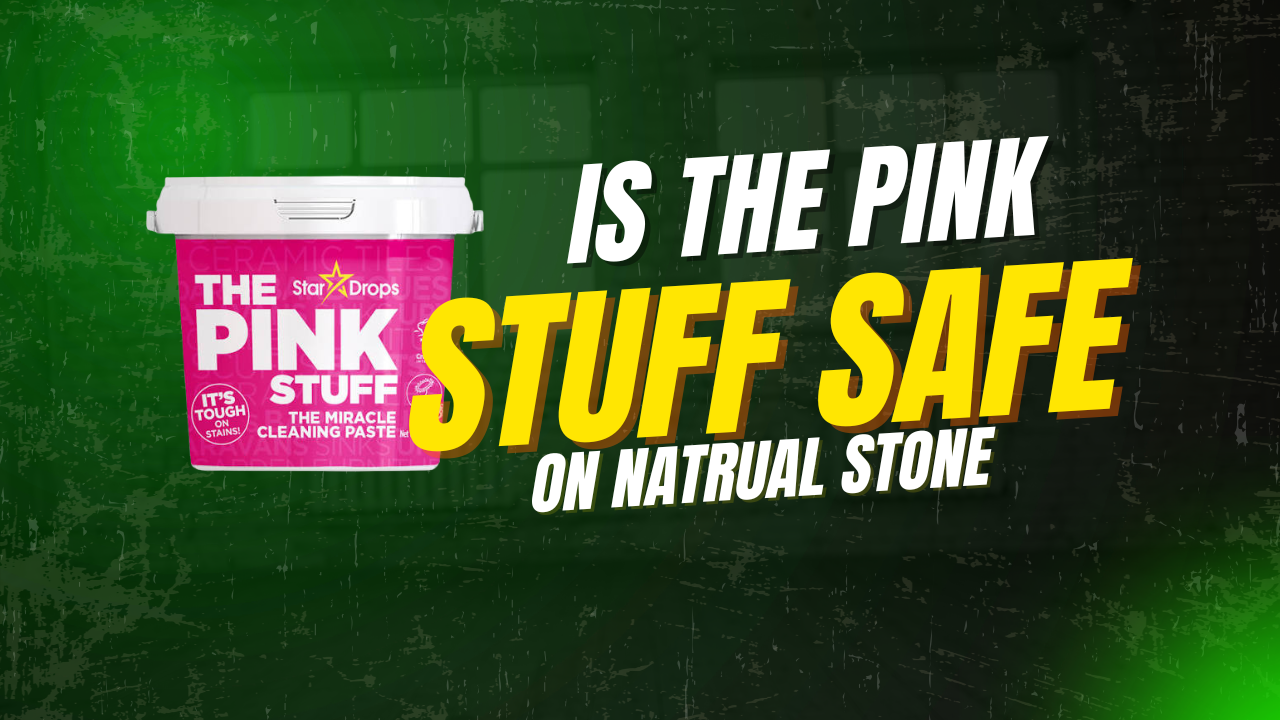
If you’ve searched this question, you’ve probably already found the problem: the internet can’t agree on the answer. One cleaning blog says The Pink Stuff will scratch your marble. Another quotes the brand saying it’s fine with a soft sponge. A TikTok shows someone “rescuing” a stained worktop with it — right next to a comment warning it ruined theirs.
So here’s a straight answer from a UK stone and tile supplier, based on the chemistry and on what the manufacturer itself actually recommends.
The short answer
The Pink Stuff’s own manufacturer advises against using its Multi-Purpose Cleaning Paste on marble and granite, and recommends using a cleaner made specifically for those surfaces. That’s not our opinion — it’s stated on their own FAQ page.
The reason is simple. It’s an abrasive alkaline paste. On robust, sealed, everyday surfaces that’s exactly what makes it effective. But marble, limestone and travertine are soft, acid- and alkali-sensitive stones, and abrasion plus alkalinity is the combination most likely to dull polish, etch the surface and leave permanent marks over repeated use.
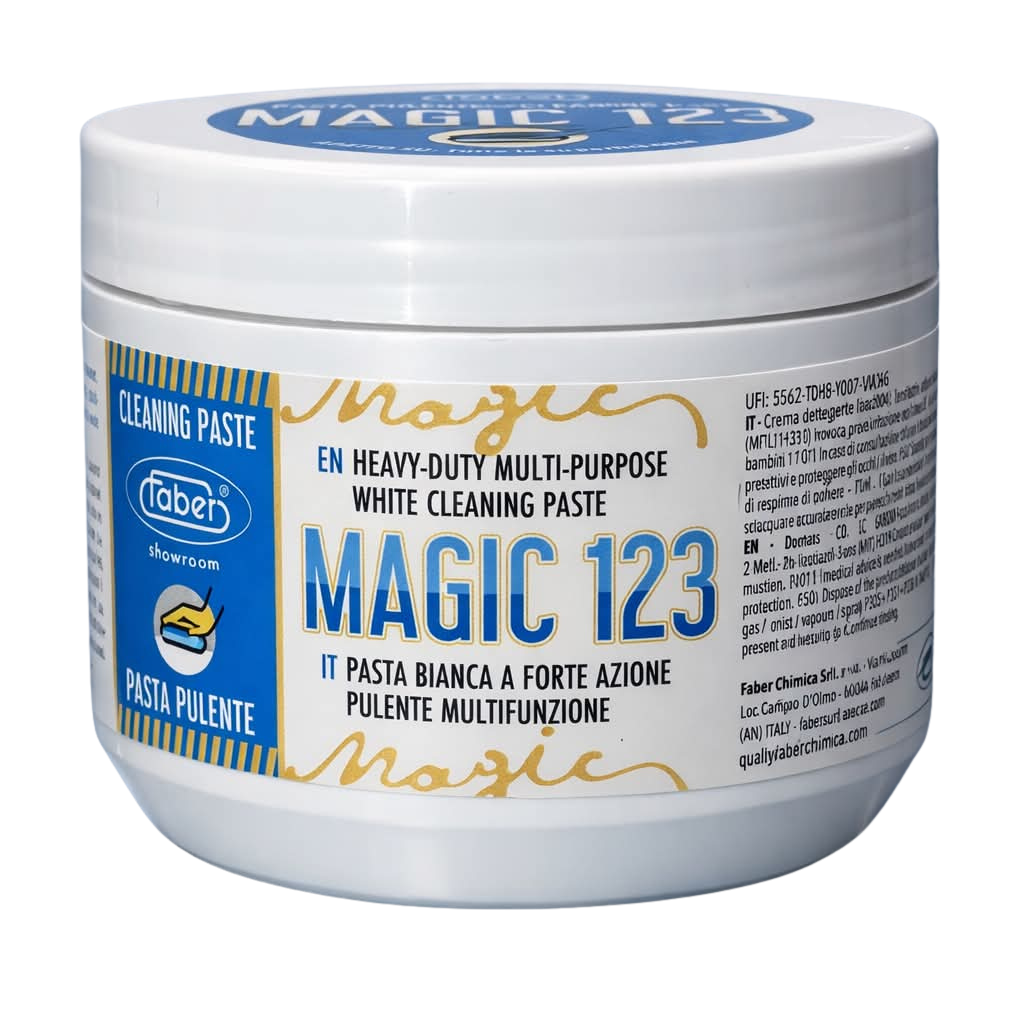
If you want the cleaning power of a paste without the risk, the answer is a near-neutral, non-abrasive paste — the kind formulated for sensitive stone in the first place, such as Faber Magic 123 at pH 6.5.
Why marble and natural stone are different
Marble, limestone and travertine are all calcium carbonate stones. That single fact explains almost every cleaning rule you’ll ever read about them.
Calcium carbonate reacts with acids — which is why lemon juice, vinegar and many descalers leave dull “etch marks” on marble. Over time it’s also vulnerable to strongly alkaline products, and because polished marble is relatively soft, it scratches far more easily than the granite or porcelain most people assume behaves the same way.
Two things damage this kind of stone during cleaning:
- The wrong pH — strongly acidic or strongly alkaline products attack the surface chemically, etching and dulling the polish.
- Abrasive particles — mineral grit in a paste physically scratches the finish. On a polished surface, those micro-scratches read as a permanent loss of shine.
An abrasive alkaline paste hits both risks at once. That’s why a product that’s brilliant on an oven door or a stainless sink is the wrong tool for a marble worktop.
What The Pink Stuff actually is
The Pink Stuff Cleaning Paste works through a combination of mild abrasion and an alkaline cleaning action. That’s a genuinely effective formula on the surfaces it’s designed for — enamel, stainless steel, glazed ceramics, uPVC, pans and outdoor items.
The manufacturer doesn’t classify it as hazardous, and for everyday cleaning it’s a good general-purpose product. The issue isn’t safety to you — it’s suitability for the surface. Abrasive particles and an alkaline pH are precisely the two things a soft, polished, acid-sensitive stone can’t tolerate long-term, which is why the manufacturer’s own guidance steers people away from marble and granite and towards a stone-specific cleaner.
Surface by surface: where an abrasive alkaline paste is risky
Surface | Risk from an abrasive alkaline paste |
Marble, limestone, travertine | High — etching and dulling from alkalinity, scratching from abrasion. Avoid. |
Polished granite & quartz | Moderate — abrasive particles can micro-scratch a polished finish over repeated use. |
Brass, copper, polished metals | Moderate — alkalinity and abrasion strip patina and dull polished finishes. |
Glazed ceramic & porcelain | Low–moderate — repeated abrasive cleaning can degrade the glaze over time. |
Glass | Low — but alkaline residue can smear and, long-term, bloom. |
Enamel, stainless steel, uPVC, pans | Low — these are the surfaces it’s genuinely made for. |
The pattern is clear: the more polished, soft or sensitive the finish, the less an abrasive alkaline paste belongs on it.
“But I’ve already used it on my marble — is it ruined?”
Not necessarily. A single careful use with a soft sponge is very different from months of scrubbing. If you notice dull patches or a loss of shine where you’ve been cleaning, that’s etching or fine scratching, and light cases can often be re-polished by a stone restoration professional.
The more useful takeaway is to switch your regular cleaning routine to something safe before the damage accumulates — because etching is gradual, and by the time it’s obvious it usually needs professional attention.
The safe alternative: a near-neutral paste built for stone
The reason people reach for a paste in the first place is sound. On rough, textured or structured surfaces — grout lines, craquelé glazes, riven slate, structured porcelain — liquid cleaners run straight off before they can dwell and work. A paste stays in contact with the full surface profile and lifts ingrained soiling a spray simply can’t.
The fix isn’t to give up the paste format. It’s to use a paste that keeps that dwell-and-lift advantage without the abrasive, alkaline chemistry.
Faber Magic 123 is a heavy-duty multi-surface cleaning paste made by Faber Chimica in Italy, formulated at a near-neutral pH of 6.5. It cleans through surfactant action in a paste carrier rather than through aggressive abrasion, which is what makes it safe on the surfaces an abrasive alkaline paste puts at risk:
- Marble, limestone and travertine — near-neutral pH sits outside the etching risk zone for acid-sensitive stone.
- Polished granite, quartz and glazed finishes — cleans without abrasive scratching.
- Brass, copper and decorative metals — lifts light oxidation without stripping polished finishes.
- Glass, rubber, PVC and more — one paste across mixed materials, indoors or out.
It handles the same stubborn, ingrained jobs people buy an abrasive paste for — stone worktops, textured tile, grout lines, taps and fixtures, even car rims and garden furniture — on surfaces where you can’t afford to gamble with the finish.
For routine daily cleaning of stone rather than heavy spot jobs, pair it with a pH-neutral maintenance cleaner such as Faber Neugel. For large-area heavy alkaline cleaning on robust floors where etching isn’t a concern, Faber 30 is the workhorse. Magic 123 is the targeted, surface-safe paste that sits between them.
How to clean stubborn marks off marble safely
- Test first on an inconspicuous area, especially on polished or delicate finishes.
- Take a small amount of a near-neutral paste on a damp white pad, microfibre cloth or sponge.
- Work it in gentle circular motions until it foams — let the chemistry do the work, not pressure.
- Rinse thoroughly with clean water until no residue remains.
- Repeat on heavy soiling rather than scrubbing harder in one pass.
A little goes a long way, and gentle-but-repeated always beats aggressive-but-once on soft stone.
Frequently asked questions
Is The Pink Stuff safe on marble? The manufacturer advises against using its Multi-Purpose Cleaning Paste on marble and recommends a cleaner made specifically for the surface. Marble is a soft, acid- and abrasion-sensitive stone, and an abrasive alkaline paste can dull and etch it over repeated use. A near-neutral, non-abrasive paste such as Faber Magic 123 (pH 6.5) is the safer choice.
Is The Pink Stuff safe on granite? The manufacturer also advises against granite. Sealed granite is more robust than marble, but abrasive particles can micro-scratch a polished finish over time. For regular use, a stone-safe cleaner is the better long-term option.
Can you use The Pink Stuff on quartz worktops? Abrasive pastes aren’t ideal on quartz — repeated abrasion can dull the polished surface, and many quartz manufacturers advise against abrasive cleaners. A near-neutral paste cleans stubborn marks without that risk.
What can I use instead of The Pink Stuff on marble? A near-neutral, non-abrasive cleaning paste formulated for stone. Faber Magic 123 (pH 6.5) delivers the same paste-format cleaning power on marble, granite, polished metal and glazed surfaces without the etching or scratching risk.
Why use a paste instead of a spray on stone? On textured and structured surfaces — grout lines, riven stone, craquelé glazes, structured porcelain — liquid cleaners run off before they can work. A paste stays in contact with the full surface profile and lifts ingrained soiling a spray can’t reach.
HF Flooring Supplies is a UK trade supplier of Faber Chimica professional stone, tile and surface care products. Trade accounts available — get in touch.
