
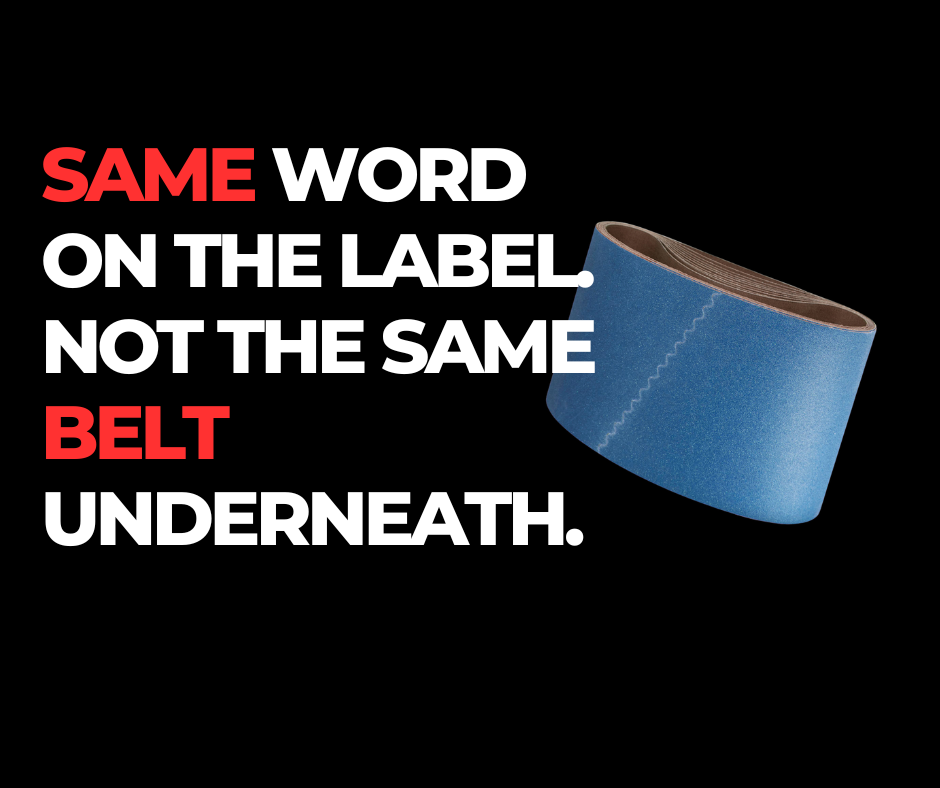
Ask most people what abrasive they are running and they will tell you the grit. 40, 60, 80, 100. Fair enough, grit decides how coarse the scratch is. But grit is only one part of the story.
The grain type decides how fast you cut and how long the belt lasts. The grade within that grain type decides whether you are paying for a harder mineral or just a marketing word. The backing decides whether the whole thing survives the job without cooking. And the grit standard, the coat, and the sequence decide whether all of that actually shows up as a clean, even floor.
Most spec sheets shout the grit and whisper everything else. This is a proper look at what is under the number, with real examples from the abrasives we stock and use ourselves, so it is not just theory.
The short version
- Grain: decides cut rate and belt life. Zirconia and ceramic fracture in tiny steps and stay sharp, which is why they last.
- Backing and coat: heavy X or Y cloth or a hybrid backing for belts, and a semi open coat for resinous wood and old finishes.
- Sequence: never skip a grit, and replace a belt as soon as it stops biting.
Two belts both labelled ceramic can behave completely differently, so check what is actually in the grain.
- Grains coveredAluminium oxide, silicon carbide, zirconia and ceramic
- Also coversBacking, open and closed coat, grit standards
- BrandMenzer belts, discs, screens and pads
- IncludesWhich abrasive to pick for each job
Two properties decide everything: hardness and toughness
Every abrasive grain lives or dies on two properties, and they pull in opposite directions.
Hardness is the grain's ability to scratch the material in front of it. It is measured on the Mohs scale, with talc at 1 and diamond at 10. For the four grains used in floor sanding and woodworking, the numbers sit surprisingly close together.
- Silicon carbideabout 9.5
- Ceramic aluminaabout 9.4
- Aluminium oxideabout 9.0
- Zirconia aluminaabout 8.5
Toughness, or friability, is how the grain breaks down under pressure. This is the property people forget, and it matters more than raw hardness. A grain that never fractures just goes blunt and starts burnishing your floor instead of cutting it. A grain that fractures in a controlled way keeps snapping off tiny worn edges to reveal fresh sharp ones underneath, so it stays sharp as it wears. That is the self sharpening effect you will see quoted, and it is real physics, not marketing.
So the hardest grain on the list is not automatically the best. Silicon carbide is the hardest of the four, yet it has one of the shortest working lives, because it is brittle and sheds fast.
How grains stay sharp: macro, micro and nano fracturing
This is the bit that separates a cheap belt from an expensive one, so it is worth understanding.
Silicon carbide and aluminium oxide
- Structure
- Monocrystalline. Each grain is essentially one large crystal.
- How it breaks
- Along big planes of weakness, with big chunks coming off at a time. It only does this a handful of times before the grain is spent. That is macro fracturing.
Zirconia alumina and ceramic alumina
- Structure
- Engineered grains built from thousands of tiny micron and submicron crystals packed together.
- How it breaks
- In tiny increments, shedding microscopic fragments rather than lumps. Zirconia can micro fracture hundreds of times across its life. Ceramic can do it thousands of times, which is why it is sometimes called a nano fracturing grain.
More fracturing events means the grain exposes fresh cutting edges again and again instead of dulling. That is the whole reason zirconia and ceramic hold their cut rate long after cheaper grains have gone smooth and started riding on top of the wood.
The four grains, and where each one earns its keep
One thing worth saying up front: the grain name on the box is the mineral, not the grade. Within every one of these families there is a quality and price ladder, driven by the purity of the mineral, how tightly the grain is graded for size, and the quality of the bond holding it down. A cheap silicon carbide and a premium silicon carbide are both silicon carbide, and they behave nothing alike. So treat the type as the starting point, not the whole answer.
Grain 1Aluminium oxide: the honest workhorse
- Best for
- Low pressure and finishing work
- Weak spot
- Wears quickly under drum sander pressure
- Our pick
- White fused grade for finishing
Blocky shaped grain with sharp edges. It is the most common abrasive on the market and it is cheap, but on its own under drum sander pressure it wears down too quickly to be the star of a heavy cut. Where it shines is low pressure and finishing work: orbital discs, hand sheets, and between coats abrading. Its blocky shape leaves a fine, consistent scratch pattern with no stray deep scratches, which is exactly what you want when you are keying a finish rather than removing timber.
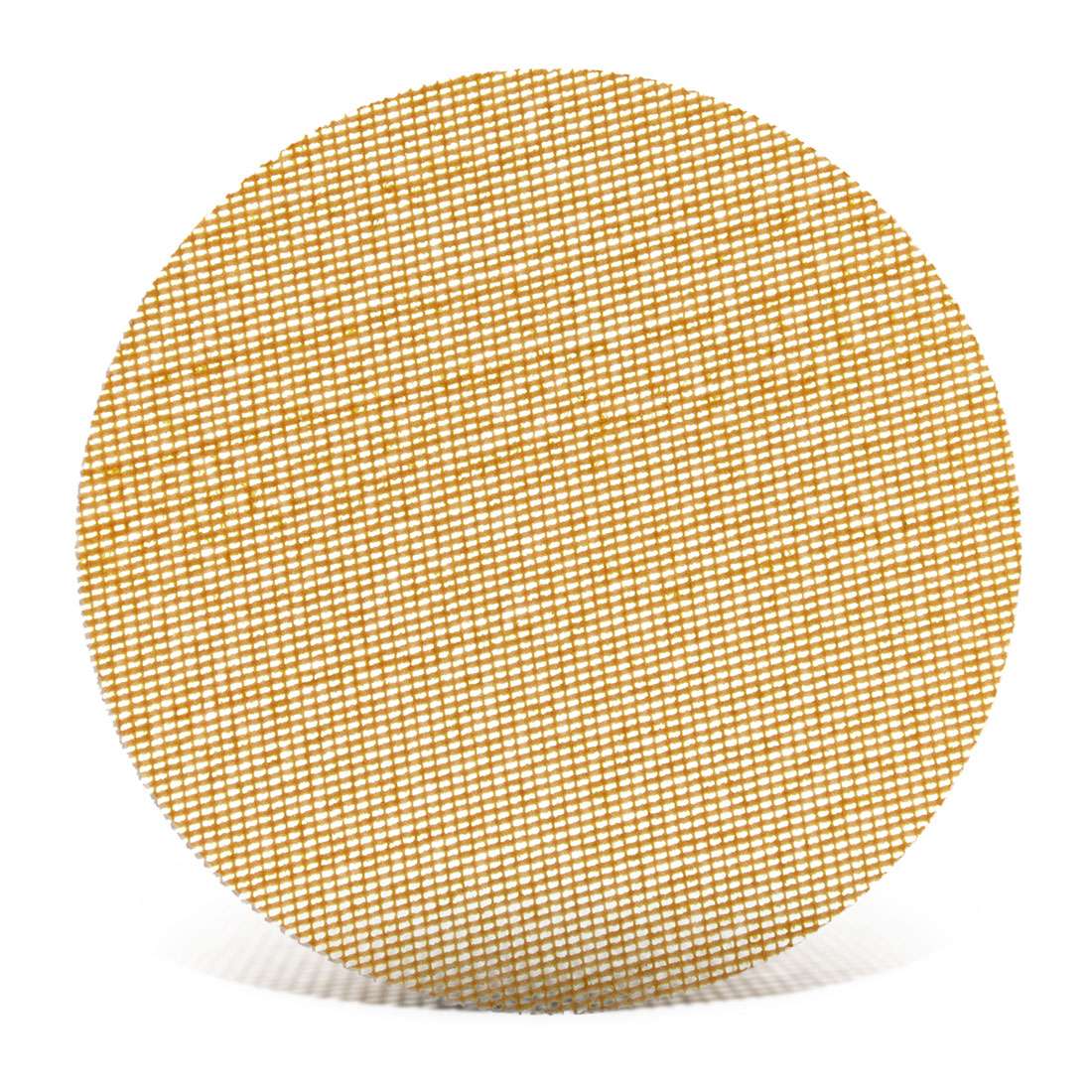
And it is not one thing. Brown aluminium oxide, around 95% pure, is the tough, cheap, semi friable everyday grade. White fused aluminium oxide, 99% plus, is more friable and runs cooler, which makes it better for lacquers and between coats. Same aluminium oxide on the label, two different price points and two different behaviours. It is why we stock the white fused grade specifically for finishing work rather than a general purpose brown. Our Menzer UltraNet 150mm mesh discs and UltraPad discs in 150mm and 406mm all use white fused grain, precisely because a final sand or a lacquer cut back needs the cooler, more consistent cut rather than raw aggression.
-
 Mesh discMenzer UltraNet 150mmWhite fused aluminium oxide mesh discs, pack of 50£51.25 + VATView product
-
-
Grain 2Silicon carbide: sharp, fast, and short lived
- Best for
- Screens, stone, screed and concrete
- Weak spot
- Friable, sheds heavily early on
- Our pick
- Menzer 406mm open net screens
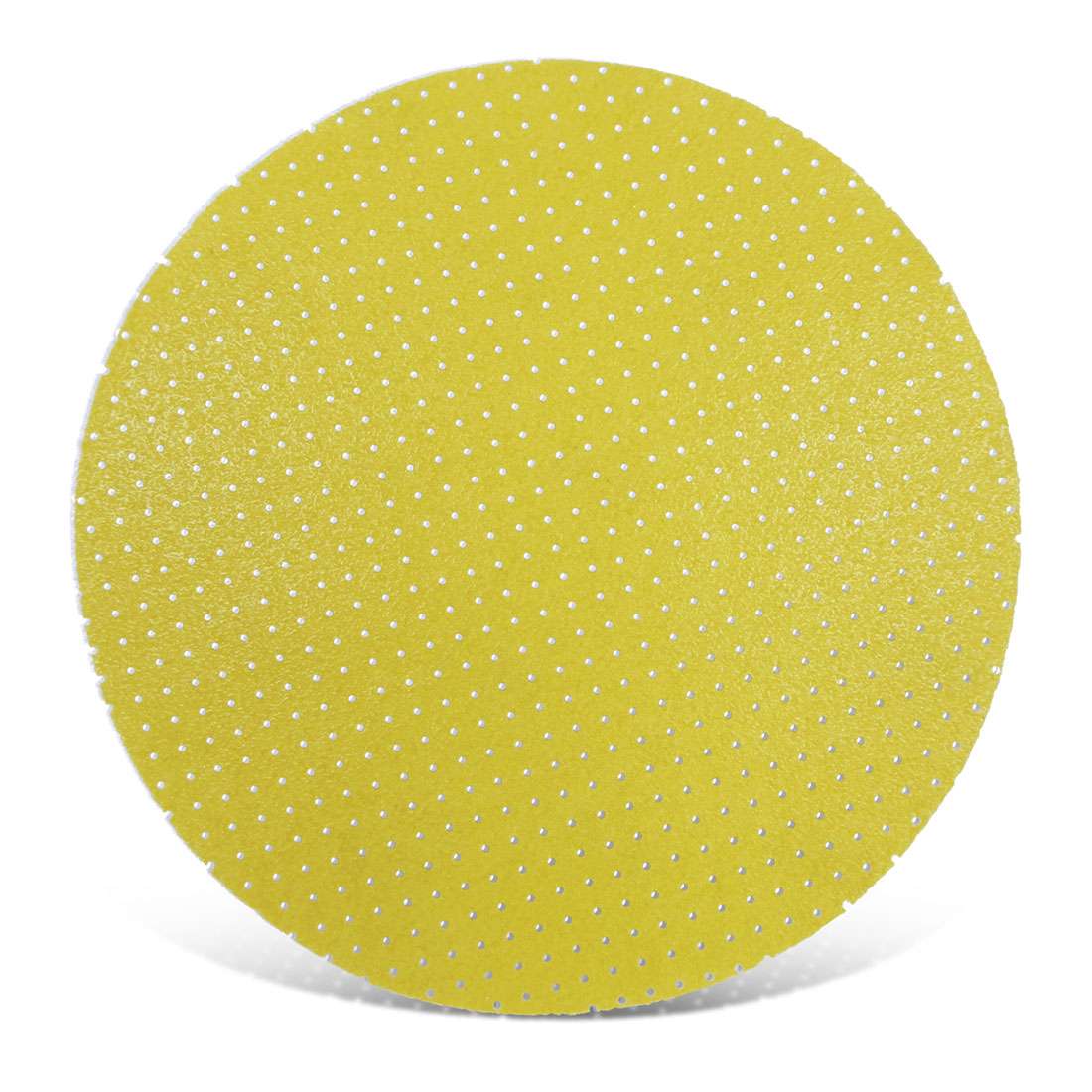
The hardest of the four and the sharpest, with a long, pointy grain. It cuts raw wood and old coatings fast, and its sharpness can leave a lovely fine scratch, which is why it turns up on screens, mesh and finishing grits. It is also the standard grain for stone, screed and concrete, anywhere you are not cutting timber. The trade off is friability. It sheds heavily, especially early in its life, and those long grain fragments can occasionally dig in and leave an errant deep scratch. On screens you will sometimes see the shed grain get trapped and drag a coarse line across the floor. A brilliant tool for the right stage, but not a grain to lean on for a long, hard cut.
Are all silicon carbides the same? Not remotely. There is black silicon carbide, roughly 95 to 98% pure, which is the common, cheaper one, and green, 99% plus pure, which is harder, sharper and more expensive. On top of the purity, the thing that separates a good SiC from a cheap one is grading consistency, meaning how tightly the grain is screened to a uniform size. Cheap grain has a loose size spread, which means the odd oversized particle riding proud of the rest, and that is exactly what leaves rogue scratches you then have to chase out. Pay a bit more and you are often paying for consistency as much as purity.
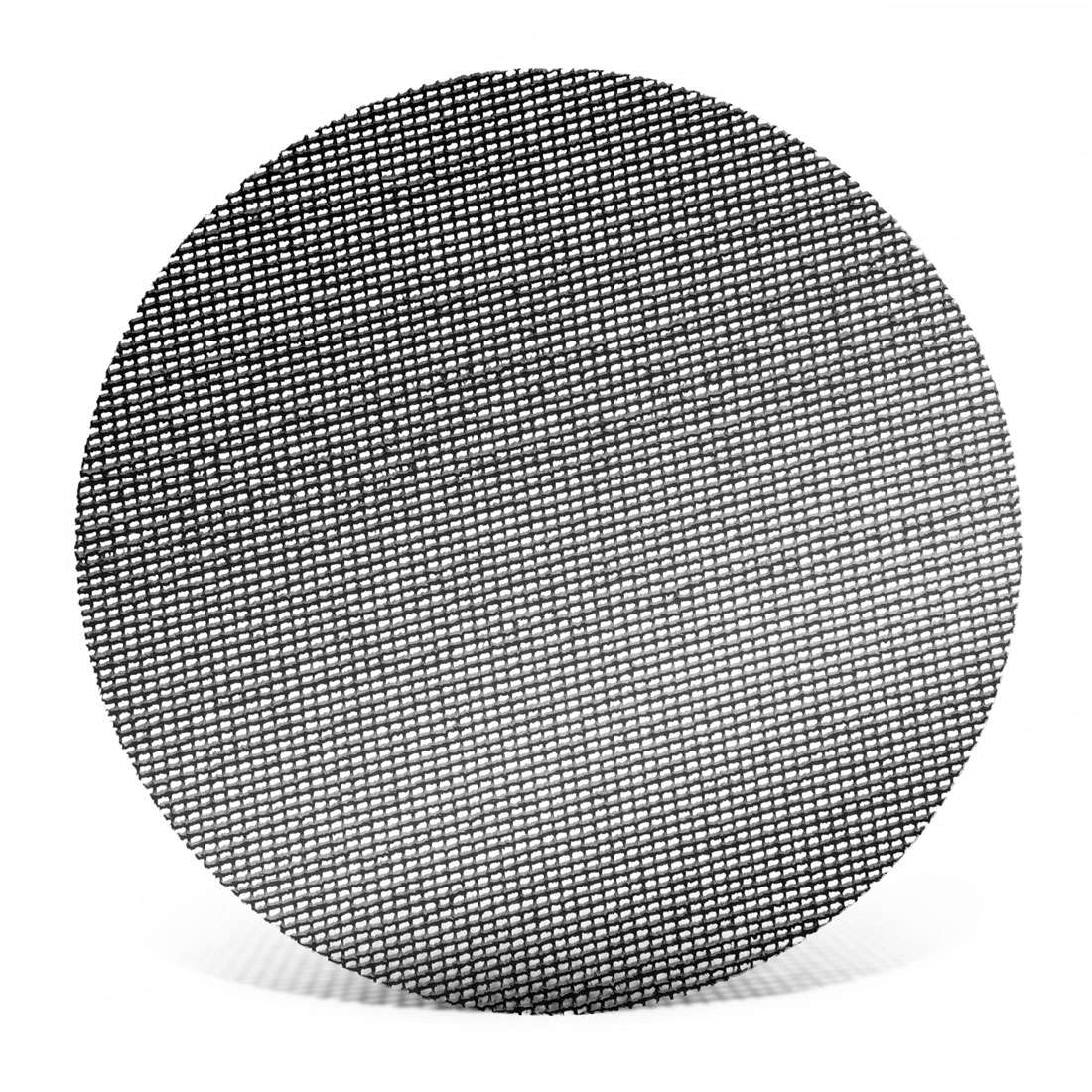
Menzer silicon carbide 406mm screens
£31.37 + VAT
Built with a genuine open net mesh so dust pulls straight through rather than packing between the grains, keeping the screen cutting cool instead of glazing over.
Shop silicon carbide screensGrain 3Zirconia alumina: the drum belt hard worker
- Best for
- Belt and drum sanding on demanding floors
- Needs
- Firm pressure to self sharpen
- Our pick
- Menzer Blue Zirconia
A tough, co fused grain, aluminium oxide married to zirconium oxide, long and spindly in shape. It micro fractures and self sharpens, so it lasts far longer than silicon carbide on hard woods and tough coatings. This is the go to grain for belt and drum sanding on demanding floors. One important catch: zirconia needs firm pressure to work. Starve it of load and it will not fracture and resharpen. It will glaze over and start generating heat instead of cutting. Give it the pressure it wants and it earns its place.
Here too there is a spread. Zirconia is sold in different alloy ratios, with grades around 25% and 40% zirconia, and the fineness of the crystal structure, set by how fast the melt is quenched in manufacture, makes a real difference to how well it holds up. A budget zirconia belt and a premium one can be a world apart in life and cut, even at the same grit.
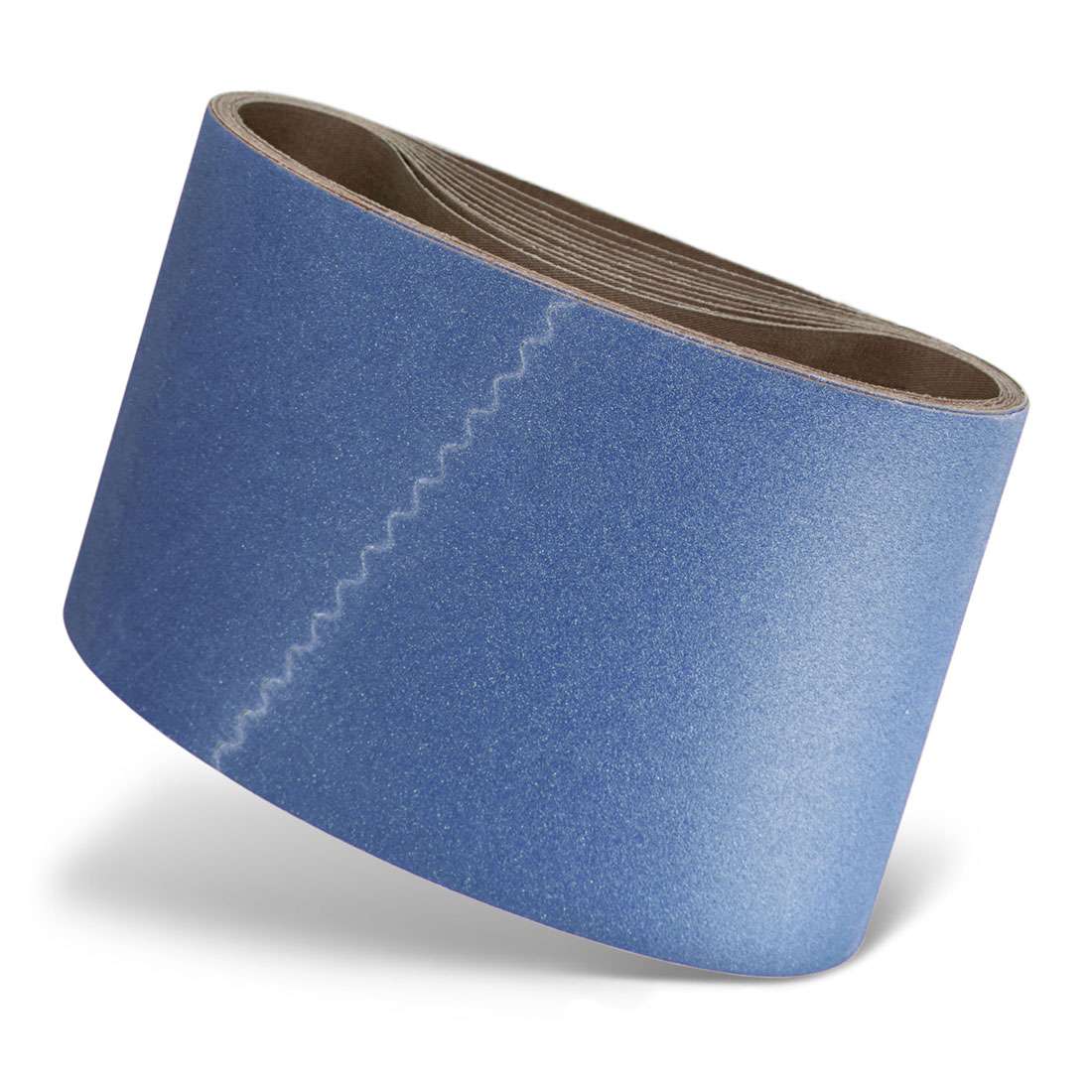
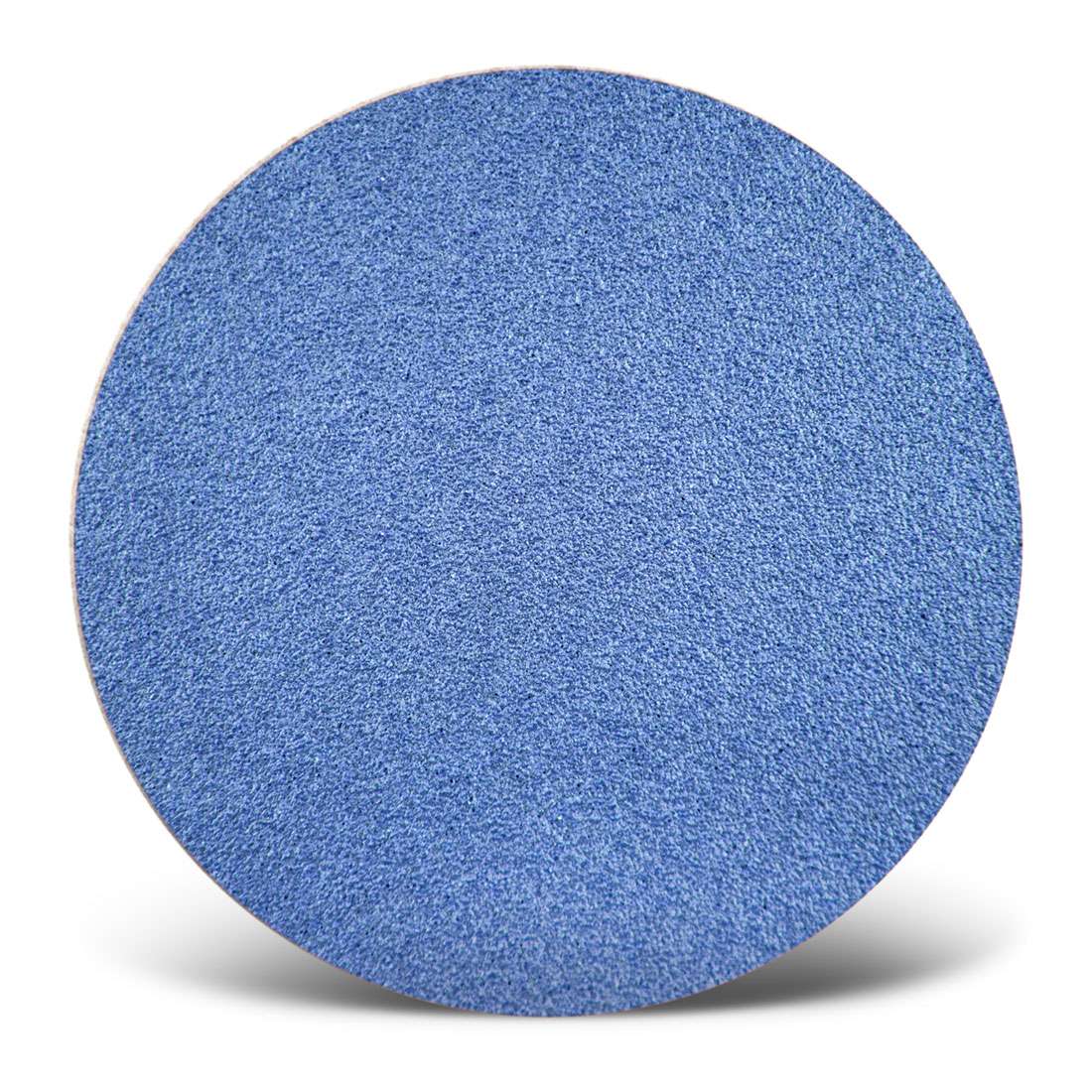
This is the grain behind our own Menzer Blue zirconia belts, 200 x 750mm, and the matching 178mm edger discs. They use self sharpening zirconia alumina on a hybrid polyester reinforced backing rather than basic cotton cloth, semi open coated to resist lacquer and resin clogging. It is the everyday workhorse for general stripping and hardwood profiling.
-
Drum beltMenzer Blue Zirconia belt200 x 750mm, pack of 10, 24 to 100 gritFrom £35.62 + VATView product
-
Edger discMenzer Blue Zirconia disc178mm matching edger disc, 40 to 100 gritFrom £52.50 + VATView product
Grain 4Ceramic alumina: the premium grain
- Best for
- Exotic and very hard timbers, hardened finishes, sports floors
- Needs
- Adequate pressure and the right machine
- Our pick
- Menzer Ruby HD, 100% ceramic
This is the engineered end of the spectrum. Ceramic grain is made by a sol gel, or seeded gel, process. Alumina is grown from a gel and sintered below its melting point, producing a grain made of thousands of submicron crystallites, around 0.2 to 0.5 microns each, instead of a few big fused crystals. That ultra fine structure lets it shed microscopic fragments continuously. It stays sharp, runs cool, and lasts three to five times longer than a conventional aluminium oxide in the right application. It is the first choice for exotic and very hard timbers, aluminium oxide hardened finishes, and sports floors.
The newest ceramics go a step further with shaped grain. The grain is formed into precise triangular structures and stood up on the backing like rows of tiny cutting tools. Instead of ploughing through the surface, these points slice, fracturing into fresh sharp edges as they go, cutting faster and cooler with less pressure. 3M Cubitron and Norton RazorStar are the best known examples, though those specific products are aimed at metal grinding rather than wood.
The catch with ceramic mirrors zirconia: it is engineered to self sharpen under adequate pressure and the right machine. Run it too light and heat sensitive, and you never activate the mechanism you paid for. The belt glazes and you have spent premium money for a mediocre cut.
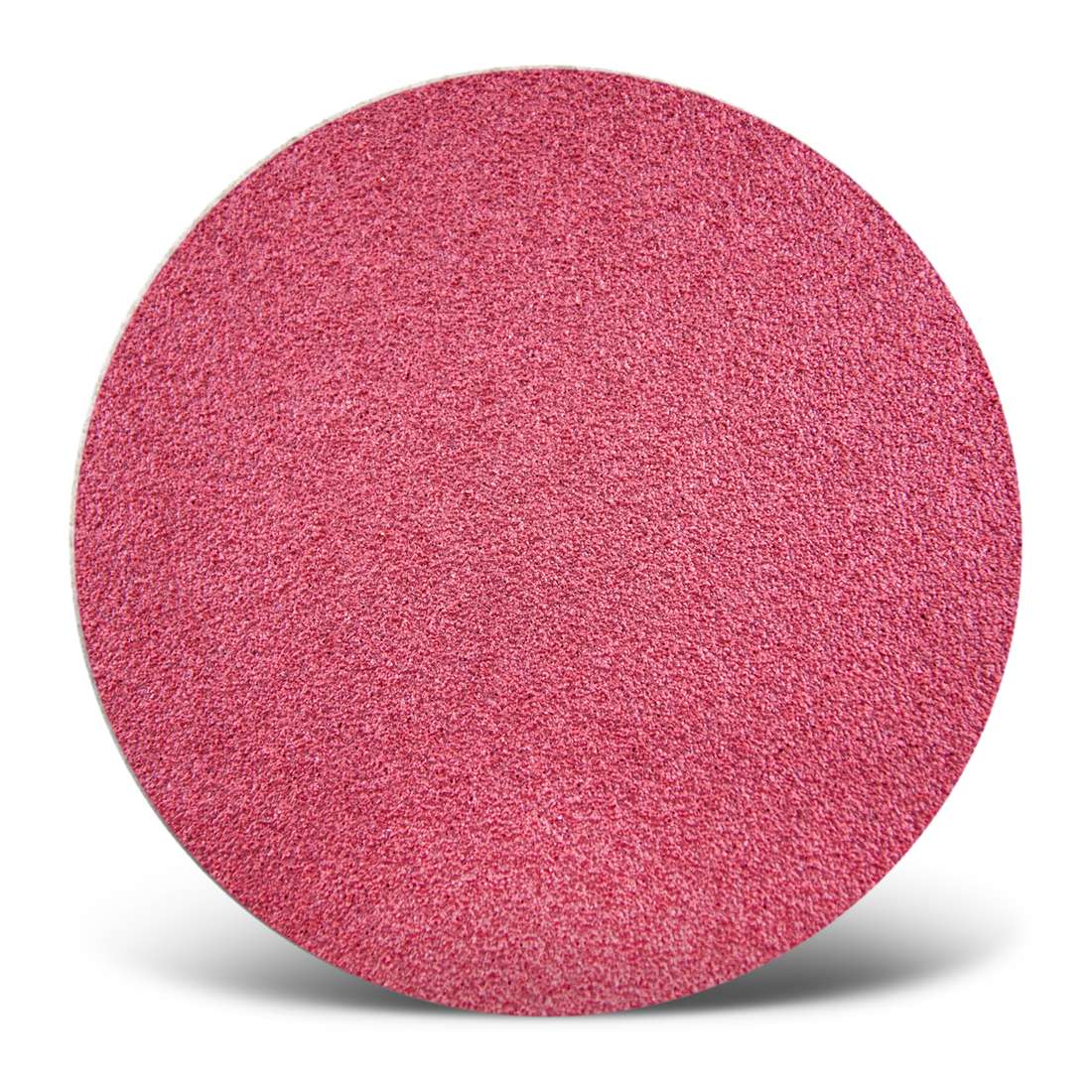
Our Menzer Ruby HD belts, 200 x 750mm, and 178mm discs are 100% microcrystalline ceramic, not a blend, on the same anti chatter hybrid backing as Blue Zirconia, semi open coated. Menzer's own testing has it outlasting a standard zirconia belt by up to three times on dense hardwoods and heavily coated floors.
-
Drum beltMenzer Ruby HD belt100% ceramic, 200 x 750mm, pack of 10, 40 to 100 gritFrom £68.37 + VATView product
-
Edger discMenzer Ruby HD disc100% ceramic, 178mm matching edger disc, 40 to 100 gritFrom £76.87 + VATView product

How much ceramic is actually in your ceramic belt?
Ceramic has the widest spread of the lot. At one end, an entry level ceramic belt that is mostly aluminium oxide, or zirconia, with a modest dose of ceramic grain. At the other, a high content shaped grain product with a grinding aid coating. Both wear the word ceramic and the price gap between them is enormous.
Here is the part the labels do not tell you. Grain type on a box is not a pass or fail, it is a spectrum. Because aluminium oxide is cheap and ceramic and zirconia are expensive, manufacturers routinely blend grains: a proportion of premium grain cut with cheaper grain to hit a price point. A belt sold as ceramic might be a minority of ceramic grain sitting in an aluminium oxide crowd, or blended with zirconia, which is itself a step down in price from true ceramic. Two belts, both stamped ceramic, can behave completely differently on the floor.
The blend content is rarely printed anywhere you can see it. So the only reliable way to judge is by behaviour. Does it hold its cut rate deep into the belt's life, does it stay cool, does it leave a consistent scratch, and how many square metres does it actually sand before it is done? A true high ceramic content belt keeps cutting when a blended one has quietly gone smooth.
This is exactly why it is worth being upfront about our own range rather than letting the word ceramic do the talking on its own.
Menzer Ruby HD
- Grain
- Stated plainly as 100% ceramic, no blend
- Best for
- Dense hardwoods, heavy restoration, drum and edger
- Price
- Belts from £68.37 + VAT, pack of 10
Menzer Purple HD 150mm
- Grain
- Honestly listed as a ceramic blend
- Best for
- A genuinely good disc for edging and worktop finishing on a Festool Rotex
- Price
- From £30.00 + VAT, priced lower than the 100% ceramic Ruby HD
Neither is the wrong product. But which one you are actually buying should be clear from the label, not something you have to guess at from how it performs three belts in.
The backing matters as much as the grain
Here is the mistake almost everyone makes: obsess over grit and grain, then grab whatever backing happens to be on the shelf. That is backwards. The backing is what carries the grain through the cut. It decides how the abrasive behaves under pressure, heat and flex, not just the mineral sitting on top of it. The backing needs to match how the abrasive moves during the job.
- PaperThe cheapest and lightest, graded A to F or G. A weight is thin and flexible for fine hand work, and it climbs to E and F weight, the heavy, strong paper used for floor sanding discs, sheets and rolls. Light paper is fine for finishing. It has no place taking a heavy cut.
- ClothGraded J, X and Y, jeans, drills, then the heaviest polyester. Far more tear resistant than paper, and it survives the constant flexing of a belt going round and round, which is exactly why floor sanding belts want a proper heavy X or Y cloth. A belt on a light backing will stretch, distort and tear before the grain is even worn out.
- Film (polyester)A dead consistent, uniform thickness, so it leaves a very even scratch pattern with minimal clogging. Great for fine and between coats work.
- Mesh or netLets dust pull straight through the whole face of the disc. Far less loading and a cooler cut, so the disc lasts longer and clogs less. It has become the standard for orbital and edge work with good extraction.
It is why Menzer build the Blue Zirconia and Ruby HD ranges on a heavyweight polyester reinforced hybrid backing rather than basic woven cotton cloth. That construction resists stretch under heat and load, so the belt tracks true on the drum from the first metre to the last instead of creeping. The fibre structure also damps machine vibration before it reaches the floor, which is what actually stops chatter marks rather than just reducing them.
The cheap discWhy the cheap disc is cheap, and why it cooks
Pick up a budget disc next to a quality one and the difference is in your hand before you have even sanded: the cheap one weighs almost nothing. That is not a bonus. It is a thin, poor backing with a mean, lightweight bond holding the grain on. And that lightness is exactly where it fails you.
A thin, cheap backing cannot take heat. Under a machine it builds up temperature fast, and once it is hot a few things go wrong at once. The bond softens and the grain starts shedding before it is actually worn, so you are throwing away sharp grit. The backing curls, loads up and glazes. And in the worst case that heat goes into the floor, with scorched timber, or a finish that softens and burns rather than abrades. A thin backing also wears through before the grain is spent, so you bin the disc with life still in it.
You bought it because it was cheap by the box. You pay for it in discs per job, heat marks and time.
Open coat vs closed coat, and grit standards
There is a second spec hiding on every belt and disc that has nothing to do with grain or grit: how much of the backing is actually covered in grain.
Closed coat
Around 90 to 95% of the surface carries grain. The most aggressive option, but on resinous pine, old wax, or a soft gummy old coating it loads up solid and starts sliding instead of cutting.
Semi open coat
Around a 30% reduction in coverage. Gaps give sanding debris somewhere to go, so the abrasive keeps clearing itself and stays cooler. Both Ruby HD and Blue Zirconia are built this way.
Open coat
Fully open, down to roughly 50 to 70% coverage. The most room for debris, for the materials that cause loading worst.
Those gaps give sanding debris somewhere to go instead of packing solid, so the abrasive keeps clearing itself and stays cooler for longer on exactly the materials that cause loading. It is a genuinely deliberate spec choice, not an afterthought. Wood is resinous and often carries old wax or finish residue, so a wood floor abrasive needs some relief built in, even at a small cost to outright aggression.
Compare that to something like Norton RazorStar, a metal grinding ceramic that runs fully closed coat. Metal does not gum up an abrasive the way timber does, so it manages heat through a grinding aid coating instead of through spacing. Same underlying physics, different substrate, different answer.
Grit standardsGrit numbers are not universal: P100 is not the same as 100
Here is a trap that catches people out without them ever realising why a sequence went wrong. There are two different grading standards for grit, and they do not always mean the same particle size.
FEPA
- What it is
- The European standard. Anything with a P in front of the number, such as P100 or P120.
- Where you will see it
- Most UK and European abrasives. It also holds a tighter tolerance band on particle size than CAMI.
CAMI
- What it is
- The American standard. Just a plain number with no P.
- Where you will see it
- A lot of US made or US branded product.
At coarse grits the two systems are close enough not to matter. Above roughly P220, though, they diverge. A CAMI graded 400 is noticeably finer than a P400, closer to a P800. Mix an unlabelled American product into a European graded sequence at the fine end and you can unknowingly skip a step, or double up on one, without the numbers ever telling you.
The sequenceWhy you cannot skip grits
This is the bit that makes the whole sequence work. Each grit only removes the depth of scratch left by the grit before it. An 80 grit belt leaves a scratch of a certain depth. A 100 or 120 that follows it is only deep enough to remove that 80 grit scratch, nothing more.
Skip from 40 straight to 80
The 80 sands the peaks of the 40 grit scratch pattern smooth, but it cannot reach into the valleys.
Work through the full sequence
Every grit does the job of removing the one before it, so the surface ends up properly level.
The floor can look perfectly sanded dry. Then you put oil or lacquer on it, the finish sits in those unreached valleys, and the coarse scratch pattern ghosts straight back through the coating, usually worse under raking light. The fix is simply not skipping. It is worth noting both Ruby HD and Blue Zirconia are stocked across the full 40g, 60g, 80g and 100g run for exactly this reason. The progression only works if you are not missing a rung.
The dull belt is not just slow, it is doing damage
A worn out belt does not announce itself. It fades, and a lot of contractors keep running it because it still feels like it is working. It is not. A spent grain stops shearing wood fibre and starts burnishing, polishing and case hardening the surface instead of removing material.
That matters for two reasons. First, a burnished surface takes stain and oil unevenly. The compressed, glazed timber absorbs less than timber that has been properly opened up by a sharp cut, and you get patchy, blotchy colour that has nothing to do with the wood species and everything to do with a belt that should have been changed twenty minutes earlier. Second, burnishing generates heat, and heat on a worn belt is how you end up with scorch marks and a belt that is now not just dull but glazed solid.
Learning to feel the difference is one of the more valuable, least talked about skills in this trade. A sharp belt bites and pulls the machine forward slightly. A dull one skates.
The belt is cheap. The comeback is not.
Match the grain to the machine, and to the wood
A few practical realities worth having in your head before you buy.
- Ceramic and zirconia need a machine that can drive themBoth grains rely on pressure to trigger the self sharpening fracture that makes them worth the money. Put a premium ceramic belt on a light or underpowered machine and you will never load it hard enough to activate what you paid for. Ruby HD and Blue Zirconia are both built for full size drum and belt sanders such as the Lägler Hummel, Bona Belt and Frank or Pallmann Cobra, which can actually deliver the pressure these grains need.
- Match the mineral to the materialZirconia and ceramic are built for wood. The moment you are on stone, screed or concrete, or cutting back a hard old lacquer, silicon carbide is usually the better suited mineral, which is why it dominates screens and stone prep discs.
- Watch the edger against the drumIf your edger is running a different grain or grade than your drum machine, the two leave subtly different scratch patterns, invisible dry and glaringly obvious once oil or lacquer catches the light. Buy matched grain families. Our Blue Zirconia and Ruby HD both come as a 200 x 750mm belt and a matching 178mm edger disc in the same grain and grade, so the edge lines up with the field instead of leaving a visible ring where the two meet.
What it means on the job, and why the cheap belt is not cheap
Here is the honest case for spending more per belt. It comes down to two payoffs.
- A clean scratch pattern makes the next grit easier work. When a grain cuts consistently, it leaves an even scratch of predictable depth. The next grit up only has to remove that shallow, uniform layer, so one clean pass and the previous scratch is gone. When a grain is inconsistent or worn out, it leaves an uneven pattern with the odd deep stray scratch. Now the next grit has to chase those out, and you will sometimes have to drop back a grit to catch them.
- Longevity turns into cost per square metre and hours saved. A self sharpening grain holds its cut rate from the first metre to the last, so you change belts less often and every belt does more work. A cheap belt dulls, stops cutting, and starts burnishing, which is not just slow. It is a risk: heat, glazing, chatter, and burns that mean rework.
It is a genuine trade off worth doing the maths on rather than assuming.
Menzer Blue Zirconia belt
- Price
- Baseline
- Belt life on demanding hardwoods
- Baseline
Menzer Ruby HD ceramic belt
- Price
- Roughly double at the entry grit
- Belt life on demanding hardwoods
- Up to three times, on Menzer's own data
Pay twice, get three times the belt life on the jobs where it counts, and you have come out ahead on cost per square metre before you have even counted the saved belt changes and machine downtime. That is the quiet truth about quality abrasives: they do not just cost more, they earn more.
Which HF abrasive for the job
| Job | What we would reach for |
|---|---|
| Everyday stripping, general hardwood profiling (drum) | Menzer Blue Zirconia 200 x 750 belt |
| Dense or exotic hardwoods, heavy restoration (drum) | Menzer Ruby HD 100% ceramic 200 x 750 belt |
| Matching edger for everyday stripping | Menzer Blue Zirconia 178mm disc |
| Matching edger for dense hardwood and restoration | Menzer Ruby HD 178mm disc |
| Edging and worktop finishing on a Festool Rotex | Menzer Purple HD 150mm ceramic blend disc |
| Fine finishing and between coats (Bona FlexiSand and similar) | Menzer UltraPad 150mm or UltraNet 150mm mesh |
| Final buffer sand, cutting back lacquer (16 inch buffer) | Menzer UltraPad 406mm |
| Screens for stone, screed, or cutting back hard old lacquer | Menzer Silicon Carbide 406mm screens |
A few more habits worth keeping regardless of which abrasive you are running.
- Backing: heavy X or Y cloth or hybrid reinforced backing for belts and drums, film or mesh for finishing. Be suspicious of any disc that feels weightless.
- Grit numbers: check for the P. FEPA and CAMI are not the same particle size above P220.
- Sequence: never skip more than one grit stage. The next grit can only remove the scratch the last one left.
- A belt that has gone smooth mid job: it is not the grit, it is a spent grain. You are now burnishing, not cutting. Change it.
Match the grain to the job
We stock the full Menzer floor sanding range, belts, discs, screens and pads across zirconia, 100% ceramic, ceramic blend, and white fused aluminium oxide grains, so you can match the grain to the job rather than to whatever the wholesaler had on the shelf.
- Orders placed Mon to Fri before 2PM are dispatched the same day for next working day delivery
- Not sure which grain, grade or backing suits your floor? Get in touch
Frequently asked questions
What is the difference between open coat and closed coat sanding belts?
Closed coat means the grain covers 90 to 95% of the backing for the most aggressive cut. Open and semi open coats leave gaps between the grains, around 50 to 70% coverage for fully open and about a 30% reduction for semi open, so sanding debris has somewhere to go instead of packing solid. Resinous wood, old wax and gummy coatings need that relief to avoid loading and heat build up. Hard, clean timber can usually take a closed coat.
Is all zirconia sanding belt self sharpening?
Genuine zirconia alumina grain is inherently self sharpening because of its fine microcrystalline structure, but the zirconia content varies by product, commonly 25% or 40%, and cheaper grain can be blended with aluminium oxide to hit a price. It also only self sharpens under adequate machine pressure. Run it too light and it glazes instead of fracturing.
Can you skip grits when sanding a wood floor?
No. Each grit only removes the scratch depth left by the grit before it. Skipping a stage, 40 straight to 80 for example, leaves the coarser scratch pattern in the valleys, which looks fine dry but ghosts back through oil or lacquer once it is applied.
How do you know how much ceramic is in a ceramic sanding belt?
Manufacturers rarely publish the exact ceramic content, and many ceramic belts are blended with aluminium oxide or zirconia to hit a price point. The only reliable way to judge is by how the belt performs: whether it holds its cut rate, stays cool, and lasts the number of square metres a genuine high content ceramic should.
Do sanding belts and discs go off if stored too long?
The abrasive mineral itself does not degrade, but the resin bond and backing are sensitive to humidity and temperature swings. Damp storage softens the bond and curls the backing, and very dry conditions make it brittle. Properly stored abrasives can last years. Poor storage is the real risk, not age on its own.
