
When a beautiful natural stone surface gets laid or installed — marble in a hallway, travertine in a kitchen, limestone flags in a period farmhouse, a granite worktop in a newly fitted kitchen — the question of how to protect it properly is one of the most important decisions the homeowner or contractor will make. Get it right and that surface will look exceptional and be easy to maintain for years. Get it wrong and the stone will stain, absorb oils and moisture, and deteriorate in a way that is expensive and sometimes impossible to reverse.
The market for stone sealers is not short of options. But understanding what separates a genuinely professional sealer from a basic one requires looking beyond the label and understanding a little of the chemistry involved. This guide explains exactly what Faber Hidro 150 is, how it works at a scientific level, why that matters in practice, and what to look for — and look out for — when choosing a stone sealer in the UK.
What is Faber Hidro 150?
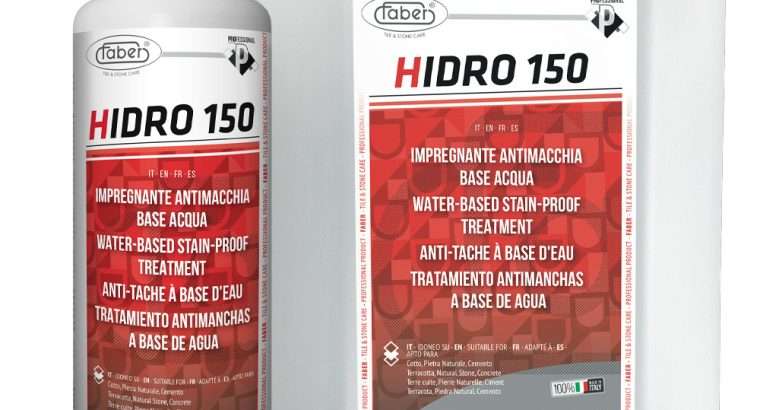
Faber Hidro 150 is a professional grade water based impregnating stone sealer made by Faber Chimica, an Italian surface care manufacturer with decades of formulation expertise behind their professional product range. Its intended use, as stated on its safety data sheet, is as a water based stain-proof impregnator for natural stone and tile surfaces.
It is one of the few professional grade stone impregnators that carries independent food contact certification — making it suitable not just for floors but for kitchen worktops, dining tables and food preparation surfaces where other sealers are entirely unsuitable.
Faber Hidro 150 is available in the UK from HF Flooring Supplies in 1 litre and 5 litre sizes with next working day delivery on orders placed before 2pm Monday to Friday.
What Does Impregnating Actually Mean?
The term impregnating sealer is used widely in the stone care industry but it is worth understanding precisely what it means — and more importantly what it does not mean.
An impregnating sealer penetrates below the surface of the stone and provides protection from within the pore structure rather than forming a film or coating on top of the stone surface. This is fundamentally different from a surface sealer or topcoat, which sits on the stone and can peel, scratch, dull and require stripping and reapplication over time.
A good impregnating sealer leaves the stone looking natural — no surface sheen, no plastic appearance, no change to the texture underfoot. The stone looks and feels like stone. It just repels water and oil rather than absorbing them.
However — and this is critical — not all impregnating sealers are equal. The term describes the delivery method, not the quality of the chemistry doing the protecting. What matters enormously is what active ingredient is being delivered into those pores and what it does once it gets there. And equally important — whether the carrier vehicle actually gives the active ingredient enough time to get there at all.
The Chemistry That Makes Hidro 150 Different
The active sealing ingredient in Faber Hidro 150 is tripotassium propylsilanetriolate — a professional grade organosilane compound. This is transparently disclosed on the product safety data sheet at a concentration of 1-1.5%. Understanding what this does, and why it matters, requires a brief explanation of how stone sealing works at a molecular level.
The pore structure of natural stone
Natural stone — marble, limestone, travertine, granite, sandstone, slate — is a porous material. Even stone that appears smooth and dense to the naked eye contains a network of microscopic pores and capillaries running through its structure. These pores are what make unsealed stone vulnerable to staining — liquids, oils and contaminants are drawn into them by capillary action and become trapped within the stone.
The walls of these pores are covered in hydroxyl groups — chemical attachment points on the stone surface at a molecular level. These hydroxyl groups are reactive, and this reactivity is exactly what professional organosilane chemistry exploits.
What happens when Hidro 150 penetrates the stone
When Hidro 150 is applied to the stone surface, its water based carrier allows the active ingredient to penetrate into the pore structure. Once inside the pores, the curing process begins.
The tripotassium propylsilanetriolate undergoes hydrolysis — reacting with moisture present in the stone and in the atmosphere — to generate reactive silanol groups. These silanol groups then react with the hydroxyl groups on the pore walls, forming strong covalent Si-O-Si bonds. These are siloxane bonds — the same type of chemical bond that gives quartz and silica their structural integrity.
The result is that the active ingredient becomes chemically bonded to the walls of the pores themselves — not deposited in the middle of the pore, not sitting as a film, but covalently grafted to the actual surface of the pore walls throughout the depth of penetration.
Simultaneously, the silanol groups on adjacent active ingredient molecules react with each other — crosslinking to form a continuous polymer network that lines the pore walls from the inside. This crosslinked network is the hydrophobic and oleophobic barrier that repels water and oil.
Why this matters in plain terms
Think of the pores in your stone as a network of tiny tunnels running through the material. Hidro 150 does not block those tunnels — it lines the walls of every tunnel with a permanent water and oil repellent coating that is chemically welded in place at a molecular level.
Because the protection is on the pore walls rather than blocking the pore itself, the stone remains breathable. Air and water vapour can still move freely through the pore structure — important for moisture management in natural stone, particularly in older properties, ground floor installations and surfaces over underfloor heating systems. But liquid water and oil encounter the hydrophobic lining and bead up rather than being absorbed.
This is fundamentally different from a sealer that simply deposits a physical barrier of dried material in the pores. A deposited barrier can be worn away, dissolved or displaced over time. A chemically crosslinked organosilane network that is covalently bonded to the stone substrate is part of the stone’s pore structure — and it is significantly more durable and longer lasting as a result.
The paint on a wall versus the dye in fabric
A useful way to think about the difference between a basic deposited sealer and professional organosilane chemistry:
You could paint a piece of fabric red. The paint sits on the surface, looks right initially, but cracks, peels and wears away over time. The fabric underneath was never changed.
Or you could dye it red. The dye penetrates the fibres and chemically bonds with them. The colour becomes part of the fabric itself. It does not peel, it does not sit on top — it is in there.
That is the difference between a basic deposited sealer and what tripotassium propylsilanetriolate does inside the pores of your stone. One coats. The other bonds.
Why the Carrier Matters as Much as the Active Ingredient
There is an aspect of stone sealer performance that almost nobody in the consumer market discusses but that makes a significant practical difference to how well a sealer actually works — the evaporation rate of the carrier solvent.
For an impregnating sealer to do its job properly, the carrier — the liquid vehicle that transports the active ingredient into the stone — needs to remain in liquid form long enough to carry that active ingredient down into the pore structure to a meaningful depth. The active ingredient is then deposited and bonded within the pore network as the carrier evaporates off.
If the carrier evaporates too quickly, the active ingredient never makes it deep into the stone. It gets deposited at or near the surface as the carrier flashes off, rather than being distributed throughout the pore structure where it can provide genuine long term protection. The result looks like impregnation but functionally behaves more like a superficial surface deposit.
The fast evaporating solvent problem
Isopropyl alcohol — a solvent used as the primary ingredient in some stone sealers at concentrations as high as 92% — has a flashpoint of just 12°C. At a normal UK room temperature of around 20°C you are already 8 degrees above that flashpoint. Isopropyl alcohol is a fast evaporating solvent under any conditions, and at typical UK indoor temperatures it volatilises rapidly from the moment it contacts the stone surface.
This creates a fundamental problem for penetration. The carrier is flashing off quickly — potentially before the active ingredient has had the opportunity to be carried to any meaningful depth within the pore structure. What you are left with is likely a predominantly surface level deposit of whatever active ingredient is present, rather than the deep impregnation the product claims to deliver.
The situation is compounded in warmer conditions — a sun warmed stone patio on a summer day, underfloor heating running beneath a kitchen floor, a warm room in a well heated British home. The higher the surface temperature above the flashpoint, the faster the alcohol evaporates and the shorter the penetration window becomes.
Why water based chemistry has a fundamental advantage here
Water has a boiling point of 100°C and a significantly lower evaporation rate than isopropyl alcohol at normal room temperatures. A water based sealer carrier remains in liquid form at the stone surface for considerably longer than a fast evaporating alcohol solvent — giving the active ingredient the dwell time it needs to penetrate properly into the pore structure before the carrier evaporates.
This is one of the genuinely underappreciated practical advantages of water based professional sealers. The slower evaporation rate of water as a carrier is not a limitation — it is a feature. It is what allows the active ingredient to be delivered where it actually needs to be.
Faber Hidro 150’s water based carrier stays liquid at the stone surface long enough for the tripotassium propylsilanetriolate active to penetrate into the pore structure, react with the pore walls, and begin the crosslinking and bonding process that delivers genuine long lasting protection throughout the depth of the stone.
In plain terms
If your carrier evaporates faster than your active ingredient can sink into the stone, you are not impregnating the stone — you are coating the surface of it. And a surface deposit, however it got there, will never perform as well or last as long as chemistry that has genuinely penetrated and bonded within the stone’s pore structure.
The carrier is not just packaging. It is a fundamental part of how well the sealer actually works.
What the Safety Data Sheet Tells You
For anyone who wants to verify the quality of a stone sealer before buying it, the safety data sheet is the most reliable source of information available. SDS sheets are legal documents and must accurately reflect a product’s composition.
The Faber Hidro 150 SDS is transparent about its formulation. The active sealing ingredient — tripotassium propylsilanetriolate — is listed at 1-1.5% concentration. The carrier is predominantly water, with isopropanol present at only 1-1.5% and methoxypropanol at less than 0.1%. The product is explicitly classified as incombustible, carries no transport hazard classification, and requires no UN number for shipping — entirely consistent with a water based formulation presenting minimal physical hazard.
The hazard classification is modest — signal word Warning, not Danger — covering eye and skin irritation only, consistent with the slightly alkaline pH of the product.
This transparency is worth noting. Professional manufacturers with genuine active chemistry are not shy about disclosing it — the active ingredient is their competitive advantage and the SDS reflects it clearly.
What to look for in any stone sealer SDS:
- Is the active sealing ingredient named and identified?
- What is it and what concentration is it present at?
- What is the carrier — water based or predominantly solvent?
- What is the flammability classification?
- What transport hazard classification does it carry?
- What signal word does it carry — Warning or Danger?
A sealer that is predominantly solvent carrier with an undisclosed or absent active ingredient in the SDS raises questions that are worth asking before application to an expensive natural stone surface. High solvent content with no identifiable professional active chemistry suggests either a very low active concentration, a basic commodity active, or both. And as discussed, a fast evaporating solvent carrier raises serious questions about whether meaningful penetration is actually being achieved regardless of what the active ingredient is.
If there was genuinely impressive sealing technology in a product, you would expect to see it on the SDS. Professional manufacturers like Faber are proud of their active chemistry — they do not hide it.
The Safety Advantage of Water Based Chemistry
Stone sealers are most commonly applied in kitchens and bathrooms — enclosed domestic spaces that frequently contain potential ignition sources. Gas hob ignition systems, extractor fan motors, underfloor heating controls — all common in the UK homes and kitchens where stone sealers get applied.
A sealer with a flashpoint of 12°C — classified as a highly flammable liquid — presents a genuine fire risk in these environments. The vapours from a highly flammable solvent based product are heavier than air, travel at ground level and can ignite at a considerable distance from the point of application.
Faber Hidro 150 is explicitly classified as incombustible on its SDS. It carries no flammability classification, no flame pictogram and no highly flammable hazard statement. It can be applied safely in occupied domestic spaces without the fire risk associated with high solvent content products, and without the need for respiratory protection beyond sensible basic precautions.
For professional contractors working in occupied homes this also has very practical implications — managing ignition sources when applying a highly flammable product in a client’s kitchen is simply not a concern with a water based formulation.
Food Safe Certified — Why This Matters
Faber Hidro 150 is independently certified safe for food contact. This certification covers kitchen worktops, dining tables and food preparation surfaces — the exact environments where natural stone is increasingly installed in UK homes.
This is not a minor detail. Consider what it means in practice:
The worktop you seal with a stone impregnator is the same surface you prepare food on. Chopping vegetables, rolling pastry, placing freshly washed fruit — all happening on a surface that has been treated with a stone sealer. The question of whether that sealer is certified safe for food contact is not an abstract one.
A sealer that is predominantly isopropyl alcohol with an undisclosed active ingredient is almost certainly not food safe certified. Isopropyl alcohol is not a food safe substance and a product carrying a Danger signal word with a highly flammable classification and undisclosed active chemistry is not one that any reputable certification body would certify for food contact surfaces.
Hidro 150’s food contact certification is independently verified and covers the surfaces where it matters most. For kitchen worktop applications specifically — marble, granite, limestone, quartz agglomerate — this certification should be a baseline requirement, not a premium feature.
Which Surfaces Does Hidro 150 Protect?
Faber Hidro 150 is suitable for use on a wide range of natural stone and tile surfaces commonly found in UK homes and commercial properties:
- Marble
- Limestone — including traditional British limestone flags and Cotswold stone
- Travertine
- Granite
- Sandstone — including Yorkshire sandstone and buff sandstone
- Slate — including Welsh slate and reclaimed slate flooring
- Basaltina and porphyry
- Quartzite
- Agglomerate stone — marble-concrete, marble-resin and quartz-resin agglomerates
- Terracotta
- Natural stone worktops — kitchen and bathroom
- Stone hearths and fireplace surrounds
- External stone paving, paths and steps
Always test on a small inconspicuous area first, particularly on highly polished or sensitive surfaces.
Natural Tone or Colour Enhancement — Hidro 150 vs P147 Plus
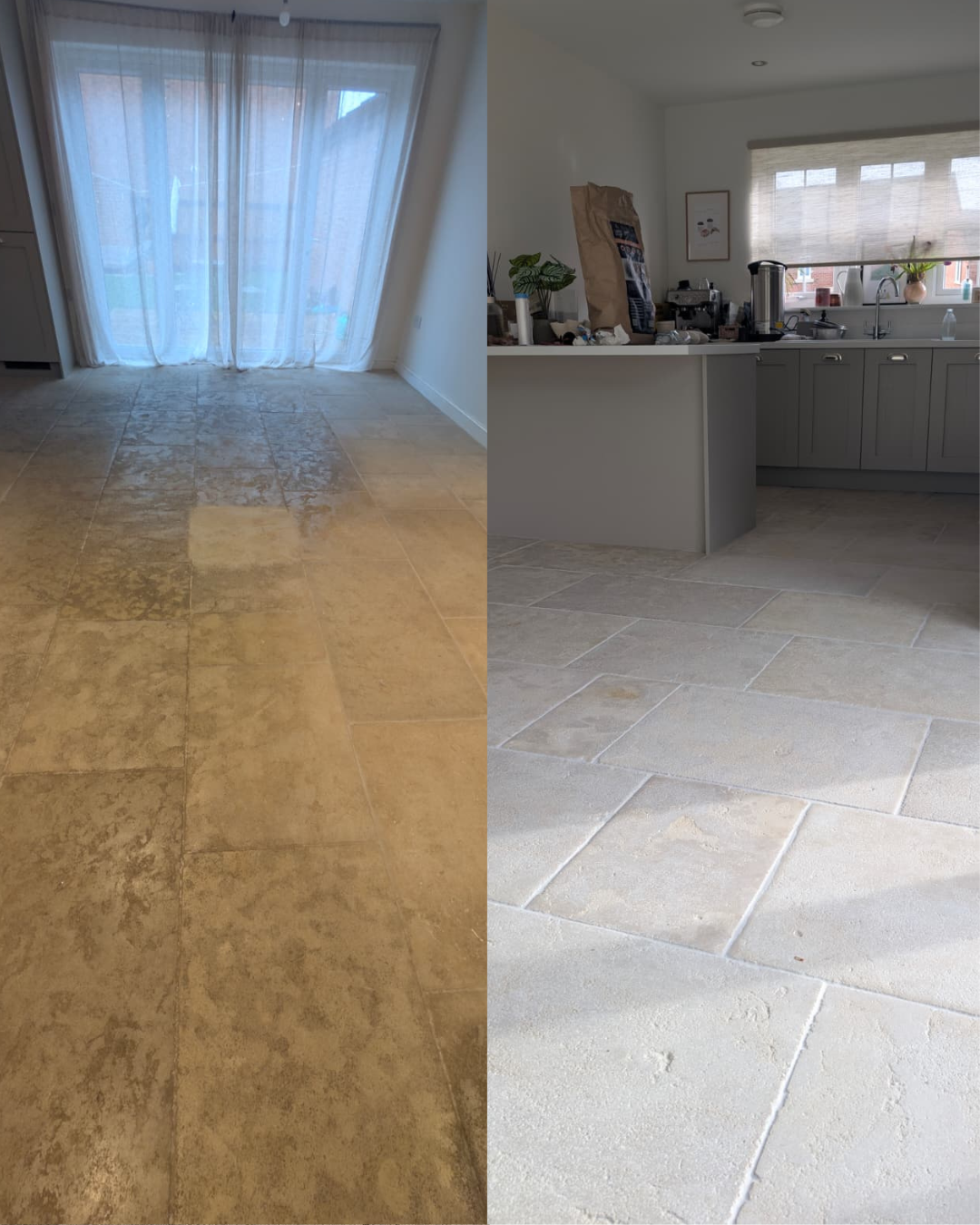
Faber Hidro 150 preserves the natural dry appearance of the stone — once cured and dry the stone looks exactly as it did before sealing, with no darkening, no sheen and no change to the surface appearance. This is the preferred finish for most natural stone applications and the appropriate choice where the natural character and colour of the stone is the point.
For applications where a richer, deeper appearance is desired — bringing out the natural colour tones and warmth of the stone — Faber P147 Plus is the alternative. P147 Plus uses a similar professional impregnating approach but delivers a colour enhancing effect that enriches the stone’s natural tones without producing a surface gloss. It is particularly popular on sandstone, travertine and limestone where the warm earthy colour tones of the stone are a key part of the appeal.
Both products provide professional impregnating protection. The choice between them is purely a matter of the desired finish.
How to Apply Faber Hidro 150
Surface preparation The stone surface must be thoroughly clean and completely dry before application. Any existing soiling, grease, mineral deposits, grout haze or old sealer residues must be removed first. Faber 30 is the recommended deep cleaning product for pre-seal preparation — applying Hidro 150 over a contaminated surface will lock contamination in and compromise both penetration and performance.
Surface temperature must be between +5°C and +40°C. Do not apply in direct sunlight, on surfaces hot to the touch, or when there is any risk of rain, frost, mist or high humidity — particularly important for outdoor applications.
Application Apply Hidro 150 generously and evenly to the dry surface using a brush, lambswool applicator, roller or cloth. Ensure complete and even coverage across the whole surface.
The product is fast drying and normally leaves no residues. On low absorbency surfaces, slight residues may appear — simply wipe off with a clean dry cloth before they dry.
For highly absorbent surfaces, apply a second coat no less than 45 minutes after the first.
Coverage and drying Coverage is 15-20 m² per litre — efficient for a professional grade product. The surface dries within one hour of application and is ready for use after 2-3 hours.
Important Always ensure the surface is fully dry and the product fully cured before applying any maintenance cleaner or subsequent treatment. If applying over a penetrating water repellent primer as a first stage, wait for the primer to dry completely before applying Hidro 150.
Faber Hidro 150 in the Stone Care Programme
Hidro 150 sits in the middle of a complete professional stone care programme:
Before sealing — deep clean with Faber 30 Remove all ingrained soiling, grease and mineral deposits to ensure the sealer penetrates clean open stone and performs as designed. This step is not optional — a sealer applied over a contaminated surface will underperform and the contamination will be locked into the stone permanently.
Sealing — Faber Hidro 150 or P147 Plus Apply the appropriate sealer for the desired finish. Allow to cure fully before returning to use.
Ongoing maintenance — Faber Neugel or Faber Algafloor Maintain the sealed surface with a pH neutral cleaner that cleans effectively without attacking or degrading the sealer. Using an inappropriate cleaner — particularly high concentration alkaline cleaners or acidic cleaners — will shorten the life of the sealer significantly.
Periodic resealing Even the best impregnating sealer will require reapplication over time as the protection gradually diminishes with use and cleaning. The frequency depends on traffic levels, the type of stone and the cleaning products used in maintenance. A properly applied Hidro 150 treatment on a well maintained domestic surface should provide several years of protection before resealing is required.
Where to Buy Faber Hidro 150 in the UK
Faber Hidro 150 is available from HF Flooring Supplies in 1 litre and 5 litre sizes with next working day delivery across mainland UK on orders placed before 2pm Monday to Friday.
As a selected UK Faber partner, HF Flooring Supplies stocks the full Faber professional range including cleaners, sealers, polishing products, stain removers and specialist surface treatments for every stone and tile care application. Trade accounts are available for flooring professionals, stone restoration specialists and cleaning contractors across the UK.
Frequently Asked Questions About Faber Hidro 150
What is Faber Hidro 150? Faber Hidro 150 is a professional grade water based impregnating stone sealer. Its active ingredient is tripotassium propylsilanetriolate, a professional organosilane compound that chemically bonds with the stone substrate during curing to provide long lasting water and stain resistance. It is independently certified safe for food contact.
How does Hidro 150 work? Hidro 150 penetrates into the pore structure of the stone. The organosilane active ingredient hydrolyses in the presence of moisture and forms covalent chemical bonds with the hydroxyl groups on the pore walls, while simultaneously crosslinking with adjacent molecules to form a continuous hydrophobic network. The result is protection that is chemically bonded to the stone rather than simply deposited in it.
Is Hidro 150 food safe? Yes — Faber Hidro 150 is independently certified safe for food contact. It is suitable for use on kitchen worktops, dining tables and food preparation surfaces. This certification makes it one of the few professional grade stone impregnators appropriate for kitchen worktop applications where food contact is a genuine consideration.
Will Hidro 150 change the appearance of my stone? No — Hidro 150 preserves the natural dry appearance of the stone. Once cured there is no visible change to the surface, no darkening and no surface sheen. It will not yellow over time. If you want a colour enhancing effect that deepens the natural tones of the stone, Faber P147 Plus is the alternative.
Is Hidro 150 safe to use indoors? Yes — Hidro 150 is water based and explicitly classified as incombustible on its safety data sheet. It carries no flammability classification and can be applied safely in enclosed domestic spaces including kitchens and bathrooms without the fire risks associated with high solvent content sealers.
How long does Hidro 150 take to dry? The surface dries within one hour of application and is ready to return to use after 2-3 hours.
What coverage does Hidro 150 give? Coverage is 15-20 m² per litre depending on the absorbency of the surface. On highly absorbent surfaces a second coat may be required after 45 minutes.
Does Hidro 150 need to be applied before or after grouting? Hidro 150 should be applied after grouting and after the grout has fully cured. Ensure the surface is thoroughly cleaned with Faber 30 or an appropriate grout residue cleaner before sealing to remove any grout haze or residue.
How long does Hidro 150 last? The longevity of any impregnating sealer depends on traffic levels, the type of stone and the cleaning products used in maintenance. Using a pH neutral maintenance cleaner such as Faber Neugel or Algafloor will significantly extend the life of the sealer. On a well maintained domestic surface, a properly applied Hidro 150 treatment should provide several years of protection before resealing is required.
Can Hidro 150 be used on kitchen worktops? Yes — and its food contact certification makes it specifically appropriate for this application. It provides stain resistance against the oils, acids and liquids that kitchen worktops are regularly exposed to, and its invisible finish preserves the natural appearance of the stone.
What is the difference between Hidro 150 and P147 Plus? Both are professional impregnating sealers. The difference is purely aesthetic — Hidro 150 preserves the natural dry appearance of the stone while P147 Plus enhances and deepens the natural colour tones. The choice between them depends entirely on the finish you want.
Can Hidro 150 be used on external stone in the UK? Yes — Hidro 150 is suitable for both indoor and outdoor use including external stone paving, paths, steps and garden surfaces. Do not apply when there is risk of rain, frost or high humidity.
Where can I buy Faber Hidro 150 in the UK? Faber Hidro 150 is available from HF Flooring Supplies with next working day delivery across mainland UK. Available in 1 litre and 5 litre sizes. Orders placed before 2pm Monday to Friday are dispatched the same day.
What is the difference between Hidro 150 and a basic solvent based stone sealer? A basic solvent based stone sealer typically uses a fast evaporating alcohol carrier such as isopropyl alcohol at high concentration. At normal UK room temperatures, a carrier with a flashpoint of 12°C evaporates very rapidly from the stone surface — potentially before the active ingredient has had time to penetrate to a meaningful depth. Hidro 150 uses water as its primary carrier, which evaporates significantly more slowly and gives the professional organosilane active ingredient the dwell time needed to penetrate properly, react with the pore walls and form the chemically bonded crosslinked network that delivers genuine long lasting protection.
Final Thoughts
Faber Hidro 150 is not simply a stone sealer. It is a professionally engineered organosilane impregnating system that chemically bonds with the stone substrate at a molecular level, crosslinks within the pore structure, and delivers protection that is genuinely part of the stone rather than simply deposited in it.
It is water based and non-flammable. Its water carrier gives the active ingredient the dwell time to penetrate properly — something a fast evaporating solvent carrier cannot reliably deliver. It is transparent about its active chemistry on its safety data sheet. It is independently certified safe for food contact. It preserves the natural appearance of the stone. And it has been formulated by one of Italy’s leading professional surface care manufacturers with decades of expertise behind it.
For anyone serious about protecting natural stone in the UK — whether that is a newly laid limestone kitchen floor, a sandstone patio, a marble bathroom, a granite worktop, or a heritage property with original stone flagging — Hidro 150 is the professional choice.
