
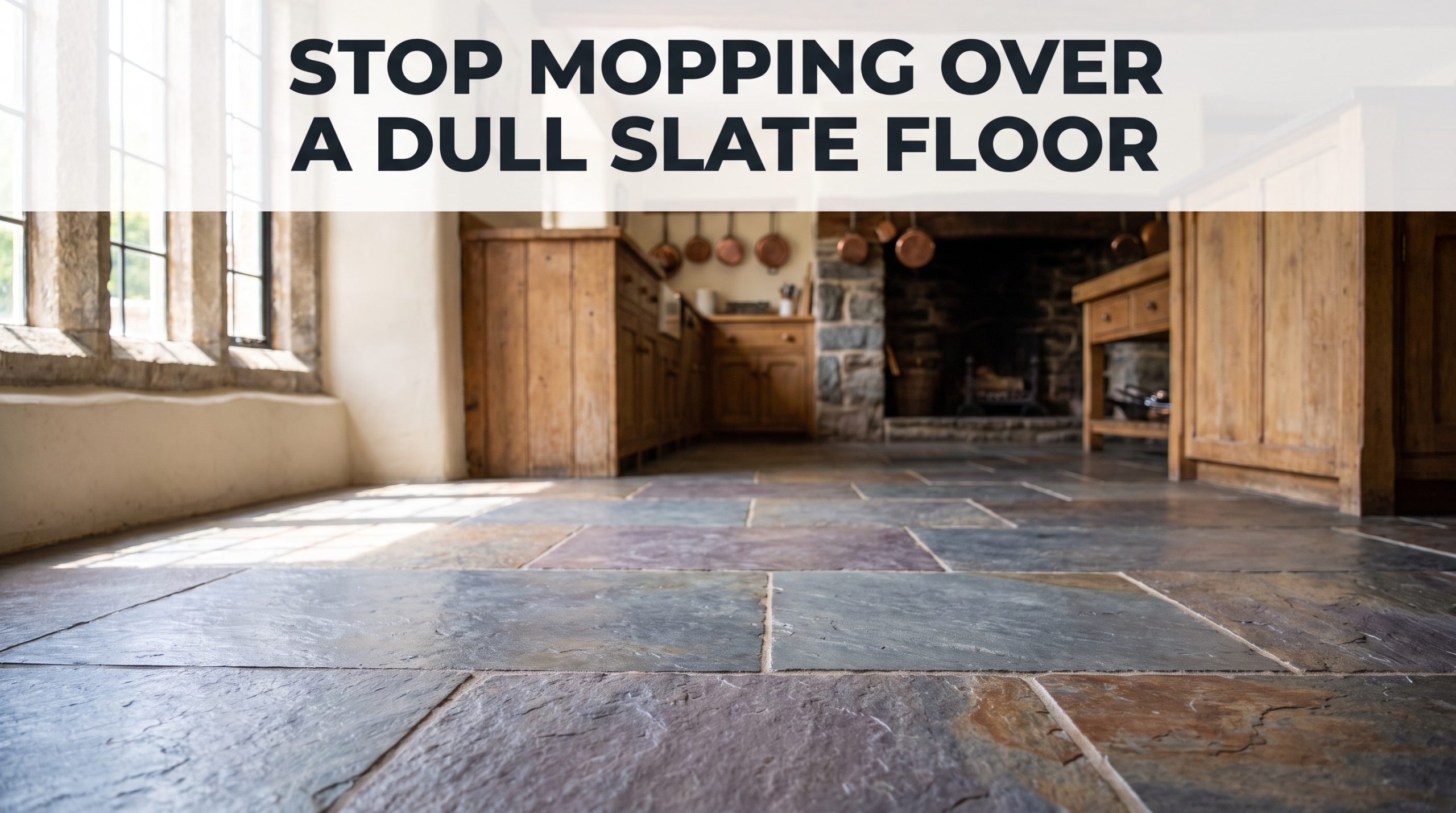
A customer comes in with a familiar story. Their slate hallway or kitchen floor has been down for ten, fifteen, twenty years. It used to have real depth to it. The blues and greys had character, the surface looked almost wet. Now it just looks tired.
They have mopped it with washing up liquid for years, maybe hit it with vinegar a few times when it looked especially grim, and the floor has responded by getting duller, not cleaner.
This is one of the most common problems we hear about at HF Flooring Supplies, and it is almost never actually a wear problem. It is a chemistry problem. Slate that looks flat and lifeless usually has two things going on at once: years of ingrained grime sitting in the stone's natural texture, and a sealer that either was never applied correctly or has worn out and stopped protecting the surface. Cleaning over the top of that with the wrong products just adds another layer to the problem.
The short version
- Deep clean first: strip the floor back to bare, uncontaminated stone with Faber 30, a concentrated alkaline deep cleaner.
- Match the sealer to your slate: Deep Enhancer for dense slate, Wet Look Eco or P147 Plus for standard or more porous slate, Hidro 150 for no colour change at all.
- Not sure which? A simple water test on clean, dry stone tells you whether your slate is dense or porous.
Sealing over contaminated stone locks the problem in, so never skip the deep clean.
- FloorSlate, cleft surface
- MethodDeep clean, rinse, dry, then seal
- CleanerFaber 30, alkaline at around pH 11
- Cleaner dwell time10 to 15 minutes
The products in this guide
A deep clean followed by one of four sealers, chosen by how dense your slate is.
-
 Deep cleanFaber 30Alkaline deep cleaner for ingrained grease and old residueFrom £11.36 + VATView product
-
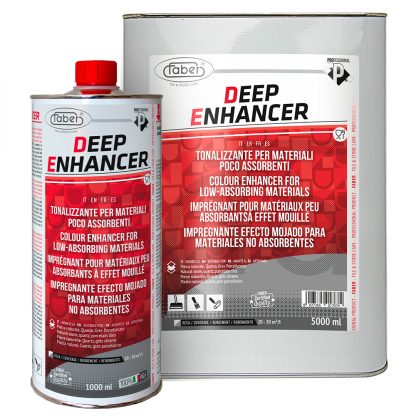
Dense slateFaber Deep EnhancerSolvent based colour enhancer for low porosity slateFrom £46.59 + VATView product
-
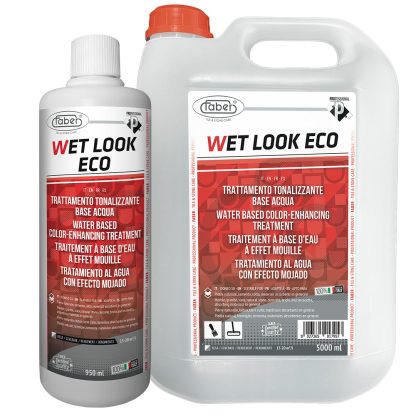
Porous slateFaber Wet Look EcoWater based, subtle natural colour deepeningFrom £54.91 + VATView product
-
-
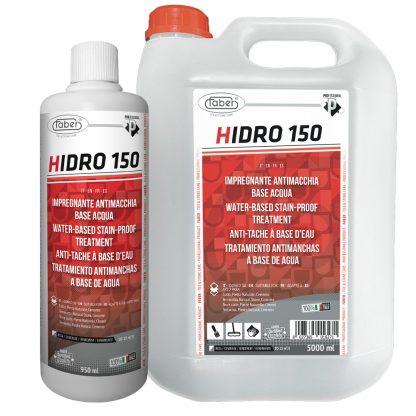
No colour changeFaber Hidro 150Water based, breathable stain proof impregnatorFrom £30.14 + VATView product
Why slate behaves differently to other stone
Slate is a metamorphic rock. Clay minerals and volcanic ash are compressed under heat and pressure until they form the dense, layered structure that gives slate its characteristic cleft surface. That splitting along planes structure is what makes slate slate, and it is also exactly why it needs different treatment to something like granite or marble.
The cleft surface is not flat. It has natural micro fissures and texture variation across every tile, and those fissures do two things: they absorb liquid more readily than the stone's overall density would suggest, and they trap residue from anything you clean it with that does not rinse away completely. A neutral looking cleaning product that would be fine on smooth porcelain can build up in slate's texture over years and leave the floor looking permanently dull, no matter how often it is mopped.
Slate also is not chemically uniform. Most commercial slate is predominantly quartz and mica, both broadly acid resistant, but almost all of it contains at least some calcite or dolomite. Acidic cleaners, vinegar being the classic offender, react with those minerals slowly and invisibly. You will not see damage after one clean. You will see it after two years of regular vinegar cleaning, by which point the surface texture and colour have both changed permanently.
Density and porosity also vary significantly by where the slate came from.
| Slate type | Typical density | Porosity | Colour character |
|---|---|---|---|
| Welsh slate | Very dense | Low | Dark blue grey, subtle |
| Brazilian slate | Very dense | Low | Dark, fine grained |
| Spanish slate | Dense | Low to medium | Consistent dark grey |
| Westmorland green | Medium | Medium | Grey green, strong cleft |
| Indian black slate | Variable | Medium to high, origin dependent | Fine texture, can look flat unsealed |
This variation matters for cleaning and it matters even more for sealing, because the sealer that suits a dense Welsh slate is not necessarily the one that suits a more porous Indian black slate. More on that in section 04.
Why cleaning over the problem never works
Every ineffective slate cleaning routine follows the same pattern, and it is worth being specific about why it fails.
- Household cleaners redistribute soilWashing up liquid cuts light surface grease well enough on a smooth worktop, but on slate's textured surface it leaves a surfactant film in the fissures rather than lifting soil out of them. The floor looks temporarily cleaner and then dulls again within days.
- Sealing over contamination locks it inIf you apply any impregnating sealer, even the correct one, over a surface that still has grease, old wax residue, or years of surfactant build up in its texture, the sealer cannot penetrate properly. You end up sealing in the contamination rather than protecting clean stone.
- Acidic and abrasive products compound damageVinegar etches calcite bearing minerals. Baking soda is mildly abrasive. Neither causes obvious damage on day one, which is exactly why people keep using them. The damage is cumulative and only becomes visible once it is already significant.
The only way to actually fix a dull, ingrained slate floor is to strip it back to bare, chemically clean stone first, and that is a job for a proper alkaline deep cleaner, not a mop and washing up liquid.
Deep cleaning with Faber 30
Faber 30 2.0 is Faber Chimica's concentrated alkaline deep cleaner, and it is the correct product for exactly this problem: ingrained grease, foot traffic soiling, and old residue that routine cleaning cannot touch. It is rated safe for slate among the other natural stones on its approved surface list.
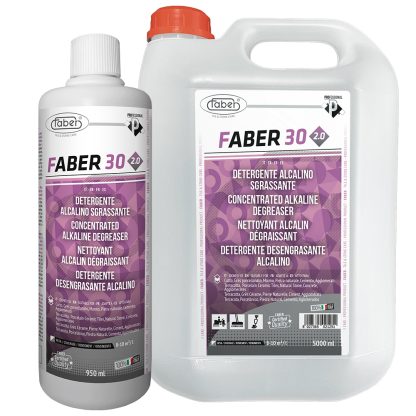
Faber 30 2.0
From £11.36 + VAT
Concentrated alkaline deep cleaner, available in 1 litre and 5 litre bottles.
Shop Faber 30How it works
- High alkalinity, around pH 11It breaks down organic soiling through saponification, the same chemical process that turns fat into soap. Grease and oily grime that are otherwise insoluble in water become water soluble and lift away in the rinse, rather than just being smeared around.
- Dwell time does the real workFaber 30 needs 10 to 15 minutes of contact time to fully penetrate the micro fissures in slate's cleft surface and act on soiling sitting below the visible surface, not just on top of it.
- Three dilution strengthsMatch the chemistry to the job. Used undiluted it will strip old wax or polymer coatings. At 1 to 2 it handles heavy ingrained grease. At 1 to 6 it is calibrated for periodic deep cleaning rather than a full strip.
- Safe on acid sensitive stoneThe alkalinity that dissolves grease does not etch calcite the way an acidic cleaner would, which matters given how much UK slate contains at least some calcite.
- Full strip of wax or polymer
- Undiluted
- Heavy ingrained grease
- 1 to 2 with water
- Periodic deep clean
- 1 to 6 with water
How to use it on slate
- Prepare the floor by sweeping or vacuuming loose debris, and treat manageable sections rather than the whole floor at once.
- Dilute to the strength that matches the job: 1 to 2 for a genuinely neglected floor with heavy ingrained soiling, 1 to 6 for a periodic deep clean on a floor in reasonable condition.
- Apply the solution evenly across the section with a single disc machine or stiff brush, working it into the cleft texture.
- Wait 10 to 15 minutes, agitating periodically to help the solution penetrate the fissures fully.
- Extract with a wet vacuum, then rinse thoroughly with clean water.
- Let the floor dry completely before moving on to sealing.
Any alkaline residue left on the surface can interfere with how a sealer cures afterwards, and sealing a damp floor traps moisture beneath the sealer and compromises the result.
Sealing slate: matching the product to your stone
This is the step most DIY slate restorations get wrong. Not because sealing is complicated, but because there is not a single best slate sealer. The right choice depends on your slate's density and porosity, and on whether you want the floor to look natural or to have its colour deepened.
Step 4.1Test first: is your slate dense or porous?
Before choosing a sealer, do a simple water test on clean, dry stone. Drop a small amount of water onto the surface and watch what it does.
Water beads and sits on top
- What it means
- Denser, lower porosity slate. The water sits for a while before slowly darkening the stone. Typically Welsh, Brazilian, or good quality Spanish slate.
- Best suited to
- Faber Deep Enhancer
Water absorbs and darkens quickly
- What it means
- More porous slate. This is common with Indian black slate and some Westmorland green.
- Best suited to
- Faber Wet Look Eco or P147 Plus
Step 4.2Dense, low porosity slate: Faber Deep Enhancer
Faber Deep Enhancer is a solvent based colour enhancing impregnator built specifically for low absorption, compact surfaces where water based products struggle to penetrate efficiently. Its hydrocarbon carrier gets into dense material structure that water based enhancers cannot reach effectively. On genuinely dense slate, this is exactly the profile that suits it: it deepens the natural tone, delivers strong stain and water repellency, and leaves a matt finish with no added gloss or surface film.
Deep Enhancer offers a dwell time choice that is worth understanding.
- 20 to 30 minutes
- Good, easily managed colour enhancement
- 45 to 60 minutes
- Noticeably deeper colour and stronger protection, with residue slightly harder to remove
On a dense slate where penetration is naturally slower, the extended dwell time is usually worth the extra care at the removal stage.
How to use it
- Apply an even coat with a brush, roller, or lambswool applicator, covering the section fully.
- Redistribute any excess across the surface after 5 to 10 minutes so nothing pools.
- Wait 20 to 30 minutes for standard enhancement, or 45 to 60 minutes for maximum colour depth on very dense stone.
- Remove all residue thoroughly with a floor polisher and a white or lambswool pad. This step is critical.
- Clean equipment immediately with white spirit, not water. This is a solvent based product and water will not shift it from brushes or applicators.
- The surface is dry within 1 to 2 hours. Return the floor to normal use after 4 to 6 hours.
Anything left on the surface dries into a greasy patina that is genuinely difficult to remove later.
Step 4.3Standard or more porous slate: Wet Look Eco or P147 Plus
If your slate is more porous, with Indian black slate the most common example along with some Westmorland green, a compact surface product like Deep Enhancer is not the right fit. HF's own experience with slate restoration points to two better options instead.
Faber Wet Look Eco
- Type
- Water based colour enhancing impregnator
- Look
- Subtle, natural colour deepening that replicates freshly wetted slate, with a slight sheen and no surface film
- Best for
- Most residential slate floors, including Indian black and Westmorland green. Lower VOC and easier to apply in an occupied property.
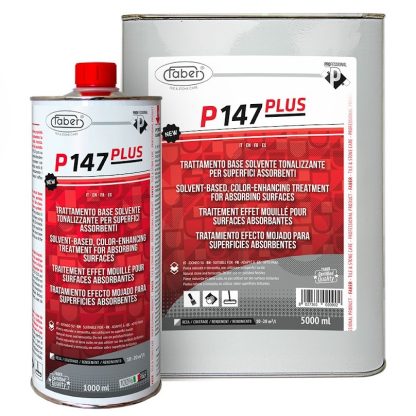
Faber P147 Plus
- Type
- Solvent based colour enhancer
- Look
- Noticeably stronger, more dramatic colour enhancement. Matt rather than glossy, so the enhancement is about colour depth, not shine.
- Best for
- Restoration jobs where slate has faded significantly and the client wants the floor returned to how it looked when first laid
Both are applied in broadly the same way as Deep Enhancer: even coat, dwell time, then residue removal. Always check the specific technical data sheet for exact timings before starting, since dwell times differ between the two products.
Step 4.4No colour change at all: Faber Hidro 150
If the floor's natural colour is exactly what the customer wants preserved, which is common on conservation properties or where a very light slate would look wrong artificially darkened, Faber Hidro 150 is the right product regardless of density or porosity. It is a water based, breathable impregnator that penetrates the stone and protects against oil and water based staining without changing the colour, texture, or sheen of the surface at all.
- Type
- Water based, breathable
- Drying
- Fast drying
- Certified
- Food contact certified
- Suitable for
- Indoor and outdoor slate
How to use it
- Apply a thin, even coat with a brush, lambswool applicator, roller, or cloth.
- Wipe off any residue immediately with a clean dry cloth. Hidro 150 is fast drying and generally leaves nothing behind, but on more compact areas a slight residue can appear.
- Apply a second coat on highly absorbent slate, waiting at least 45 minutes after the first.
- The surface is dry within about an hour. Normal use can resume after 2 to 3 hours.
Clean first, then seal to match
Restoring a dull, tired slate floor comes down to getting two things right in order: strip out the years of ingrained grime and residue with a proper alkaline deep clean, then seal with the product that actually matches your slate's density and the finish you want, rather than whatever sealer happens to be to hand.
The key takeaways
- Slate's cleft, textured surface traps residue from household cleaners in a way smoother stone does not, which is why it dulls even when it is being cleaned regularly.
- Sealing over contaminated stone locks the problem in. Deep clean first, always.
- Faber 30 handles the deep clean, using alkaline saponification and proper dwell time to break down grease and grime that mopping cannot touch.
- Sealer choice depends on density: Deep Enhancer for dense, low porosity slate wanting colour enhancement, P147 Plus or Wet Look Eco for standard or more porous slate, and Hidro 150 wherever the natural colour needs to stay exactly as it is.
If your slate floor has lost its depth and character and mopping is not bringing it back, the fix starts with proper deep cleaning chemistry, not a stronger scrub.
Ready to bring your slate floor back?
Start with the deep clean. Order Faber 30 from HF Flooring Supplies and restore your slate floor properly today.
- Orders placed Mon to Fri before 2PM are dispatched the same day for next working day delivery
- Not sure which sealer? Contact us
Frequently asked questions
Can I seal my slate floor without deep cleaning it first?
No. Sealing over grease, old wax, or years of cleaning product residue traps the contamination beneath the sealer and prevents proper penetration. The result looks patchy and never achieves the finish the sealer is capable of. Always deep clean with Faber 30 and rinse thoroughly before applying any sealer.
How do I know if my slate is dense or porous?
Do a water test on clean, dry stone. Drop a small amount of water on the surface. If it beads and sits for a while before slowly darkening the stone, it is dense, low porosity slate suited to Deep Enhancer. If it absorbs and darkens quickly, it is more porous and better suited to P147 Plus or Wet Look Eco.
Is Faber 30 safe to use on all types of slate, including Welsh slate?
Yes. Faber 30 is formulated to be safe on acid sensitive stone, including slate containing calcite or dolomite, when used at the correct dilution and rinsed thoroughly afterwards. Welsh slate, Spanish slate, Brazilian slate, and Indian black slate can all be deep cleaned with Faber 30.
What is the difference between Deep Enhancer and P147 Plus for colour enhancement?
Deep Enhancer is formulated specifically for dense, low absorption compact surfaces and penetrates that type of structure efficiently. P147 Plus is a more general purpose solvent based colour enhancer suited to standard or more porous slate. Both give a matt, colour deepened finish rather than gloss, but choosing the one that matches your slate's porosity gives a better, more even result.
Can I use a water based sealer if I want strong colour enhancement?
Wet Look Eco is water based and gives a genuine but subtler colour deepening than the solvent based options. If maximum colour depth is the priority, for example on a faded floor being restored to its original appearance, P147 Plus (or Deep Enhancer, on dense slate) will give a more pronounced result than a water based product can.
How often does a sealed slate floor need re sealing?
Do a water bead test periodically. If water still beads on the surface, the sealer is active. Once water starts absorbing and darkening the stone, the sealer has depleted. In a typical residential setting this is roughly every three to five years, though heavy foot traffic will shorten that.
Are Deep Enhancer and P147 Plus safe to use indoors?
Both are solvent based with a flash point below 21°C, so they require good ventilation during application, no naked flames or ignition sources nearby, and appropriate PPE. They are safe for indoor use when applied correctly under these conditions. Faber 30 and Hidro 150, by contrast, are water based and do not carry the same flammability precautions.
All Faber products mentioned in this guide are available from HF Flooring Supplies. HF Flooring Supplies is a selected UK partner for Faber Chimica.
